Clear Sky Science · en
Atomically tweaking spin-crossover cooperativity to augment molecular memory density
Turning Molecules into Tiny Memory Cells
Our phones, computers, and data centers rely on materials that can remember whether they are in one state or another—like tiny yes/no switches. This paper explores how individual molecules on a metal surface can be turned into such switches, and more importantly, how to pack many of them side by side without having them all flip together. The work shows a way to "tune" how molecules talk to each other so that a single chain of atoms can hold several separate bits of information instead of just one.
Why Molecular Magnets Matter
Many modern data-storage technologies rely on magnetic bits that can be either on or off. A special class of molecules called spin-crossover complexes can act as molecular-scale magnets. Each of these molecules can switch between a low-spin state and a high-spin state when triggered by heat, light, or an electrical signal. That switch changes both the magnetic property and the shape of the molecule. When many such molecules sit close together, their tiny shape changes push and pull on neighbors, often forcing whole groups to flip in unison. This collective behavior is great for strong signals but bad if the goal is to address individual molecules as separate memory bits.
Chains That Behave Like a Single Giant Switch
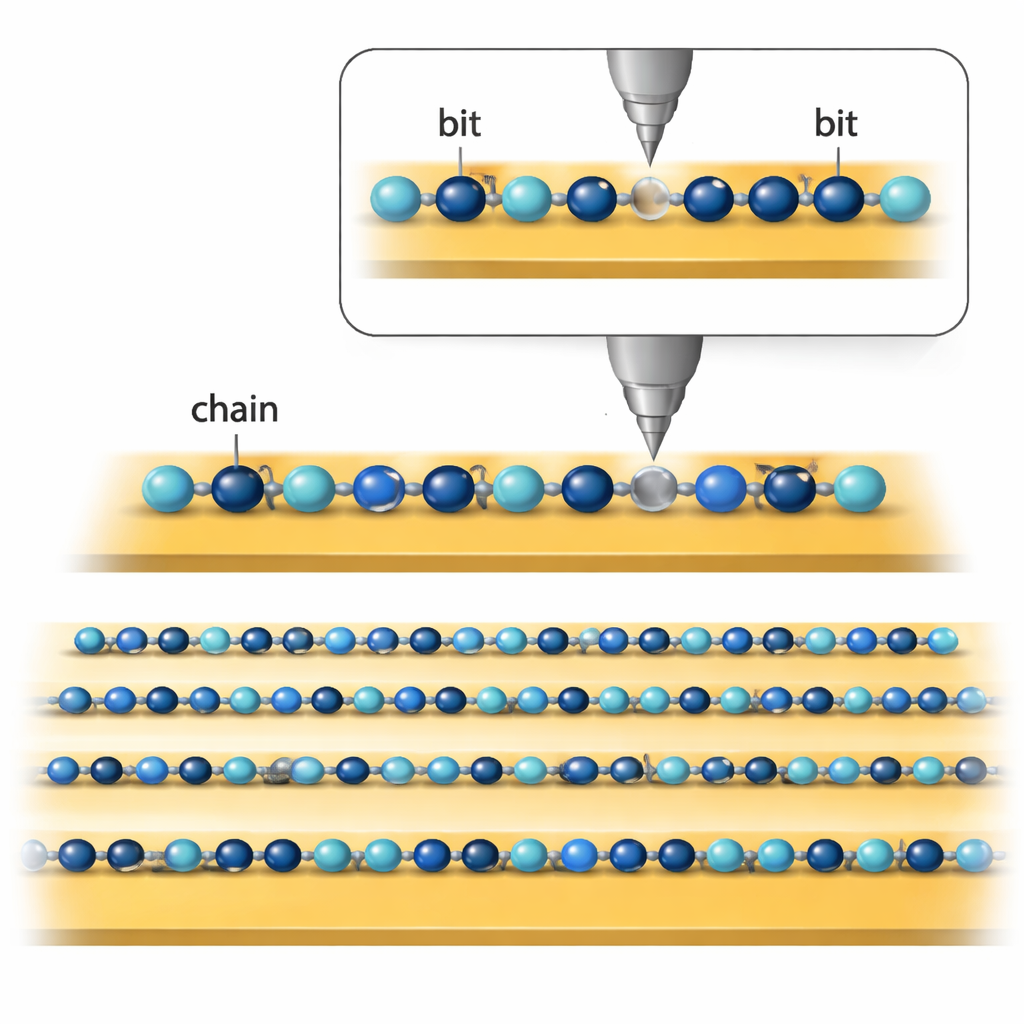
The researchers start from a well-studied system: chains of nickel-based molecules arranged on a clean gold surface. Within each chain, nickel atoms are bridged by small organic linkers, forming a regular, one-dimensional structure. In this arrangement, neighboring nickel centers strongly affect each other. When a scanning tunneling microscope (STM) tip locally excites one part of a chain, all visible nickel sites in that chain can switch their spin states together, from a pattern of alternating high-spin and low-spin sites to the opposite pattern. Functionally, the entire chain behaves like a single bit of memory—either in configuration A or configuration B—limiting the information density to one bit per chain.
Breaking Up Collective Behavior Atom by Atom
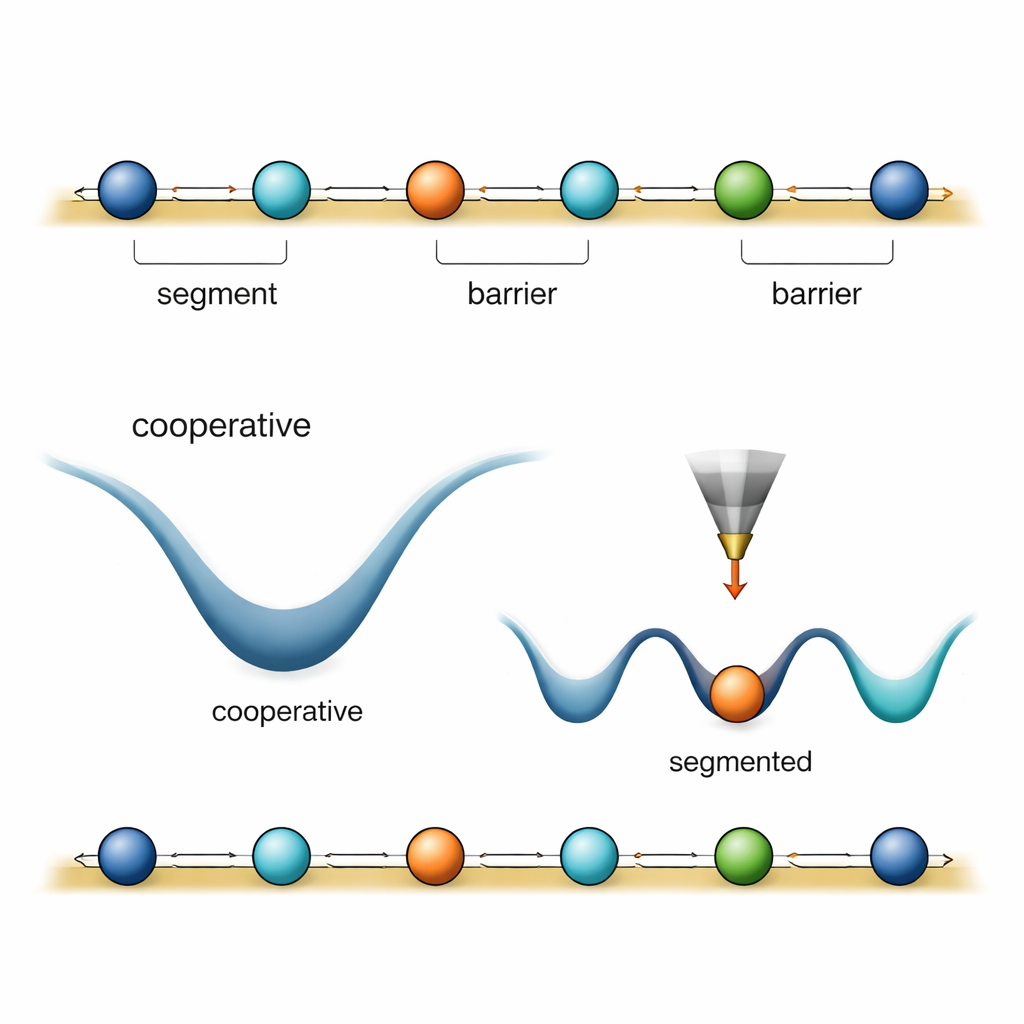
To get more bits out of the same physical space, the team applies a strategy they call coordination-field engineering. They deliberately replace some of the nickel centers with iron atoms, or swap some of the oxygen atoms in the linkers for nitrogen atoms. These atomic substitutions subtly change the electronic environment around specific metal sites so that those sites lose their ability to switch spin states under the usual stimulus. Instead of behaving as flexible, switchable elements, these doped sites act as rigid anchors. Along a chain, each such anchor cuts the once-cooperative nickel sequence into shorter sections that are still switchable, but now largely independent of one another.
Writing and Reading Individual Molecular Bits
With these "anchor" atoms in place, the researchers use the STM tip as both a writing and reading tool. By applying short voltage pulses at selected positions, they can flip the spin states within one segment between two distinct configurations, corresponding to digital 0 and 1. Neighboring segments, separated by non-switchable iron or nitrogen-based nodes, remain unchanged during this operation. The team demonstrates two-bit and three-bit systems along single chains and cycles through all possible combinations (such as 00, 01, 10, 11 for two bits). Reading the stored information is done gently, at low voltage, to avoid accidentally changing the states, while small differences in apparent height and electronic signal reveal whether a given segment is in its 0 or 1 configuration.
A Roadmap to Denser Molecular Memory
Under the hood, computer calculations show why this works: nickel-based units naturally sit close to a balance between two spin states, so small movements of the surrounding atoms can tip them from one state to the other. In contrast, the modified iron and nitrogen-containing units strongly favor a single spin state and barely move when the chain is disturbed. As a result, they block the mechanical and magnetic ripple that would otherwise race down the chain. In plain terms, this study shows how carefully swapping just a few atoms can turn one big, collective switch into several smaller, independently controllable ones. That insight could guide the design of future molecular memory devices in which every few atoms act as an addressable bit, pushing data storage far beyond what today’s technologies can achieve.
Citation: Liu, J., Bai, Y., Xu, Z. et al. Atomically tweaking spin-crossover cooperativity to augment molecular memory density. Nat Commun 17, 1968 (2026). https://doi.org/10.1038/s41467-026-68796-4
Keywords: molecular memory, spin crossover, single-molecule electronics, high-density data storage, scanning tunneling microscopy