Clear Sky Science · en
Coherent Ising machine based on polarization symmetry breaking in a driven Kerr resonator
Light that thinks through hard choices
Many of today’s toughest problems, from designing new drugs to routing delivery trucks, boil down to choosing the best combination out of an astronomical number of possibilities. This article explores a new kind of optical machine that uses light circulating in a fiber loop to "settle" into good answers to these problems, potentially faster and more efficiently than conventional computers, while using simple, robust hardware borrowed from modern telecommunications.
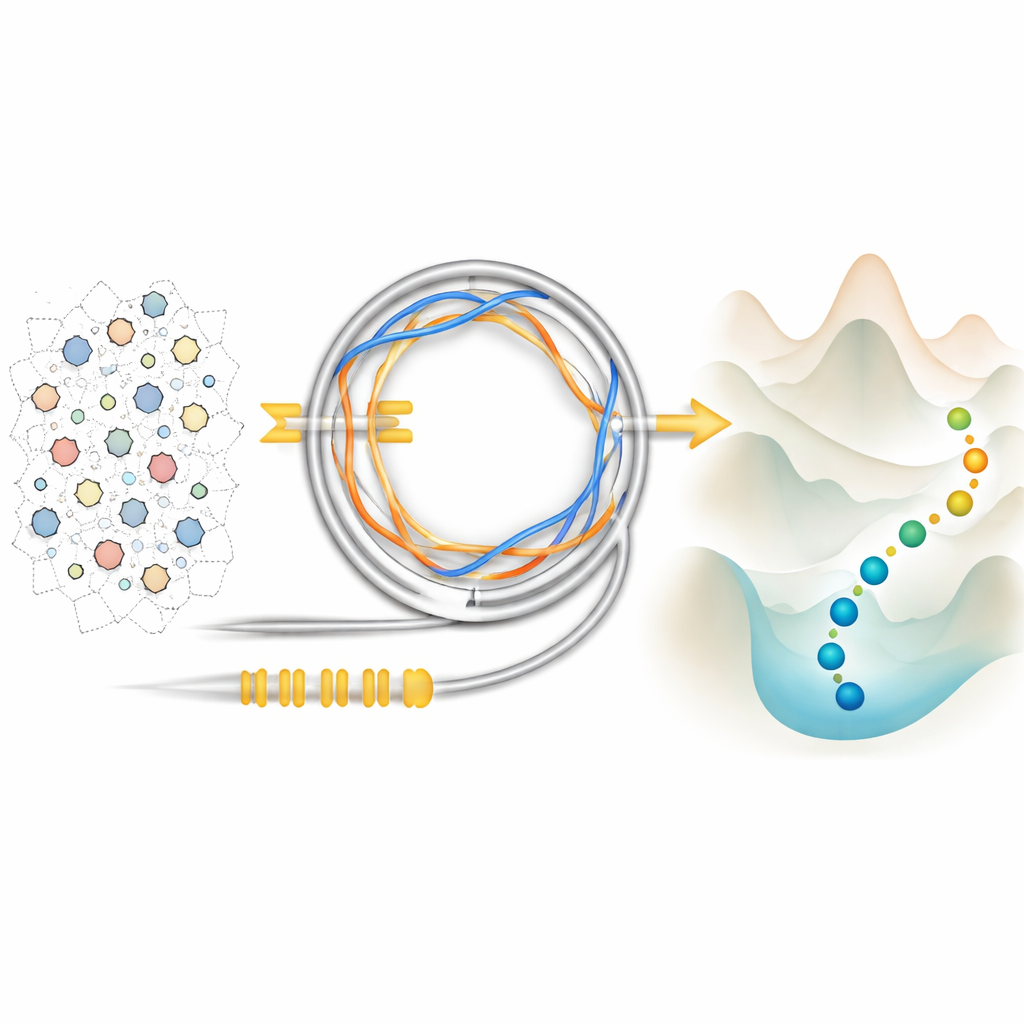
Why hard problems look like tiny magnets
Researchers often translate complex decision tasks into a model borrowed from magnetism, where countless tiny magnets—or “spins”—each point in one of two directions. The best solution to a problem corresponds to the arrangement of spins with the lowest overall “energy,” much like a system of magnets seeking a calm, stable state. Special devices called Ising machines physically imitate this behavior: they represent each spin with a physical element that can sit in one of two stable states, then let the whole network evolve until it naturally falls into a low-energy pattern that encodes a promising solution.
Turning light into artificial spins
Existing optical Ising machines usually encode spins in the phase of light waves inside networks of laser-like oscillators. Reading out and stabilizing these delicate phases requires elaborate control circuits and extremely precise alignment, which limits reliability and speed. In this work, the authors introduce a different approach: they build spins from the polarization of light—essentially, the orientation of its electric field—inside a ring of standard optical fiber known as a Kerr resonator. A single laser feeds short pulses into this fiber loop; each pulse acts as one spin, and a whole train of pulses forms a time-multiplexed chain of many spins circulating in the resonator.
When symmetry breaks and choices appear
Inside the fiber ring, two perpendicular polarization modes can exist. The setup is tuned so that, at low power, only one mode carries light, while the other remains dark. As the laser frequency and power are adjusted, nonlinear effects in the fiber cause light to appear in the second polarization mode, but in one of two possible, equally likely configurations. A carefully placed polarization element inside the loop flips the relative state on every round trip, leading to a repeating pattern that can take one of two distinct forms. These two patterns correspond to the spin being “up” or “down.” Crucially, the system’s design uses a topological protection effect so that small imperfections or drifts do not favor either spin state. This means the spins remain unbiased and stable over time, an important requirement for fair and repeatable computation.
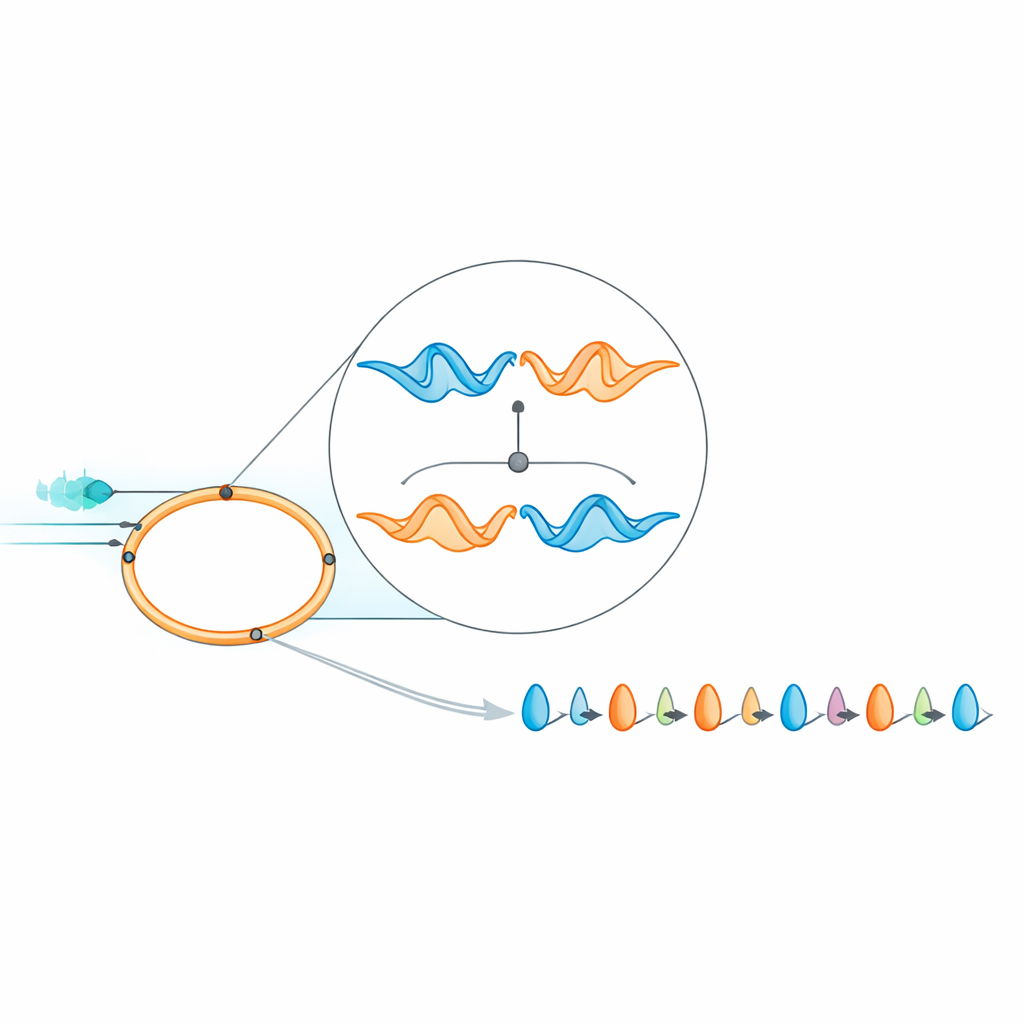
Letting spins talk and search for good answers
To solve an optimization problem, the pulses must influence one another so the spins prefer certain collective arrangements over others. The authors implement this by measuring the intensity pattern at the resonator output—which reveals each spin’s state through simple brightness differences—and feeding a carefully processed version of that signal back into the system. This feedback slightly perturbs the driving light in the second polarization mode in a way that imitates the desired “friend or enemy” relationships between neighboring spins in a one-dimensional chain. As the laser frequency is slowly swept through the point where the polarization states split, the interacting spins evolve and tend to settle into arrangements that minimize the overall energy of the corresponding mathematical model.
Performance, stability, and future promise
Experiments with up to 100 spins show that the machine can run continuously for more than an hour without manual tuning or discarding errant trials—an important practical advantage over many previous optical Ising machines. The system consistently finds low-energy configurations, reaching the true optimal state about one-fifth of the time for 64 spins, in good agreement with detailed simulations. By examining how the time needed to reliably find the best answer grows with problem size, the authors find behavior consistent with a favorable scaling that increases roughly like the exponential of the square root of the number of spins, suggesting room for competitive performance on larger tasks.
What this means for real-world problem solving
In everyday terms, this work shows that light in a simple fiber loop can reliably act as a large collection of tiny, two-state decision makers whose mutual nudging helps them arrive at good joint choices. By encoding information in polarization rather than more fragile phase signals, and by using standard telecom components, the authors demonstrate a more robust and hardware-friendly path toward optical machines that tackle difficult optimization tasks. With future improvements—such as richer connection patterns between spins and faster resonators—such polarization-based coherent Ising machines could become practical tools for speeding up complex searches in areas ranging from finance and logistics to materials discovery and molecular design.
Citation: Quinn, L., Xu, Y., Fatome, J. et al. Coherent Ising machine based on polarization symmetry breaking in a driven Kerr resonator. Nat Commun 17, 2100 (2026). https://doi.org/10.1038/s41467-026-68794-6
Keywords: Ising machine, optical computing, polarization, fiber resonator, combinatorial optimization