Clear Sky Science · en
Formation of giant carbonatite rare earth deposits controlled by deep-seated magma chambers
Why deep underground rocks matter for modern tech
Every smartphone, wind turbine and electric car depends on rare earth elements, a family of metals that make powerful magnets and bright screens possible. Today, more than half of the world’s rare earth supply comes from unusual, carbonate‑rich magmas called carbonatites. Yet only a tiny fraction of known carbonatite bodies ever become rich enough in rare earths to mine. This study asks a deceptively simple question with big implications for future supplies: what makes some of these deep magmas turn into giant ore deposits while most remain almost barren?
Hidden magma chambers as metal factories
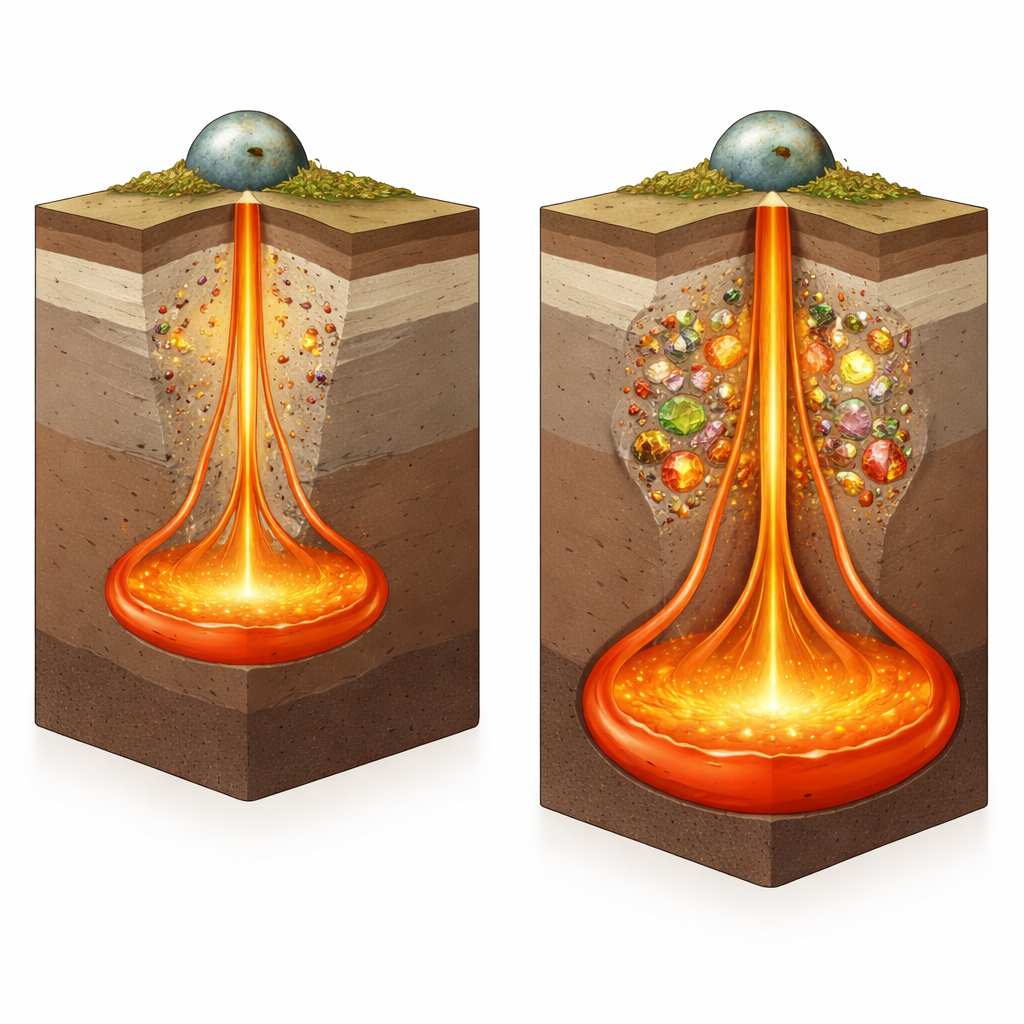
The researchers focus on magma chambers—large pools of molten rock—that form at different depths in Earth’s crust. They propose that the depth of these chambers, and therefore the pressure they experience, is the key switch that controls whether rare earths become highly concentrated. Deep chambers, more than about 10 kilometers underground, sit under higher pressure than shallow ones. That pressure affects which minerals crystallize first from the molten carbonatite and whether the remaining liquid becomes a dense, salty brine or a more ordinary hot water solution. Because rare earths are picky about which liquids and minerals they enter, this sequence matters enormously for ore formation.
Laboratory mini‑magmas under pressure
To test this idea, the team created miniature carbonatite magmas in the lab using a synthetic recipe based on natural rocks. They heated the mixture to 1000 °C until it melted completely, then slowly cooled it down to 200 °C while holding it at pressures equivalent to roughly 7–20 kilometers depth. By repeating the experiment at several pressures, they could watch which minerals appeared, how their compositions changed and what happened to rare earths at each stage. High‑resolution microscopes and chemical analyses allowed them to track minute shifts in elements like lanthanum and dysprosium between crystals and the remaining melt.
Deep settings keep rare earths in the melt
The experiments revealed a striking divide near a pressure of 0.3–0.4 gigapascals, corresponding to mid‑crustal depths. At higher pressures, a silicate mineral called olivine crystallized early, soaking up scarce silica from the melt. That change in chemistry suppressed the growth of apatite, a phosphate mineral that normally grabs and locks away rare earths. With apatite sidelined, most rare earths stayed dissolved in the residual liquid. Under these conditions, the cooling melt evolved into a thick, salty brine rich in sodium, carbonate, halogens and rare earths. From this brine, distinctive rare earth carbonates such as burbankite crystallized in abundance—minerals known from the world’s great rare earth deposits. In other words, deep magmas set the stage for efficient, late‑stage concentration of rare earths.
Shallow settings leak their treasure away
Low‑pressure experiments told the opposite story. Here, apatite formed early and in large amounts, efficiently hoarding rare earths into a widespread but low‑grade mineral network. Instead of transforming into a dense brine, the remaining melt released a separate, relatively dilute hot fluid akin to hydrothermal water. Such fluids can carry only tiny amounts of rare earths, so little additional enrichment occurred. The result is a frozen rock with rare earths dispersed through apatite and related minerals, lacking the focused pockets of ore that make mining worthwhile. Natural examples match this pattern: deep‑seated carbonatites like Palabora and Bayan Obo host giant rare earth deposits, while shallower complexes such as Alnö or Laacher See are poor in these metals.

Reading Earth’s signals to find future deposits
By tying together lab experiments, mineral chemistry and global data on known deposits, the authors argue that emplacement depth is the master control on whether a carbonatite becomes a rare earth bonanza or remains uneconomic. Deep magma chambers favor early silica‑removing minerals, delay the escape of water, generate rare‑earth‑rich brines and ultimately grow ore minerals like burbankite and bastnäsite. Shallow chambers do the opposite, locking metals into common minerals and venting fluids that cannot carry much rare earth cargo. For exploration, this means geophysical signs of large, deep magma bodies—such as gravity, seismic or electrical anomalies—may be powerful clues to where the next major rare earth discoveries will be made.
Citation: Xue, S., Yang, W., Niu, H. et al. Formation of giant carbonatite rare earth deposits controlled by deep-seated magma chambers. Nat Commun 17, 2265 (2026). https://doi.org/10.1038/s41467-026-68785-7
Keywords: rare earth elements, carbonatite magmas, magma chamber depth, brine melt, mineral exploration