Clear Sky Science · en
The climate opportunities and risks of contrail avoidance
Why jet trails matter for the planet
Most people think of airplane emissions in terms of carbon dioxide coming out of engines. But those thin white streaks we see behind jets—contrails—also trap heat in the atmosphere. This study asks a simple but surprising question: what if airlines slightly changed their routes to avoid making long‑lasting contrails? Using a climate model, the authors estimate how much this strategy could cool the planet in the coming decades, and what risks come with using a bit more fuel to do it.
Jet trails that quietly warm the world
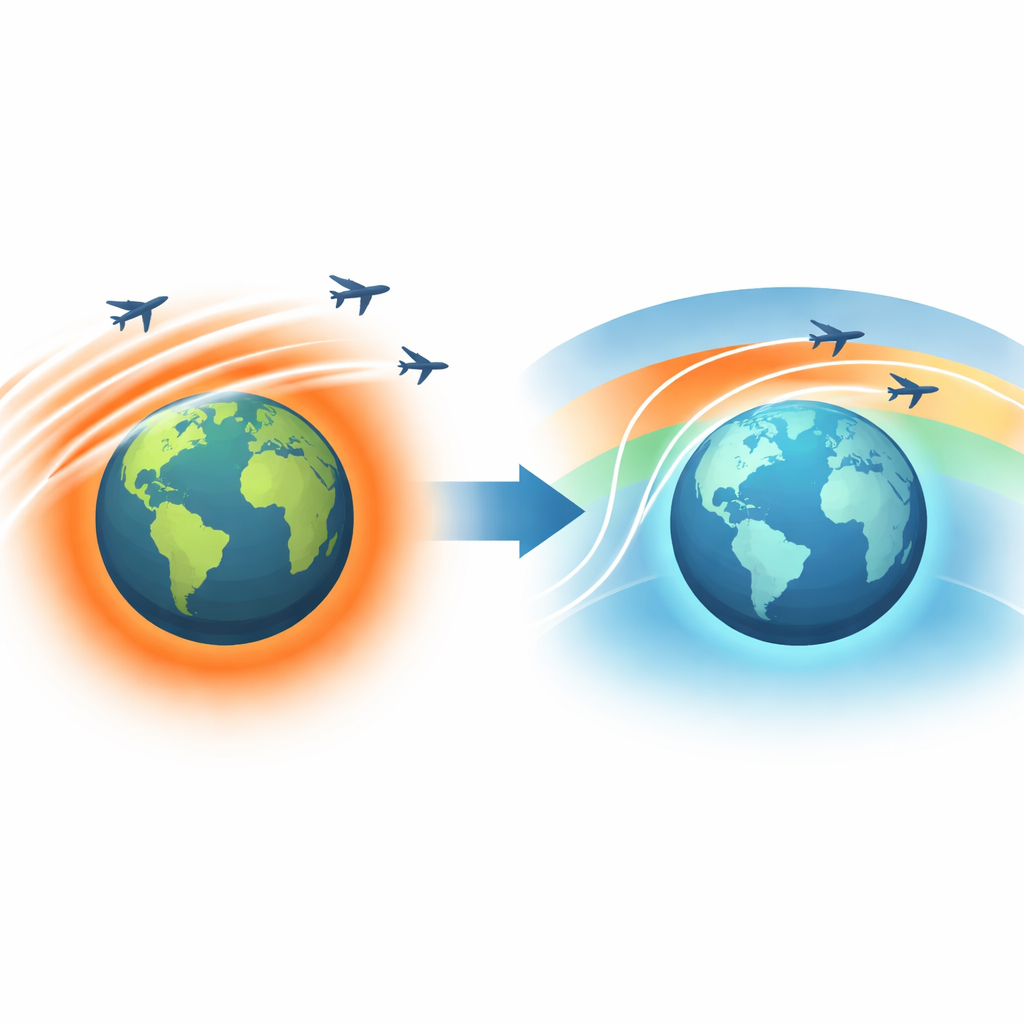
Contrails form when hot, moist exhaust from aircraft meets very cold, moist air high in the sky, turning into lines of ice crystals. Some of these spread into thin cloud layers that can linger for hours. Like a blanket, they trap some of Earth’s heat. Today, the warming from contrails is already on par with all the warming from aviation’s carbon dioxide since the dawn of the jet age. The paper shows that if aviation continues to grow and nothing is done to limit contrails, these clouds alone could raise global surface temperatures by about 0.054 degrees Celsius by 2050, slightly more than aviation’s CO2 contribution over the same period.
Staying within the temperature “budget”
World leaders have pledged to keep global warming well below 2 degrees Celsius above pre‑industrial levels. Because the planet has already warmed about 1.4 degrees, and additional delayed warming is locked in, the remaining “budget” is about 0.5 degrees. In the authors’ calculations, the combined future warming from aviation CO2 and contrails in a business‑as‑usual case would eat up roughly 19 percent of that remaining budget by 2050. That makes aviation’s sky‑made clouds a surprisingly large piece of the climate puzzle.
Rerouting flights to dodge contrail‑forming air
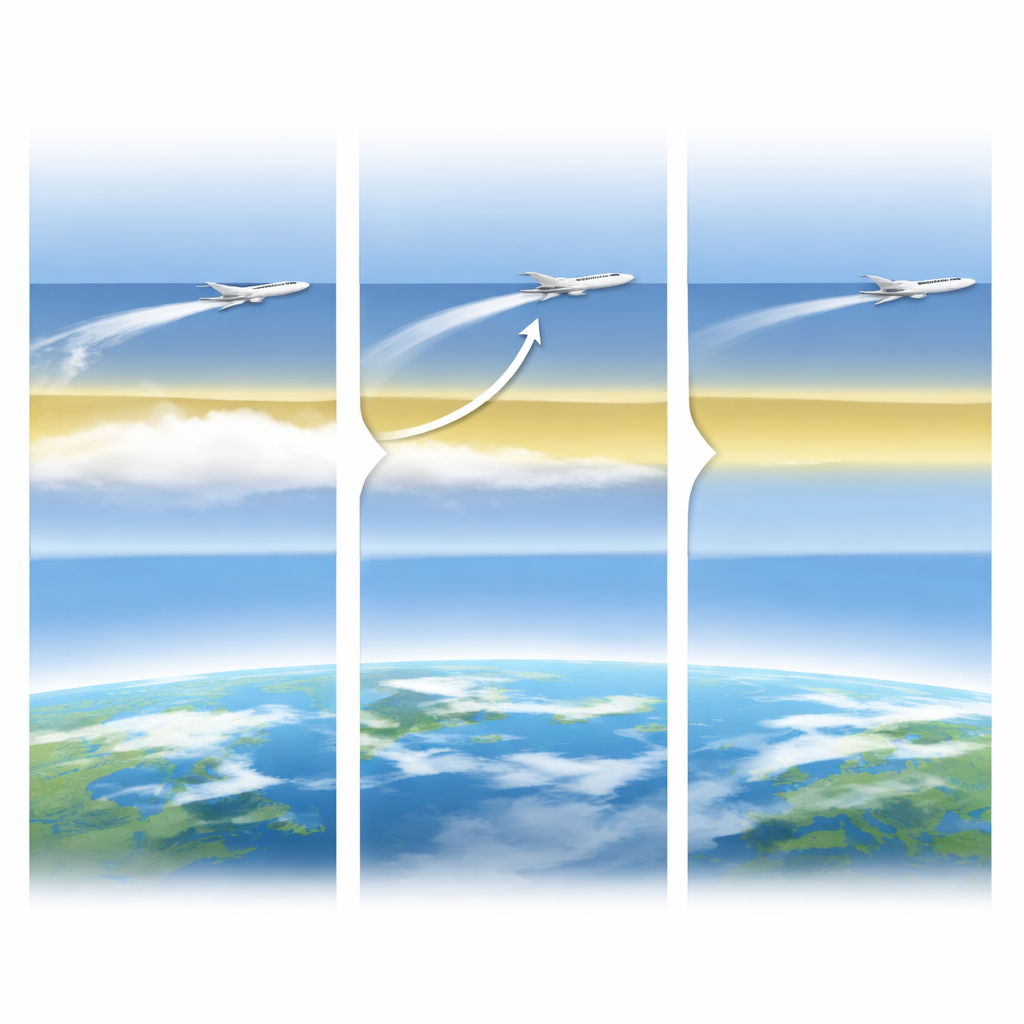
The core idea of contrail avoidance is straightforward: adjust flight altitudes or paths slightly to steer around layers of air where long‑lived contrails tend to form. The study uses a reduced‑complexity climate model to test many possible futures, varying how quickly airlines adopt avoidance, how effective it is at actually cutting contrail formation, and how much extra fuel is burned. In an optimistic case where avoidance is rolled out globally between 2035 and 2045 and is very effective, the resulting cooling in 2050 would recover about 9 percent of the remaining global temperature budget. Even at more modest effectiveness levels, the cooling benefit scales nearly linearly with how many contrails are prevented.
The high cost of waiting and the small cost of extra fuel
The authors find that timing is critical. Delaying the start of contrail avoidance by 10 years slashes its 2050 benefit from about 0.044 to 0.010 degrees of avoided warming—roughly a 78 percent loss in effectiveness. Put another way, each year of delay leaves the world about 0.003 degrees warmer in 2050. What about the downside—extra fuel burned when aircraft deviate from the shortest, most efficient routes? Across a wide range of scenarios, even assuming pessimistically large fuel penalties, the added CO2 warming is one to two orders of magnitude smaller than the warming prevented by reducing contrails. In most plausible cases, the chance that contrail avoidance would cause net extra warming this century is extremely low.
How fuel choices fit into the picture
The study also compares route changes with an often‑discussed alternative: cleaner‑burning fuels that produce fewer soot particles, which can also reduce contrail formation. If such modified fuels were rapidly adopted, they could cut contrail‑related warming by about 0.014 degrees by 2050—equivalent to a moderate‑effectiveness avoidance program. However, combining modified fuels with contrail‑avoiding routes yields only a small extra gain beyond what avoidance alone can provide. This suggests that, while better fuels are helpful, steering aircraft around contrail‑forming regions is likely to be the more powerful near‑term lever for cooling the skies.
What this means for our skies and climate
To a layperson, the message is clear: small changes to how we fly could have a surprisingly large impact on how much aviation warms the planet over the next few decades. The modelling indicates that smart navigation to avoid long‑lived contrails can cut a significant slice—around 9 percent—off the remaining temperature budget linked to the 2‑degree warming limit, with only a tiny trade‑off in extra CO2. The biggest climate risk the authors identify is not trying and slightly missing the ideal strategy, but delaying action altogether. If implemented soon, contrail avoidance offers a relatively fast, practical way to cool the planet’s flight paths while deeper cuts in aviation’s CO2 emissions are still being fought for on the ground.
Citation: Smith, J.R., Grobler, C., Hodgson, P.J. et al. The climate opportunities and risks of contrail avoidance. Nat Commun 17, 2092 (2026). https://doi.org/10.1038/s41467-026-68784-8
Keywords: aviation climate impact, contrails, flight routing, global warming, sustainable aviation