Clear Sky Science · en
Vectorial noncovalent synthesis of bendable organic crystals through dynamic dislocation
Light that Follows a Gentle Bend
Modern chips increasingly use light instead of electricity to move information, but steering light around sharp corners on a tiny chip is difficult. If the guiding material bends too suddenly, it often cracks or loses its optical performance. This study shows how to grow organic crystals that spontaneously form smooth, precise bends—without breaking—so they can route light around tight corners much like tiny, built-in fiber‑optic cables.
Why Bending Crystals Matters
Organic molecular crystals are ordered stacks of small carbon-based molecules held together by weak forces. They are attractive for future optoelectronic devices such as photodetectors, lasers, and light-emitting diodes because they can be made from solution at low cost and tuned chemically. However, shaping these crystals into curved paths has been a major challenge. Conventional methods rely on pushing, twisting, or chemically swelling a straight crystal, which tends to stretch molecules on one side and compress them on the other, leading to cracks and loss of function. Yet for dense photonic circuits—where light must be guided through narrow, intricate layouts—precise, damage-free bends are essential.
Letting the Crystal Bend Itself
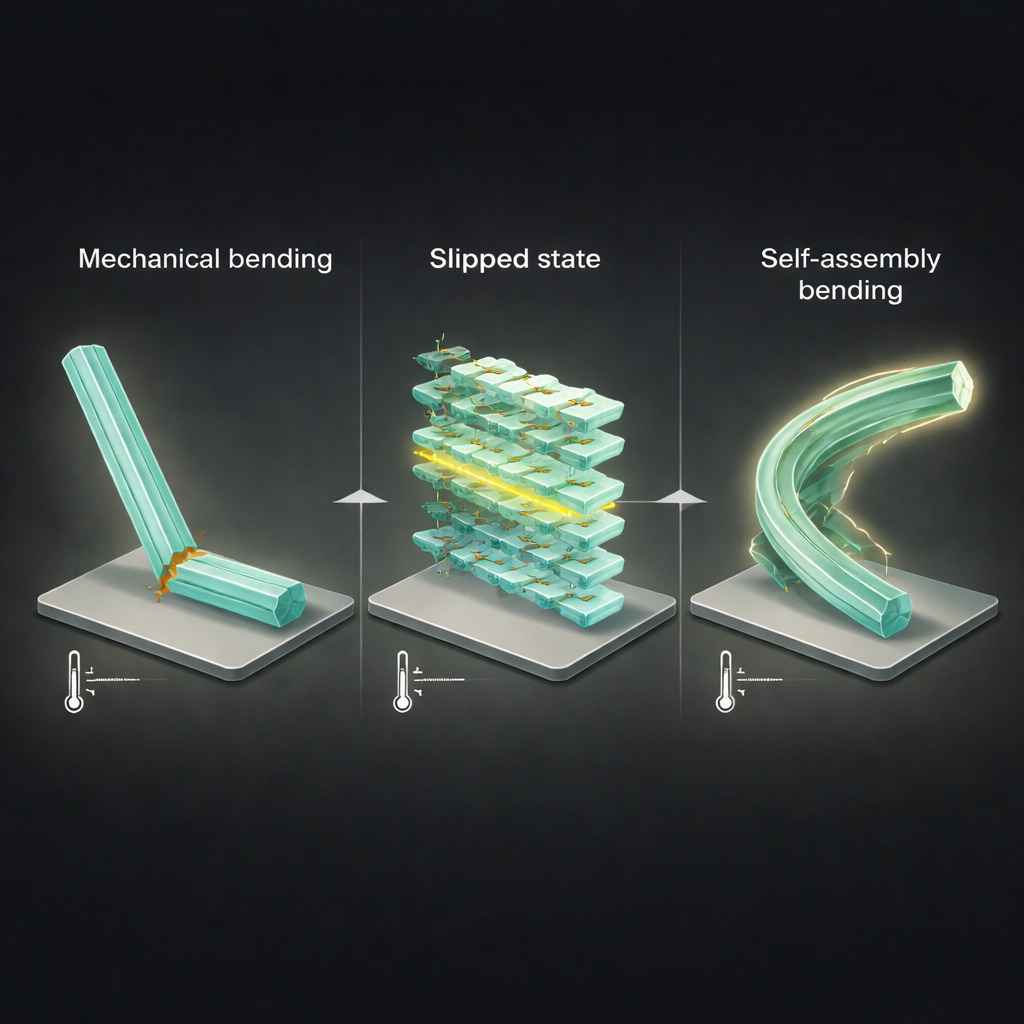
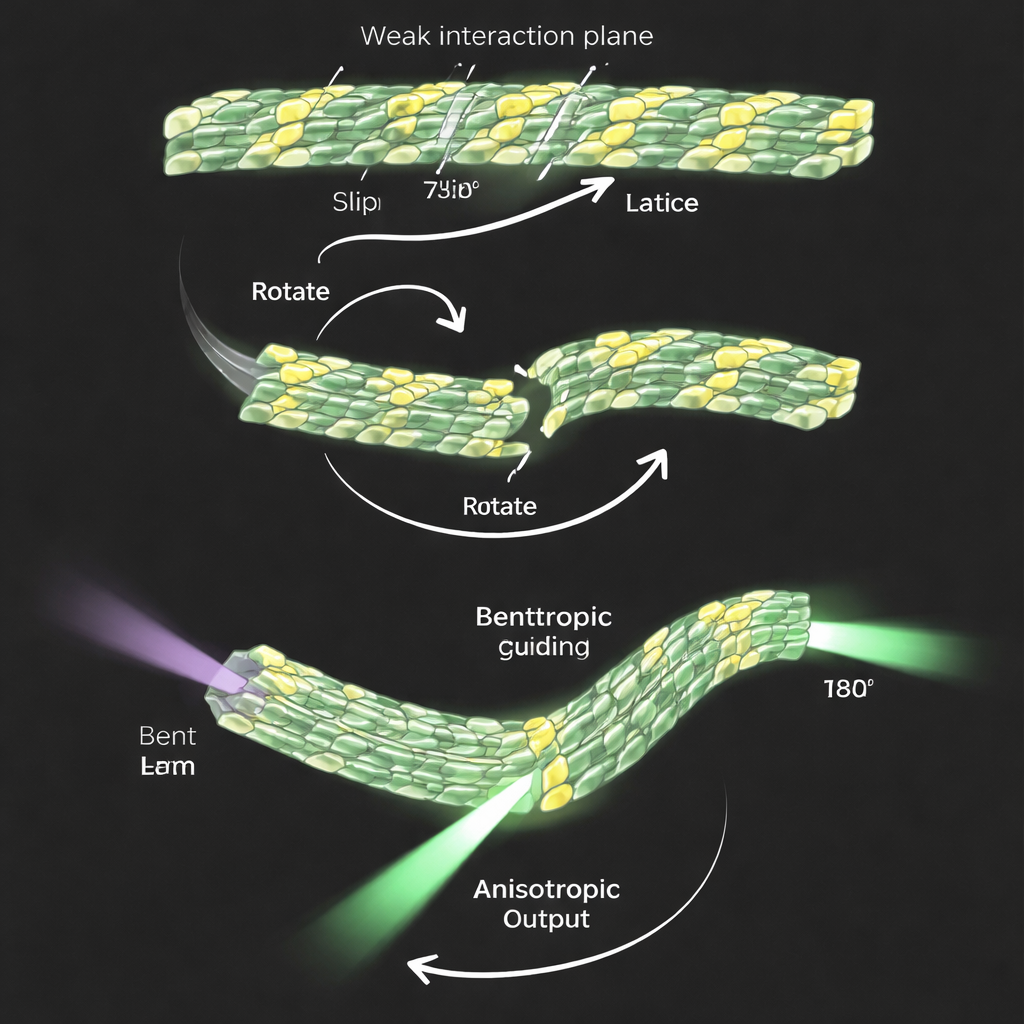
The researchers approached the problem from the bottom up: instead of bending finished crystals, they designed the way the crystals grow so that bending happens by itself. They built "cocrystals" from two different molecules—a light-absorbing donor and a light-accepting partner—that attract each other through charge transfer, a strong but noncovalent interaction. By adding electron‑withdrawing groups to one partner, they made interactions stronger along one crystal direction but weaker along another. On a mildly warmed surface, the weakly bound layers can slip past each other along a preferred internal plane. As crystal growth continues at both ends, stress builds up along this slipped interface. The crystal then relieves that stress by rotating part of itself and locking into a new configuration with a well‑defined bend, all while remaining a single, continuous piece.
Controlling Angles and Building Zigzags
Using this directional interaction strategy, the team created a family of bent cocrystals from several donor and acceptor molecules. Electron microscopy and diffraction revealed that the slip and bend always occurred along crystal planes where the layers were most widely spaced and thus most weakly bound. The resulting bending angles clustered in a narrow range—from about 62 to 85 degrees—set by the internal geometry of those planes. By adjusting solution concentration and the evaporation conditions, the scientists could choose whether crystals stopped at the slipped state or went on to bend. Raising the substrate temperature stepwise allowed them to build more complex shapes: crystals with two, three, four, five, or even six sequential bends, forming miniature zigzag light guides written directly during growth.
Light Routing and Switching in a Single Bend
The bent crystals do more than simply turn a corner: they guide and control light in an asymmetric way. In a typical example, the bent crystal behaves like two straight segments joined at about 74 degrees. When a laser excites one side of the bend, light travels along the crystal and emerges from multiple tips, but not all paths are equal. Careful measurements show that losses along the two straight sections are nearly identical, yet the brightness of the outputs differs strongly depending on which side is excited. This direction‑dependent behavior arises because the molecules’ preferred direction of light emission, known as the transition dipole, points at a tilt relative to the crystal growth direction. After the internal 180‑degree rotation that precedes bending, one arm tends to send light toward the top surface while the other favors the bottom, producing an in‑built optical switch whose on/off ratio can be tuned by changing where the crystal is excited.
From Curious Bends to Future Light Chips
To a non‑specialist, the key outcome is that these crystals can be grown so they bend themselves to exact angles without cracking, while still carrying and modulating light. This self‑directed bending, achieved by delicately balancing noncovalent forces between molecules, provides a toolkit for drawing microscopic optical tracks that curve, zigzag, and switch signals on and off—all inside organic materials made from solution. Such control over both crystal shape and light flow lays an important structural foundation for flexible, densely packed optical circuits that could one day coexist with, or even complement, conventional electronic chips.
Citation: Ma, YX., Mao, XR., Lv, Q. et al. Vectorial noncovalent synthesis of bendable organic crystals through dynamic dislocation. Nat Commun 17, 1917 (2026). https://doi.org/10.1038/s41467-026-68783-9
Keywords: bendable organic crystals, photonic waveguides, charge-transfer cocrystals, self-assembly, integrated optoelectronics