Clear Sky Science · en
Quantum magnetic J-oscillators
A New Way to Listen to Molecules
Every molecule carries its own tiny rhythm, set by how its atomic nuclei interact with one another. If we could listen to these rhythms with great precision, we could identify molecules unambiguously, monitor chemical reactions in real time, and build exquisitely stable frequency references for sensors and timing devices. This research introduces "quantum J-oscillators" – a new kind of tabletop instrument that turns the internal interactions of nuclei into continuous musical tones, all without using a conventional magnet.
From Lasers to Magnetic Clocks
Lasers and their microwave cousins, masers, revolutionized science by producing steady, highly pure tones of light or radio waves. They rely on a population inversion, where more particles occupy an excited state than a lower one, to amplify radiation at a precise frequency. Nuclear magnetic resonance (NMR) normally works in a similar spirit but uses strong magnetic fields to split nuclear energy levels, and its signals die away quickly, limiting frequency precision. Earlier "rasers"—radio-wave masers driven by nuclear spins—demonstrated very sharp signals, but they depended on an applied magnetic field, making their frequencies drift whenever that field changed.
Letting Molecules Set Their Own Tempo
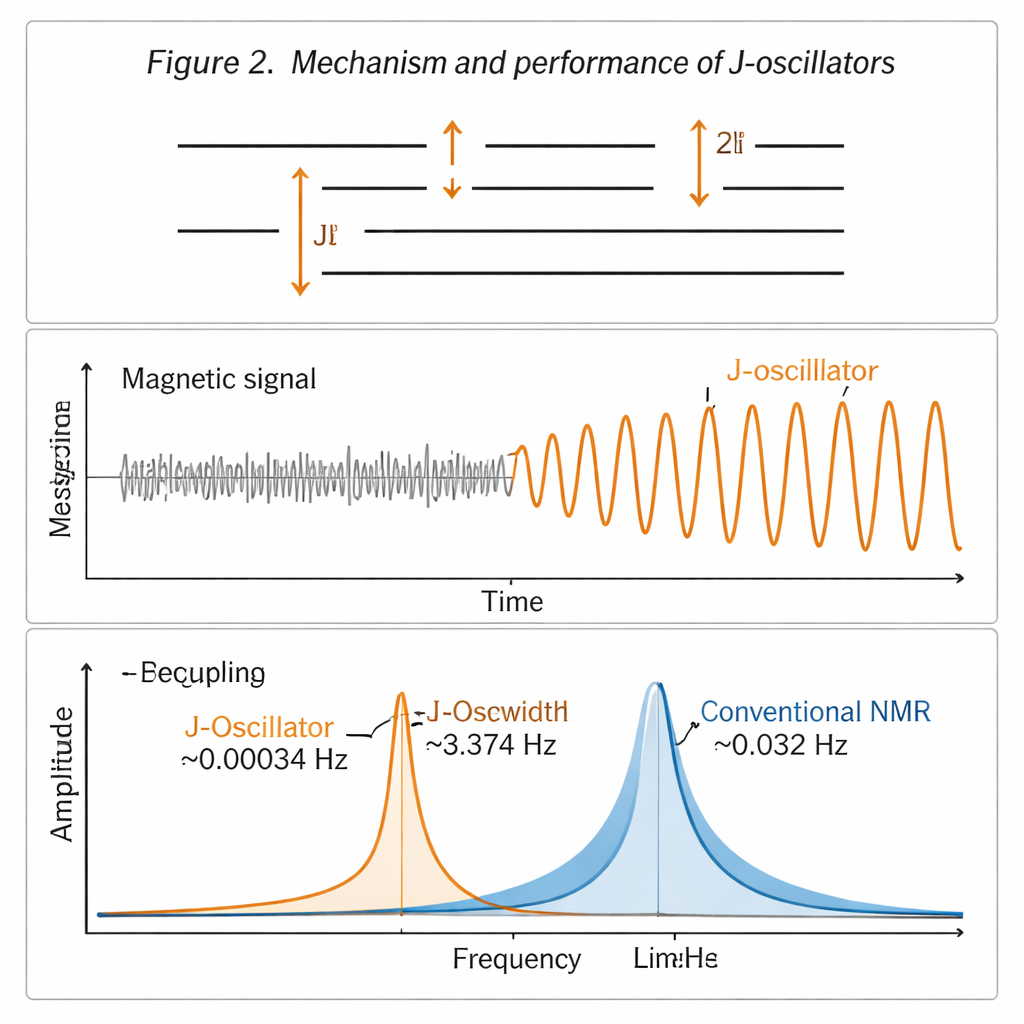
The key idea of a quantum J-oscillator is to abandon external magnetic fields and instead use an internal property of molecules called J-coupling, which reflects how strongly neighboring nuclei interact. At zero magnetic field, these couplings define a natural frequency for each molecule that does not depend on any external magnet. The authors show that by gently pushing the molecules out of balance and feeding back the signal they emit, it is possible to create a self-sustaining oscillation whose pitch is set directly by these J-couplings. In other words, the molecule itself becomes the clock, and its note is a precise fingerprint of its structure.
Building a Self-Sustaining Molecular Tone
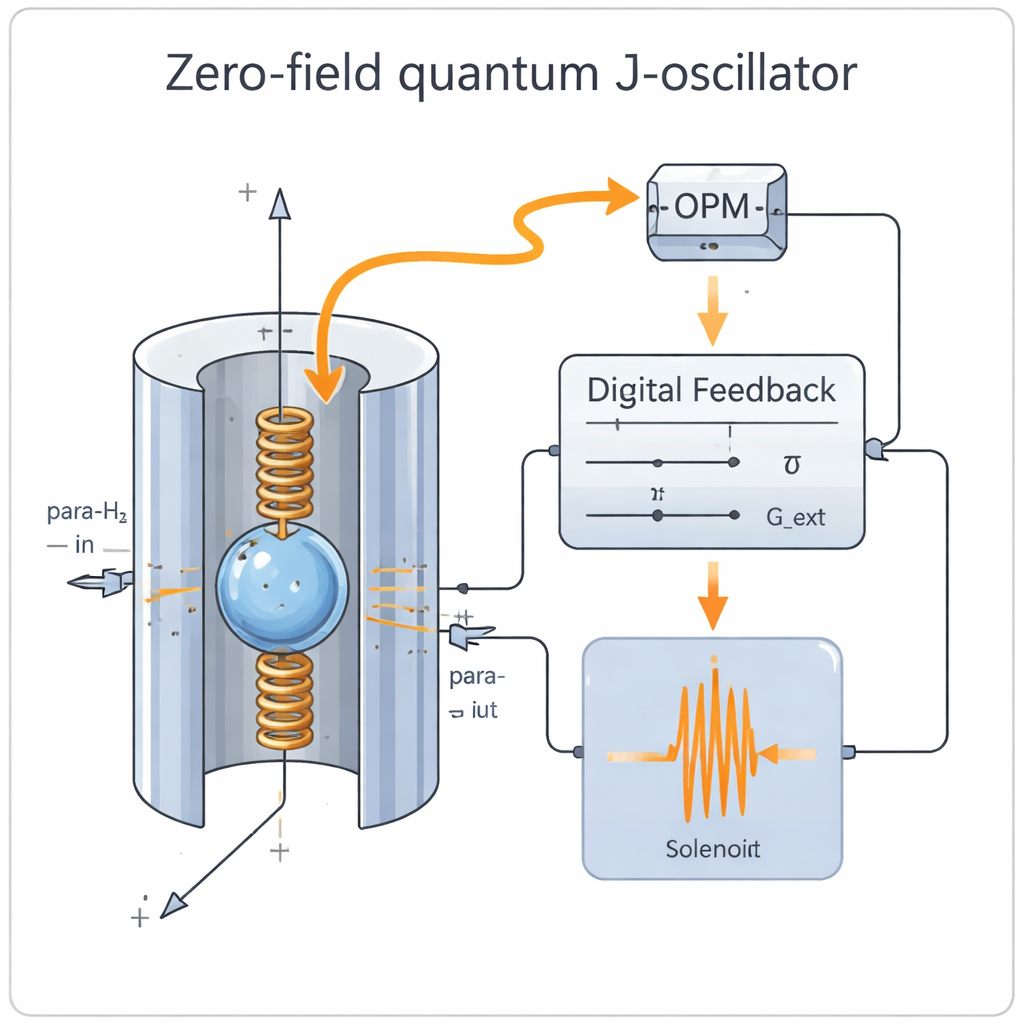
To realize this concept experimentally, the team works with a liquid sample of molecules such as acetonitrile. They use a technique called SABRE, which transfers order from specially prepared hydrogen gas into the target molecules, creating a population imbalance among nuclear spin states without any strong magnet. An ultrasensitive optical magnetometer listens to the resulting faint magnetic signal along a fixed axis. A computer then delays and amplifies this signal and feeds it back as a tiny magnetic field along the same axis using a coil that wraps around the sample. If the timing (delay) and strength (gain) of this feedback are tuned correctly, random fluctuations are amplified into a clean, continuous oscillation at one of the molecule’s J-coupling frequencies.
Sharper Peaks and Selective Tuning
In their proof-of-principle experiments, the authors show that a J-oscillator based on nitrogen-labeled acetonitrile can run coherently for an hour and produce a spectral line only about 340 microhertz wide—more than a hundred times narrower than what conventional zero-field NMR achieves on the same sample. They also demonstrate that by adjusting the feedback delay and gain, they can selectively encourage different J-related notes (for example, those at J or 2J) to oscillate while suppressing others. This allows them to tease apart overlapping signals in mixtures of similar molecules, such as different nitrogen-labeled versions of pyridine and related ring compounds, even when standard spectra blur these features together.
Beyond Chemistry: A Playground for Complex Dynamics
Because the feedback is digital and programmable, the same setup can be turned into a testbed for exploring complex behavior in many-body quantum systems. By increasing the feedback strength or applying additional fields, the interactions between different oscillation modes can give rise to multiple tones, shifting peaks, and even chaotic dynamics. The authors outline how adding small static fields or more advanced signal processing could let researchers deliberately engineer multi-mode behavior, frequency combs, or time-crystal-like patterns in a simple liquid sample, connecting the chemistry lab with ideas from nonlinear physics.
What This Means in Everyday Terms
In practical language, this work shows how to build a compact device that lets molecules sing their own, extremely pure notes, set not by a fragile magnet but by the molecules’ internal structure. Those notes are so sharp that they can serve as ultrasensitive fingerprints for distinguishing nearly identical compounds, tracking slow chemical changes, or defining new kinds of frequency standards. At the same time, the digitally controlled feedback loop transforms this chemical sensor into a small-scale arena for studying rich, tunable quantum behavior. Quantum J-oscillators thus bridge precision measurement and fundamental physics in a way that could ultimately benefit both advanced chemical analysis and future quantum technologies.
Citation: Xu, J., Kircher, R., Tretiak, O. et al. Quantum magnetic J-oscillators. Nat Commun 17, 1200 (2026). https://doi.org/10.1038/s41467-026-68779-5
Keywords: zero-field NMR, J-coupling, quantum oscillator, hyperpolarization, precision spectroscopy