Clear Sky Science · en
Printing technologies for monitoring crop health
Why smarter crop monitoring matters
Feeding a growing world with less land, less water, and a changing climate is a huge challenge. Farmers need to know exactly when their crops are thirsty, short of nutrients, or under attack—but traditional lab tests and visual inspection are slow and often too late. This article explains how “printed” electronics—sensors made much like newspaper or T‑shirt prints—can be placed directly on soil, stems, and leaves to watch plant health in real time. These low‑cost, flexible, and even biodegradable devices could help grow more food with fewer chemicals and less waste.
From guesswork to precision farming
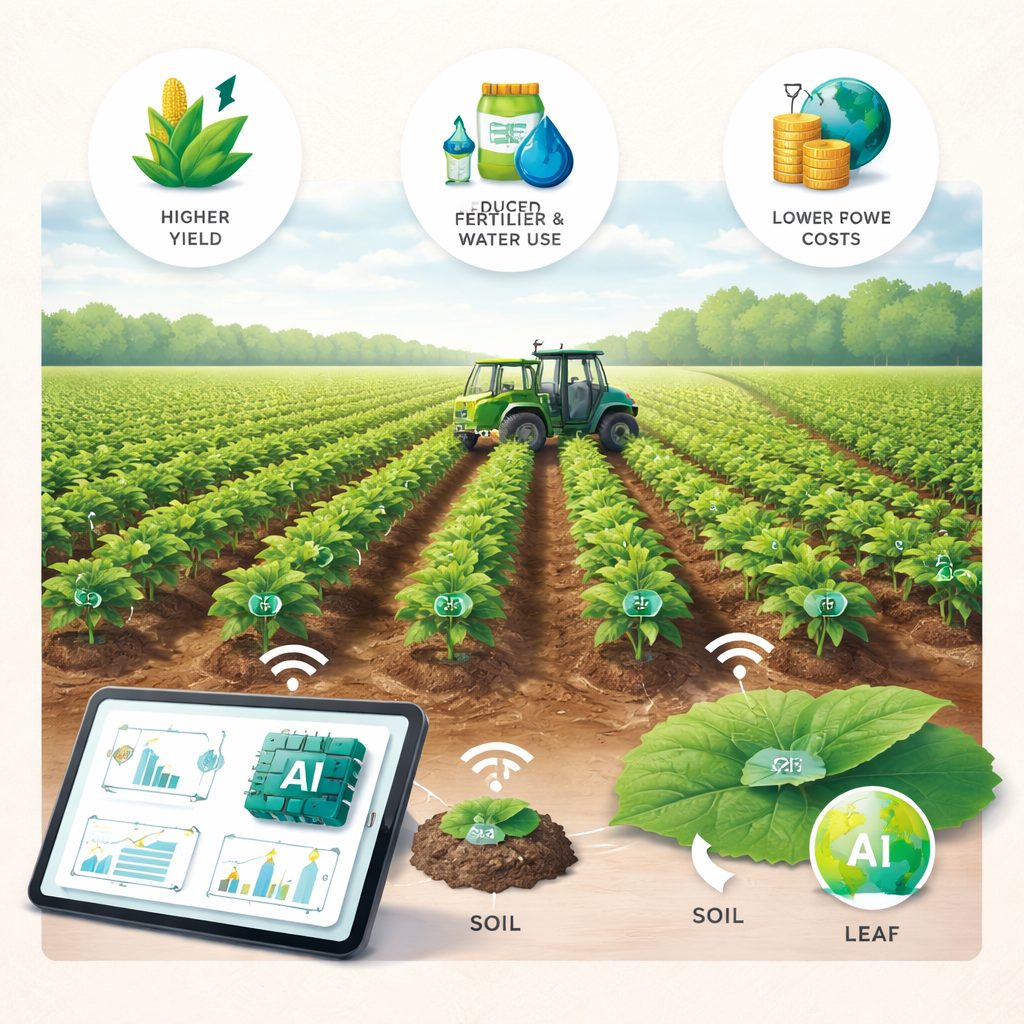
Modern agriculture increasingly relies on precision: applying water, fertilizer, and pesticides only where and when they are needed. To do that, farmers need dense, real‑time information about soil moisture, nutrients, plant stress signals, and local weather. Today’s commercial sensors usually measure only basic conditions such as soil moisture or temperature, and they are too expensive to scatter widely across fields. They also tell little about what is happening inside the plants themselves—for example, stress hormones, salt levels, or early signs of disease. Printed sensors promise to change this by being cheap enough to deploy in large numbers and gentle enough to sit directly on leaves, stems, or roots.
Printing electronics like newspapers
Instead of carving circuits out of rigid materials in a cleanroom, printing technologies add thin layers of special inks onto flexible surfaces. The review describes several key methods. Screen printing pushes thick, pasty inks through a patterned mesh, making sturdy electrodes over large areas—useful for simple soil or leaf patches. Inkjet printing sprays tiny droplets under digital control, allowing fine patterns on delicate or curved surfaces, including plant leaves. Three‑dimensional printing builds tiny structures layer by layer, such as hollow microneedles that gently tap plant sap. Direct laser writing uses a focused beam to “draw” conductive carbon on plastics, while aerosol jet printing blows a fog of ink through a narrow nozzle to write on uneven, living surfaces. Each method balances cost, resolution, speed, and compatibility with living plants.
What these tiny devices can already do
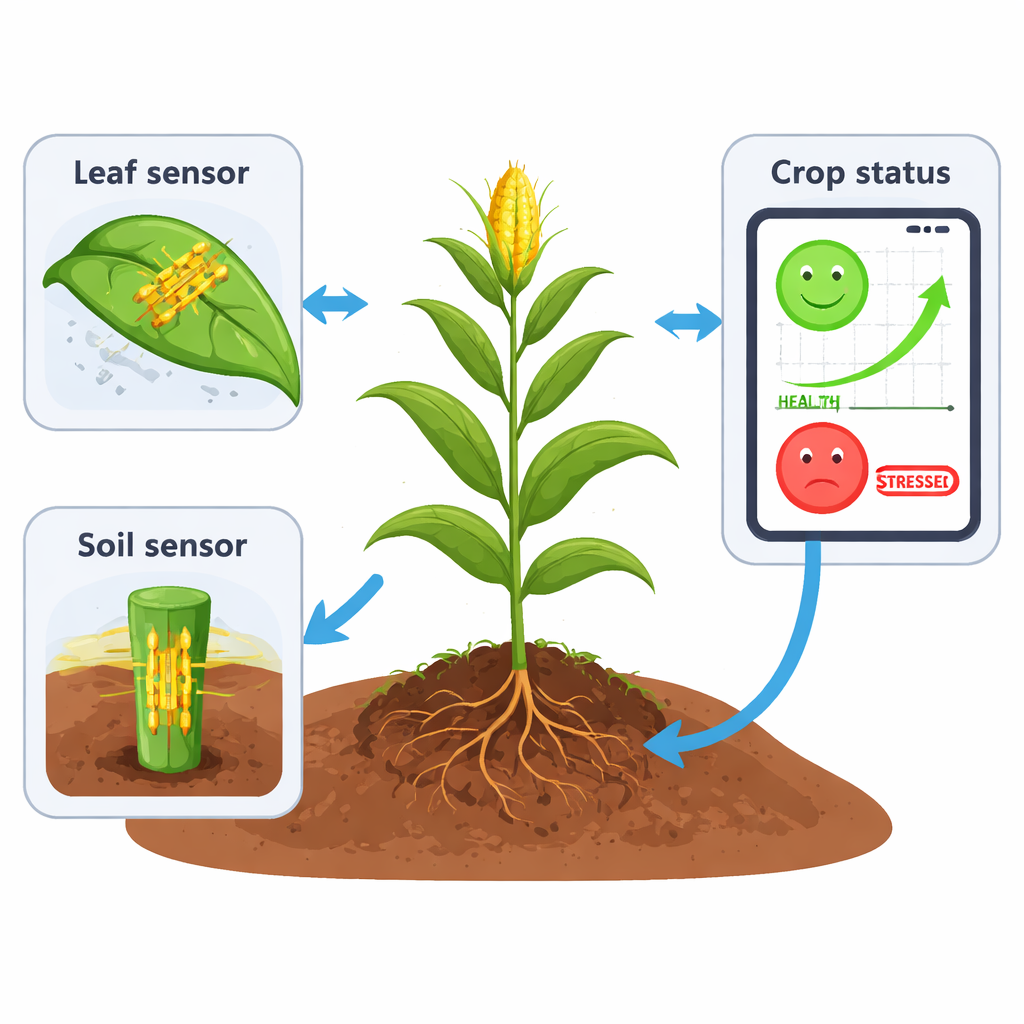
Researchers have demonstrated a wide range of plant‑mounted sensors using these printing techniques. Screen‑printed patches can monitor pH, nutrient ions, and hydrogen peroxide around roots, revealing how different crops absorb fertilizers and heavy metals over time. Tattoo‑like inkjet‑printed electrodes, thinner than a human hair, can stick to leaves without glue and record electrical signals or humidity for days. 3D‑printed microneedles combined with printed electrodes can sample tiny volumes of fluid inside leaves to track sugars, stress molecules, or cell damage with minimal harm. Laser‑written carbon patterns, sometimes coated with advanced materials such as MXenes or molybdenum disulfide, can sense humidity, temperature, or stress‑related chemicals on flexible strips. Aerosol‑jet‑printed silver lines have even been drawn directly onto ivy leaves to monitor their water content as they dry and rehydrate.
Smart inks, smart data
The heart of these sensors is not only the printing method but also the inks themselves. Beyond simple metals, scientists are using “low‑dimensional” materials such as graphene, MXenes, and layered semiconductors. These atomically thin materials offer high electrical conductivity, large surface areas, and tunable chemistry, making them ideal for detecting specific plant signals like ethylene (a ripening gas), reactive oxygen species, or hormones. Formulating these materials into printable, water‑based, and stable inks is technically demanding: the particles must be small enough not to clog nozzles, thick enough to form continuous films, and environmentally safe. Once data are collected, machine‑learning algorithms turn complex, noisy signals into simple insights—classifying types of stress, predicting future nutrient levels, or flagging problems before leaves visibly wilt or discolor.
From lab prototypes to everyday farm tools
Despite rapid progress, printed plant sensors still face hurdles before they appear widely on farms. Inks must be robust yet biodegradable; devices must survive sun, rain, and plant growth; and biological components such as enzymes need to last longer outdoors. The printing hardware itself must become cheaper, more portable, and easier to use—ideally small enough to operate in a greenhouse or even mounted on drones. The article concludes that, as materials, printing methods, and artificial intelligence mature together, printed sensors could evolve into disposable, self‑powered stickers and patches that quietly monitor crop health. For farmers, that would mean earlier warnings, more precise use of water and chemicals, and ultimately more reliable harvests with less environmental impact.
Citation: Panáček, D., Kupka, V., Nalepa, MA. et al. Printing technologies for monitoring crop health. Nat Commun 17, 2009 (2026). https://doi.org/10.1038/s41467-026-68778-6
Keywords: printed sensors, precision agriculture, plant health monitoring, flexible electronics, smart farming