Many of the liquids that power modern life—like petrol, solvents, and industrial chemicals—are hard to turn into safe, solid forms because they are oily and nonpolar. This paper introduces a new kind of soft solid, called a nonpolar organogel, that can soak up these liquids in large amounts while staying stretchy, tough, and reusable. Such materials could make cleaning up fuel spills safer and easier, and open new ways to store and handle flammable or volatile liquids.
A new recipe for tough, oily gels
Traditional gels that hold water, known as hydrogels, can be extremely strong and elastic thanks to clever polymer designs. But making equally robust gels that hold nonpolar organic liquids has been a long-standing challenge, because those liquids interact only weakly with surrounding molecules. The authors solve this by building a hybrid network that blends rigid inorganic nanowires with soft plastic-like polymer chains. Instead of relying only on weak forces between oily molecules, the material uses covalent chemical bonds to connect the nanowires and polymers into a single, cooperative framework.
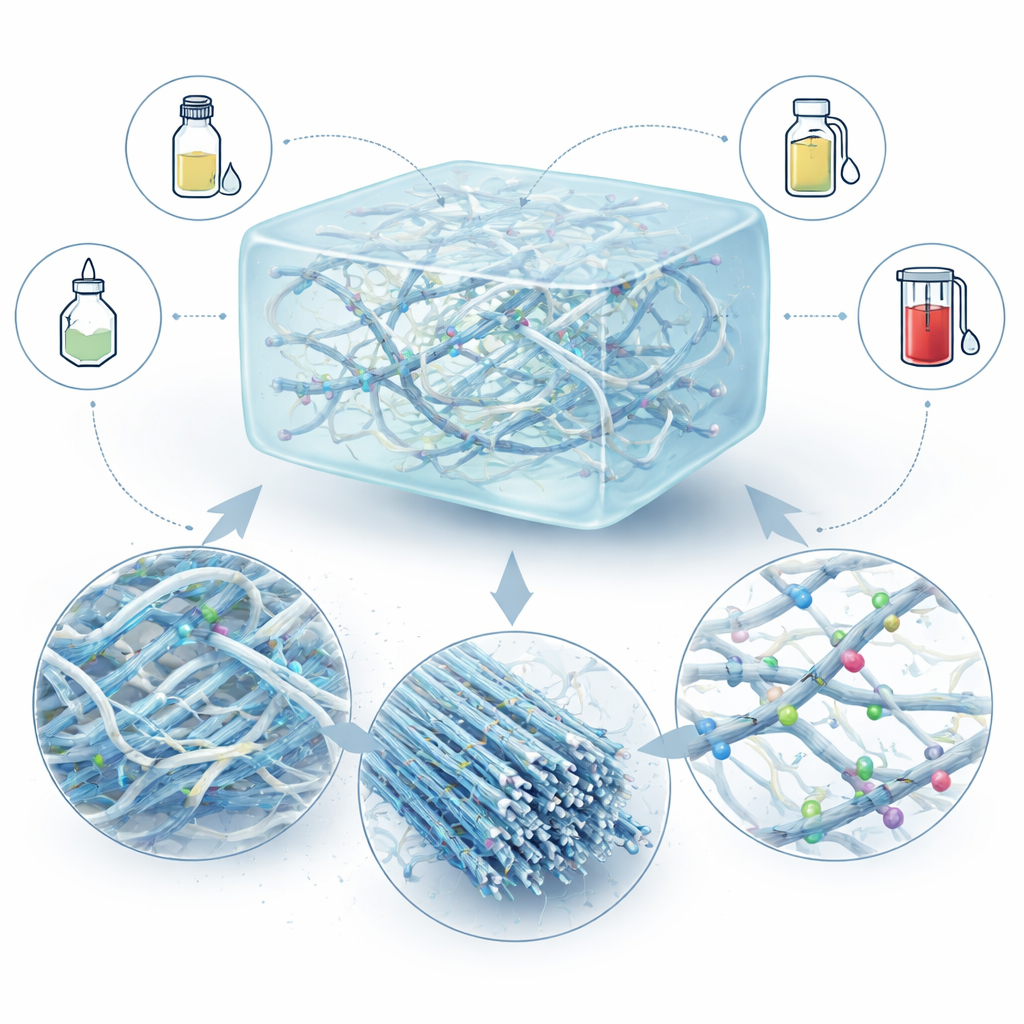
How the hybrid network works Figure 1.
At the heart of the design are ultrathin inorganic nanowires assembled from metal and oxygen clusters. The researchers decorate the surface of these nanowires with special "polymerizable" groups—chemical handles that can link into a growing plastic network. When these modified nanowires are mixed with a liquid plastic ingredient and a nonpolar solvent like octane, they first form a loose, physically linked gel. Shining ultraviolet light then triggers the plastic to form long chains that chemically attach to the nanowires. The result is a three-dimensional hybrid mesh where stiff nanowire bundles are wrapped by flexible polymer strands, all swollen with nonpolar liquid.
Stretchy, self-healing, and crack‑resistant
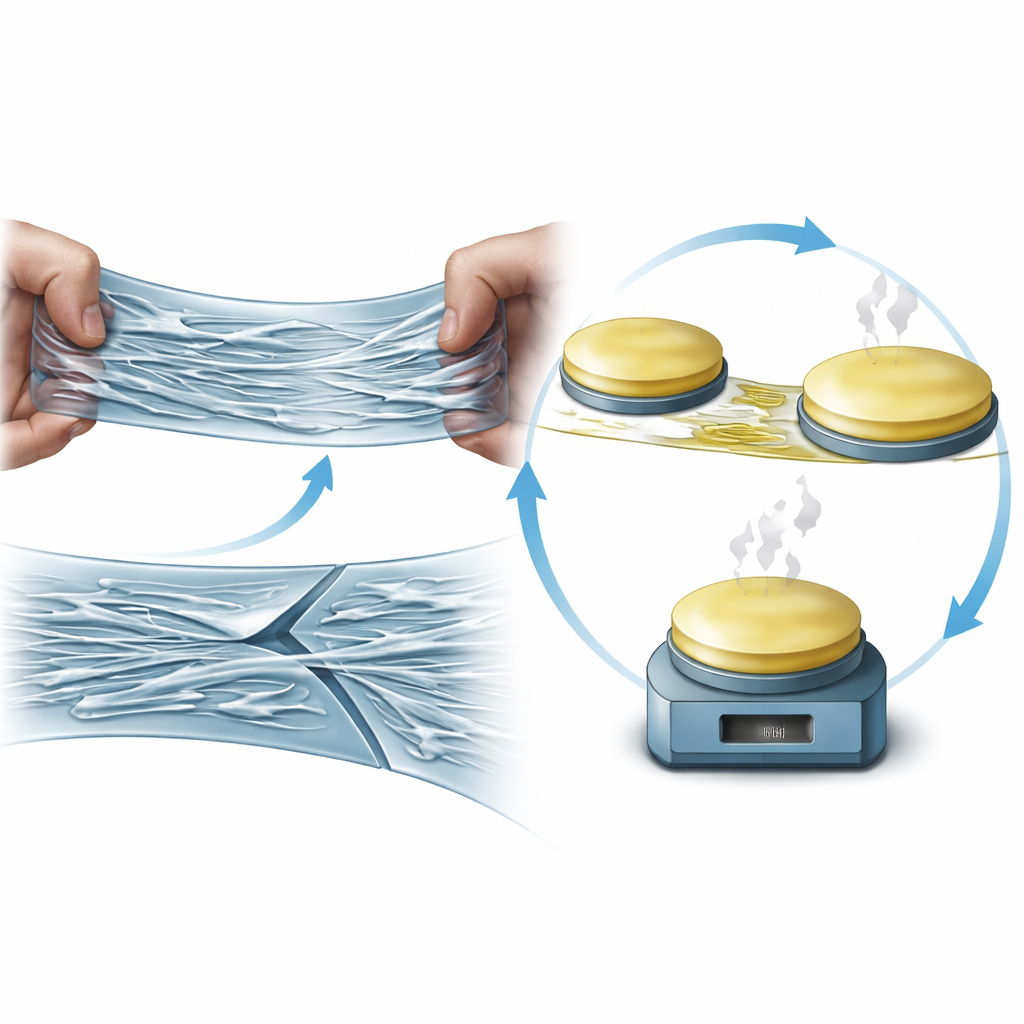
This architecture gives the organogel a combination of properties rarely seen in oily gels. Samples can stretch to more than 16 times their original length and still spring back, while resisting breakage with fracture strengths comparable to biological tissues such as skin. Under tension, the nanowires inside the gel gradually rotate and align along the pulling direction. This reorganization helps distribute stress and forces any growing cracks to follow tortuous paths, making it difficult for them to tear the material apart. The gel shows high resistance to both single catastrophic cracks and slow damage from repeated loading, and it can partially heal after being cut as polymer chains re-entangle over time at room temperature.
From lab bench to fuel spill cleanup Figure 2.
Beyond its mechanics, the hybrid gel acts as a powerful sponge for a wide range of nonpolar liquids. A dried piece can absorb more than 30 times its own mass in aromatic solvents and about 24 times its mass in commercial petrol, swelling into a clear, free-standing disk that can be lifted and handled without falling apart. The absorbed fuel can later be recovered by gentle distillation under reduced pressure, leaving the gel ready for reuse. The authors show that this absorb–release cycle can be repeated at least ten times with little loss in performance, and that the gel remains intact even after harsh freezing in liquid nitrogen.
Why this matters
For non-specialists, the key message is that the authors have found a way to make soft, rubbery solids that can safely imprison and release difficult, oily liquids while staying remarkably strong and durable. By tying together rigid nanowires and flexible polymers into a single responsive network, they bridge the performance gap between gels that love water and those that prefer oil. This strategy could be adapted to design future materials for safer handling of fuels and solvents, advanced flexible devices, and other technologies where liquid and solid must cooperate inside one robust, reusable material.
Citation: Huang, Z., Peng, J., Zhang, W. et al. Ultra-stretchable and crack-resistant nonpolar organogels.
Nat Commun17, 2045 (2026). https://doi.org/10.1038/s41467-026-68775-9
Keywords: organogels, nanowires, petrol spill cleanup, soft materials, nonpolar solvents