Clear Sky Science · en
A Magnon-photon interface based on Van der Waals Magnetic semiconductor
Turning Spins and Light into a New Kind of Switch
Modern technologies increasingly rely on both light and the tiny magnetic moments of electrons, known as spins, to move and store information. This research explores a new way to make light and spins talk to each other inside an ultrathin magnetic semiconductor called CrSBr. By carefully carving this material into a microscopic grating, the authors create a platform where light, electronic excitations, and collective spin waves strongly interact. Such control could eventually underpin faster, more efficient photonic circuits and future quantum devices that use spins as information carriers.
A Magnetic Material That Loves Light
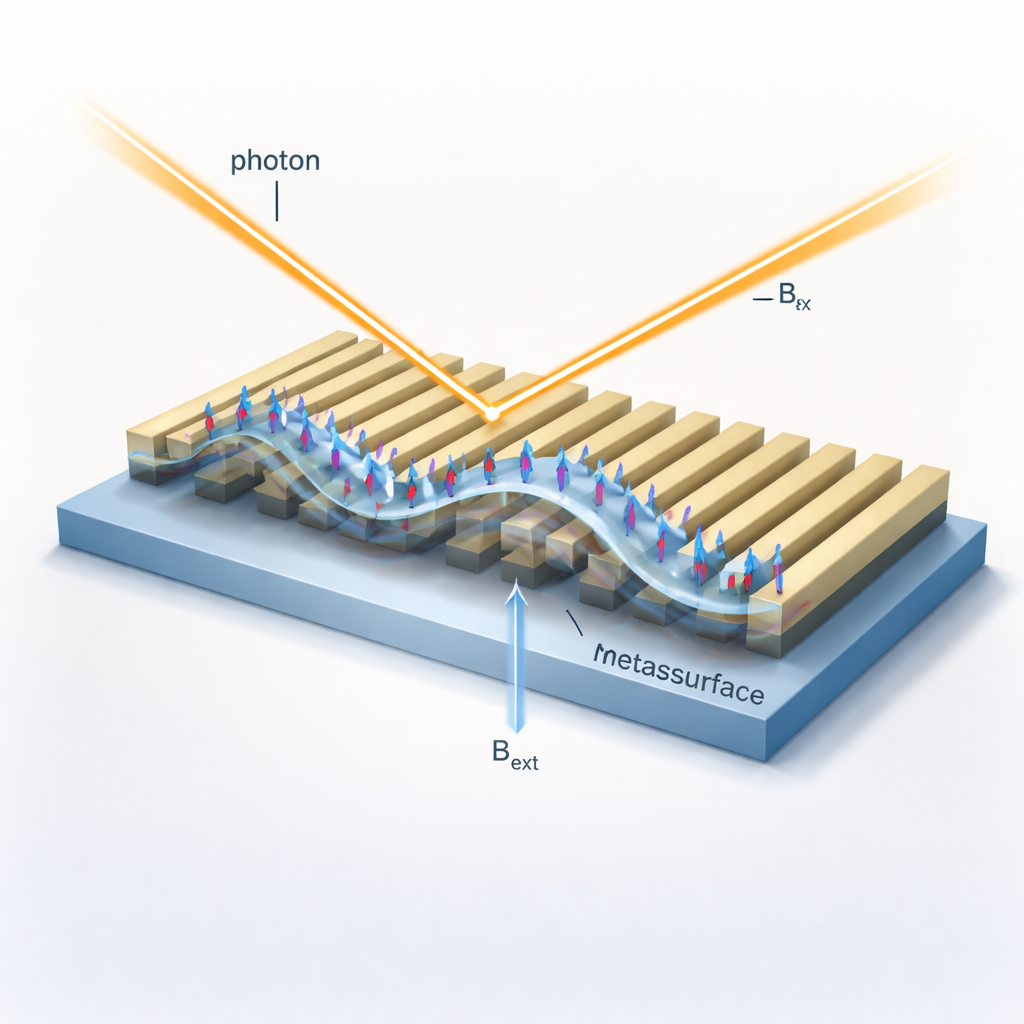
Most magnetic materials are poor at interacting with light at their fundamental electronic transitions, which makes them hard to use in optical technologies. CrSBr is a notable exception: it is a van der Waals magnetic semiconductor, meaning its layers are weakly bound and can be peeled down to very thin flakes, yet it still couples strongly to light. In this material, electrons and holes bind together to form excitons that interact intensely with incoming photons. At the same time, the spins in different layers arrange in an antiferromagnetic pattern, and their collective excitations, called magnons, can reshape the optical response on ultrafast time scales. This unusual combination of strong light–matter interaction and magnetism makes CrSBr an ideal playground for building a spin–photon interface.
Designing a Nano-Stage for Light and Spins
Instead of studying a flat crystal, the researchers pattern CrSBr into a one-dimensional metasurface: a series of nanoscale ridges and grooves that act like a carefully tuned optical grating. This structure supports special optical modes called bound states in the continuum (BICs), which are trapped light waves that, in principle, do not radiate away and can store energy for a long time. When these BIC modes interact strongly with excitons in CrSBr, they form hybrid states known as exciton polaritons. In the experiment, the team observes a bright polariton mode that couples readily to light and a dark partner mode—linked to the BIC—that is almost invisible in standard measurements because symmetry prevents it from emitting light directly.
Using Magnetic Fields as a Control Knob
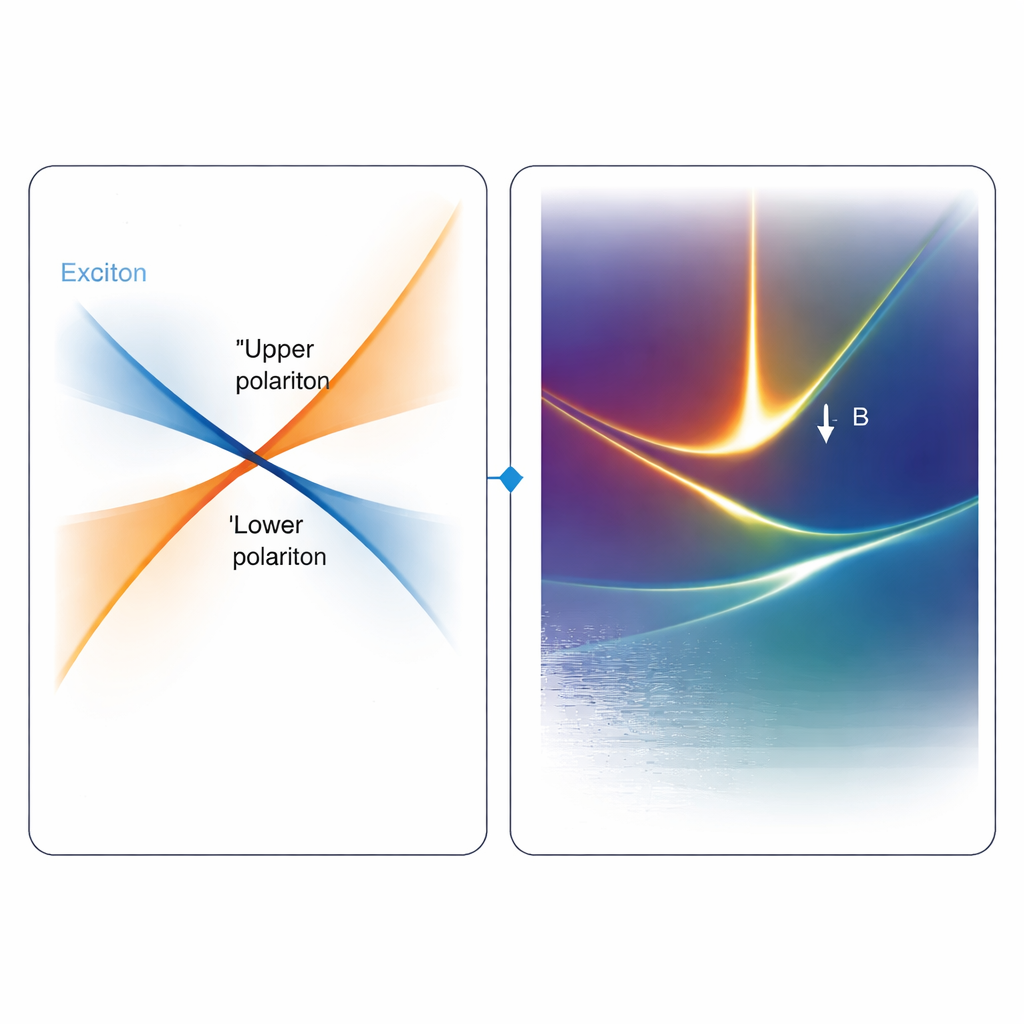
The key feature of this platform is that its optical behavior can be tuned simply by applying a magnetic field. Tilting the spins between the layers of CrSBr changes the energy of the underlying excitons, which in turn shifts the energies of the exciton polaritons in the metasurface. The authors show that the bright polariton can be shifted by more than 10 millielectronvolts, a large change for such systems. Remarkably, the dark BIC-like polariton, initially invisible, starts to "light up" as a distinct resonance when a magnetic field is applied. This brightening arises because the field subtly breaks ideal conditions, allowing some of the normally hidden BIC character to leak into measurable light, while preserving the high sensitivity of the mode to magnetic changes.
Watching Spin Waves Modulate Light in Real Time
To go beyond static control, the team uses ultrafast laser pulses to set the spins in motion and then monitors how the polaritons respond over time. These pulses launch coherent magnons—wave-like ripples in the spin arrangement—that periodically modulate the energy of the polaritons. By measuring how the reflectivity of the metasurface oscillates as a function of both time and angle of the probing light, the researchers distinguish two kinds of magnons: optical and acoustic modes, which differ in how spins in neighboring layers move relative to each other. They find that the optical magnon couples to polaritons in a way that preserves momentum, giving a strong angle dependence, while the acoustic magnon couples mainly through imperfections at the grating edges and shows little angular selectivity.
Why These Spin–Light Hybrids Matter
In simple terms, this work demonstrates a new kind of "interface" where light signals can be steered and reshaped by the collective motion of electron spins in a magnetic semiconductor. By marrying high-quality optical modes with tunable magnetism at the nanoscale, the CrSBr metasurface offers a path toward devices that use spins to control light on both static and ultrafast time scales. Such magnon–exciton polariton hybrids could form the basis of future spin-based optical switches, on-chip communication elements, and components for quantum networks that need to convert fragile spin information into robust light signals and back again.
Citation: Hu, Q., Huang, Y., Feng, J. et al. A Magnon-photon interface based on Van der Waals Magnetic semiconductor. Nat Commun 17, 1948 (2026). https://doi.org/10.1038/s41467-026-68767-9
Keywords: spin–photon interface, magnetic semiconductor, exciton polaritons, magnons, metasurfaces