Clear Sky Science · en
The contribution of sea-ice recrystallization to the Arctic snowpack
A Hidden Story in Arctic Snow
The snow that blankets Arctic sea ice might look like a simple white sheet, but this study reveals it is quietly growing from below as well as from the sky. Instead of being just frozen rain, part of that snow is actually recycled sea ice that has turned into vapor and refrozen higher up. Understanding this hidden exchange between sea ice and snow matters because it affects how much sunlight is reflected, how gases move between ocean and air, and how we predict future climate change in the rapidly warming Arctic.
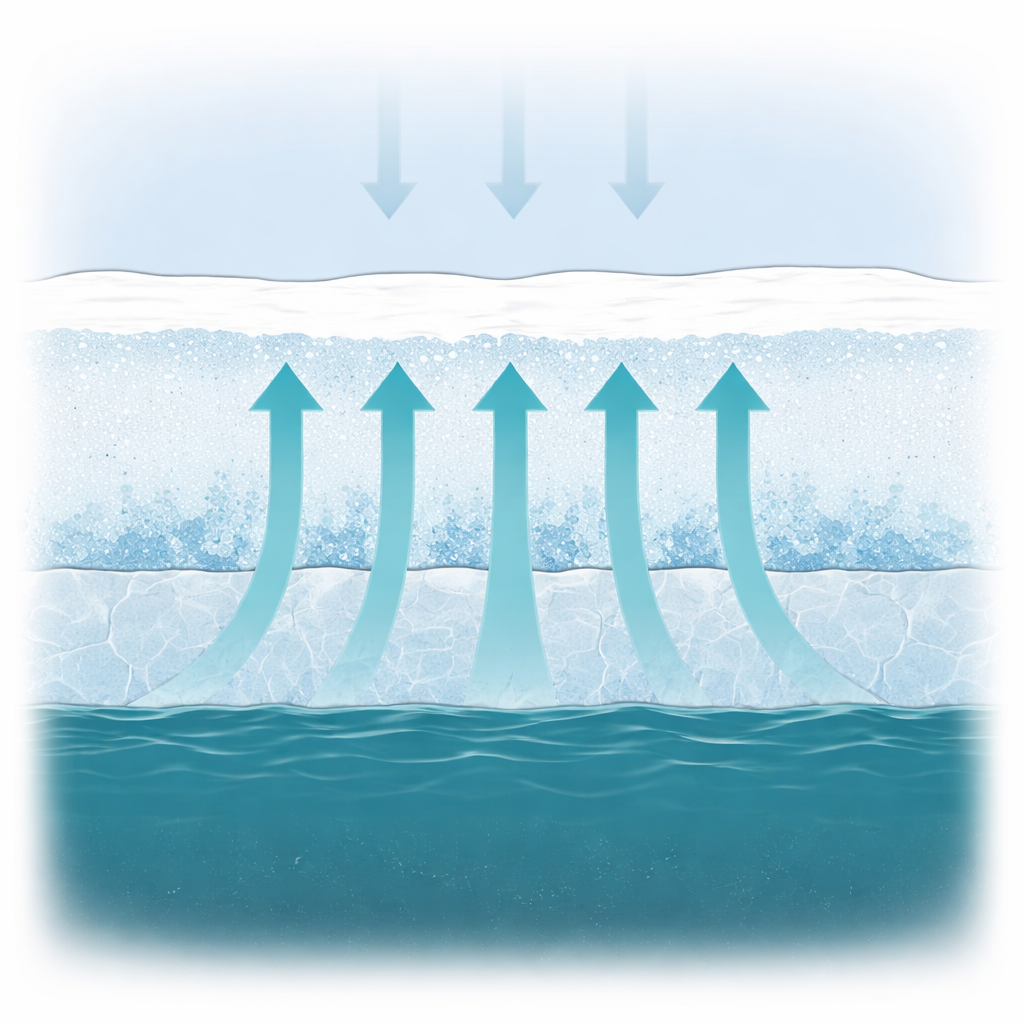
Snow Growing from the Ice Upward
Snow on sea ice sits between two very different worlds: a frigid atmosphere above and relatively warmer ocean water below. This temperature contrast creates strong vertical temperature differences through the snow, which in turn drive water vapor to move upward from the ice. As this vapor travels through tiny air spaces in the snow and refreezes, it reshapes the snow crystals into larger, more delicate structures known as depth hoar. Previous work in tundra soils hinted that ground ice could add a small amount of mass to overlying snow, but until now no one had quantified this process over drifting Arctic sea ice.
Following the Trail of Heavy Water
The researchers joined the year-long MOSAiC expedition, which drifted with Arctic pack ice between late 2019 and spring 2020. At over a hundred marked sites on a central ice floe, they repeatedly dug snow pits and measured snow depth, density, and temperature from the surface down to the snow–ice contact. Crucially, they collected more than 500 snow samples and many sea-ice cores to analyze the natural “fingerprints” of water molecules: heavy and light forms of hydrogen and oxygen. Because sea ice and snowfall have distinct isotope signatures, any input of water vapor from the ice into the snow leaves a recognizable mark in these ratios.
Evidence of Snow Fed from Below
The measurements revealed that temperature differences inside the snow were often extremely strong, with most pits exceeding the threshold where rapid crystal growth and vapor movement are expected. In nearly every vertical snow profile, the bottom few centimeters of snow—right above the ice—were much richer in heavy oxygen than the surface layers, and closer in composition to the underlying sea ice itself. At the same time, the lower snowpack tended to become less dense and more structurally transformed, consistent with upward vapor flow and recrystallization. An additional isotope measure called deuterium-excess helped rule out other explanations like salt contamination from sea spray or flooding, strengthening the case that the signal came from vapor rising out of the ice.
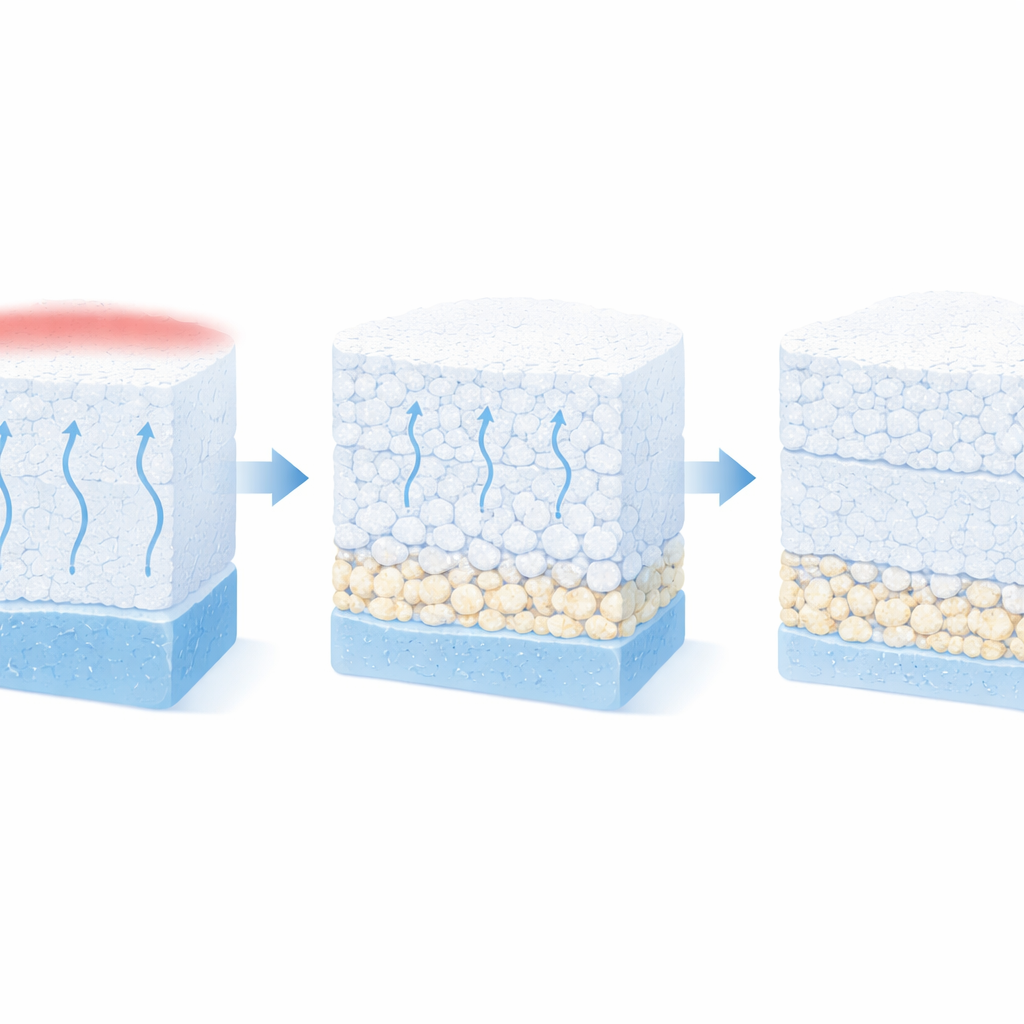
How Much New Snow Comes from Sea Ice?
To estimate how much of the snow actually originated as sea ice, the team combined two complementary approaches. First, they used results from controlled laboratory experiments, where snow above an ice slab was exposed to a known temperature gradient and the ice loss was carefully tracked. By scaling that relationship with the real-world temperature and vapor conditions measured during MOSAiC, they calculated how much ice would have had to sublimate and re-deposit into the snow. This yielded the equivalent of about 4 centimeters of snow depth added from below over the winter. Second, they applied a simple mixing model to the isotope data, treating atmospheric snowfall and sea ice as two end members. This analysis suggested an even larger contribution: on average, roughly one-third of the snow mass, corresponding to about 6 centimeters of snow, could be traced back to recrystallized sea ice.
Why This Matters for a Warming Arctic
Although each estimate carries uncertainties, together they show that sea ice is not just a platform for snow, but an active supplier of it. As the Arctic continues to warm and snow depths, winds, and temperature gradients change, this hidden growth from below will influence how thick and dense the snow becomes, how easily heat escapes from the ocean, and how impurities and chemicals are stored or released. For non-specialists, the key message is that the Arctic snowpack is partly built from recycled sea ice, and recognizing this process will help improve climate models, satellite interpretations, and our broader understanding of how the ice-covered ocean responds to a changing climate.
Citation: Macfarlane, A.R., Mellat, M., Dadic, R. et al. The contribution of sea-ice recrystallization to the Arctic snowpack. Nat Commun 17, 2429 (2026). https://doi.org/10.1038/s41467-026-68762-0
Keywords: Arctic snow, sea ice, water vapor, stable isotopes, climate change