Clear Sky Science · en
Inferring the internal structure of groups through the integration of statistical learning and causal reasoning
Seeing the Hidden Web of Social Life
Walk into a new workplace, classroom, or sports team, and you quickly get a sense of who calls the shots, who are close friends, and who quietly mentors others. Yet you usually see only a handful of brief exchanges. This article investigates how, from such sparse and noisy glimpses of behavior, people manage to reconstruct the invisible social map that shapes everyday life—and shows that our minds may be running a surprisingly sophisticated kind of data analysis and causal reasoning behind the scenes.
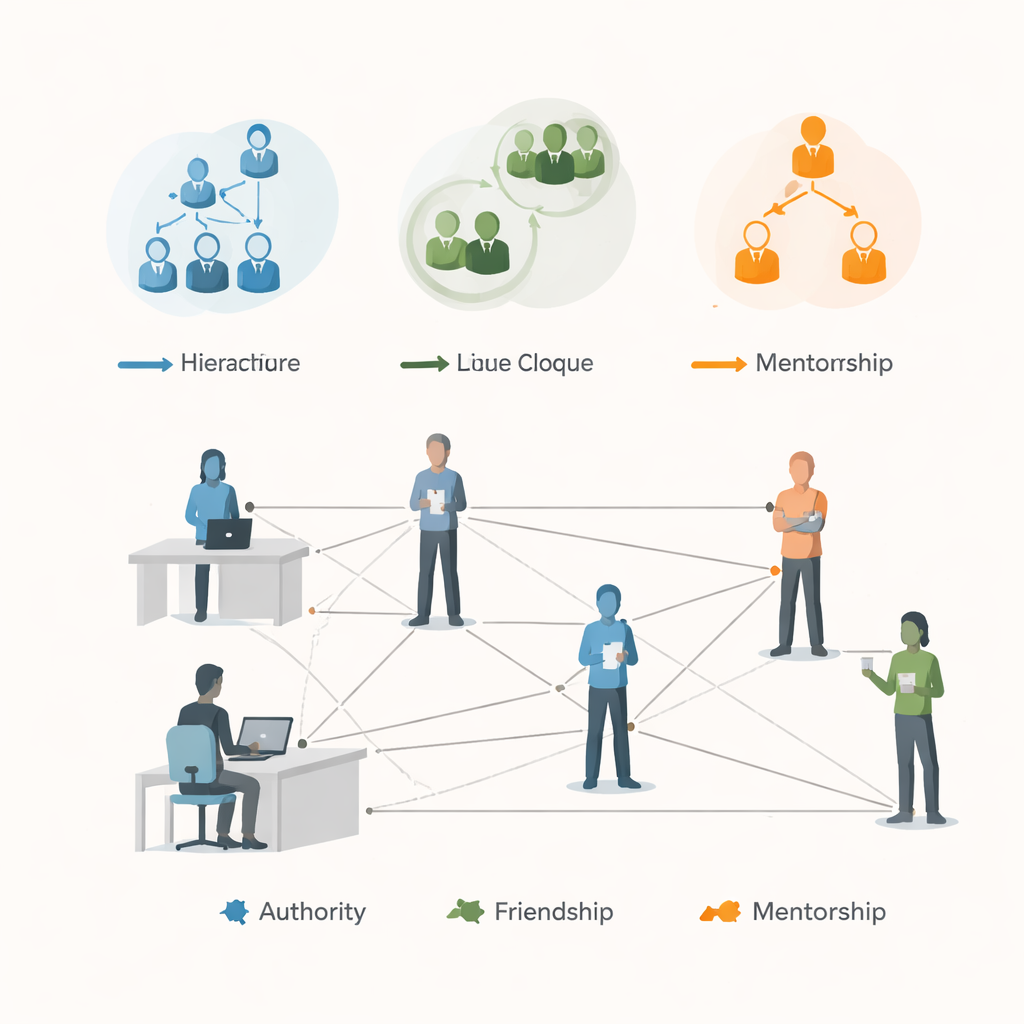
How We Read Structure from Sparse Clues
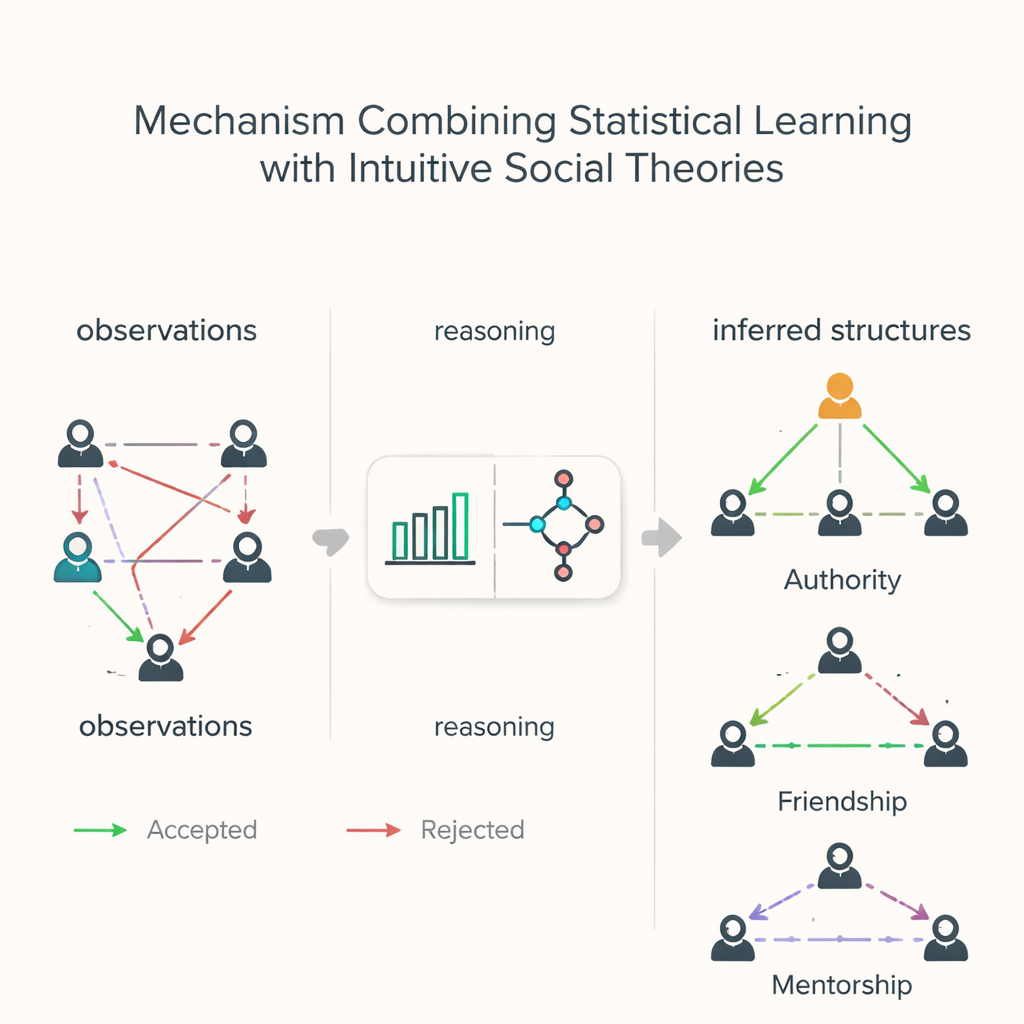
The authors argue that humans do not just track who interacts with whom; we use a combination of statistical learning and everyday “folk sociology” to infer deeper structure. On the statistical side, we notice patterns in how often and in what ways people interact, and we mentally cluster individuals into subgroups based on these patterns. On the sociological side, we carry intuitive expectations about relationships such as authority, friendship, and mentorship—who tends to give orders, who usually invites whom to socialize, and who is likely to seek or offer advice. By combining these two capacities, we can guess not only which relationships exist, but also how they shape future behavior.
From Noisy Videos to Hidden Social Maps
To test this idea, the researchers showed online participants short, cartoon-like videos of five colored figures interacting in an office setting. In each clip, one figure would approach another, send a symbol representing an order, a social invitation, or a request for advice, and then receive either a positive or negative response. After just a few such interactions, viewers were asked to judge which of several candidate diagrams best captured the group’s internal structure—for instance, a particular chain of command, a pattern of friendship cliques, or a mentorship network. Despite limited information and occasional conflicting interactions, people consistently chose diagrams that matched the underlying patterns, and they expressed graded confidence when more than one structure seemed plausible.
Predicting What Happens Next
The team then probed whether people use these inferred structures to forecast future behavior. In a second set of studies, participants again watched interaction sequences, but were later told, for example, that one worker was out of the office and another needed to assign a task, invite someone out after work, or ask for advice. Participants rated how likely each remaining colleague was to be chosen. Their predictions were not well explained by simple rules like “pick whoever has interacted most often.” Instead, they aligned closely with a computational model that first infers an underlying social structure and then asks, given that structure and common-sense expectations about orders, invitations, or advice, who is the most natural partner in the new situation.
Following the Flow of Social Influence
A final experiment made the situation more realistic by mixing all three interaction types—orders, invitations, and advice requests—within the same group. Afterwards, participants were asked who could most easily sway a particular person’s weekend plans: persuading them to work an extra shift, see a movie, or take an optional class. Different questions pulled on different kinds of relationships: extra shifts tended to follow authority lines, movie plans tracked friendship, and class decisions reflected mentorship. Once again, people’s answers were best captured by a model that selectively relied on the appropriate type of relationship for each decision, rather than a one-size-fits-all rule such as “most frequent contact.”
Why This Matters for Understanding Social Intelligence
Together, these studies suggest that ordinary adults rapidly build rich internal maps of group structure from minimal evidence, and then use those maps to explain, predict, and plan social behavior. The work shows that we go beyond simply knowing who belongs to which group: we also infer who outranks whom, who is close to whom, and who guides whose choices, even when the evidence is fragmentary. In everyday terms, our brains are constantly turning scattered interactions into a working model of the office politics, friendship webs, and mentoring chains around us—a model powerful enough to steer our decisions about whom to approach, whom to trust, and how to fit in.
Citation: Davis, I., Jara-Ettinger, J. & Dunham, Y. Inferring the internal structure of groups through the integration of statistical learning and causal reasoning. Nat Commun 17, 1959 (2026). https://doi.org/10.1038/s41467-026-68754-0
Keywords: social networks, hierarchies, statistical learning, causal reasoning, social cognition