Clear Sky Science · en
Topological robustness of classical and quantum optical skyrmions in atmospheric turbulence
Light That Keeps Its Shape in a Chaotic Sky
Modern communication increasingly relies on beams of light that carry intricate patterns, not just simple flashes. But real-world air is messy: pockets of hot and cold air act like a churning river for any laser beam, scrambling its structure. This paper explores a special kind of light pattern called an optical skyrmion and asks a practical question: can these patterns survive passage through turbulent air well enough to carry information reliably, both for everyday links and for delicate quantum technologies?
Twisting Patterns Written in Light
Optical skyrmions are swirling patterns embedded in a light beam, where the local “direction” of the light field twists in a controlled way across the beam’s cross-section. Instead of thinking about light only as bright or dim, the authors treat each beam as a map from positions in space to points on a sphere that represents polarization states. When that map wraps around the sphere an integer number of times, the beam has a topological charge: a number that counts how many times the pattern winds. Crucially, topology cares about overall winding, not fine details. That opens the possibility that even if turbulence bends and blurs the beam, the core winding number could remain intact—much like a knotted loop that can be stretched but not untied without cutting.
Classical and Quantum Beams Face the Same Storm
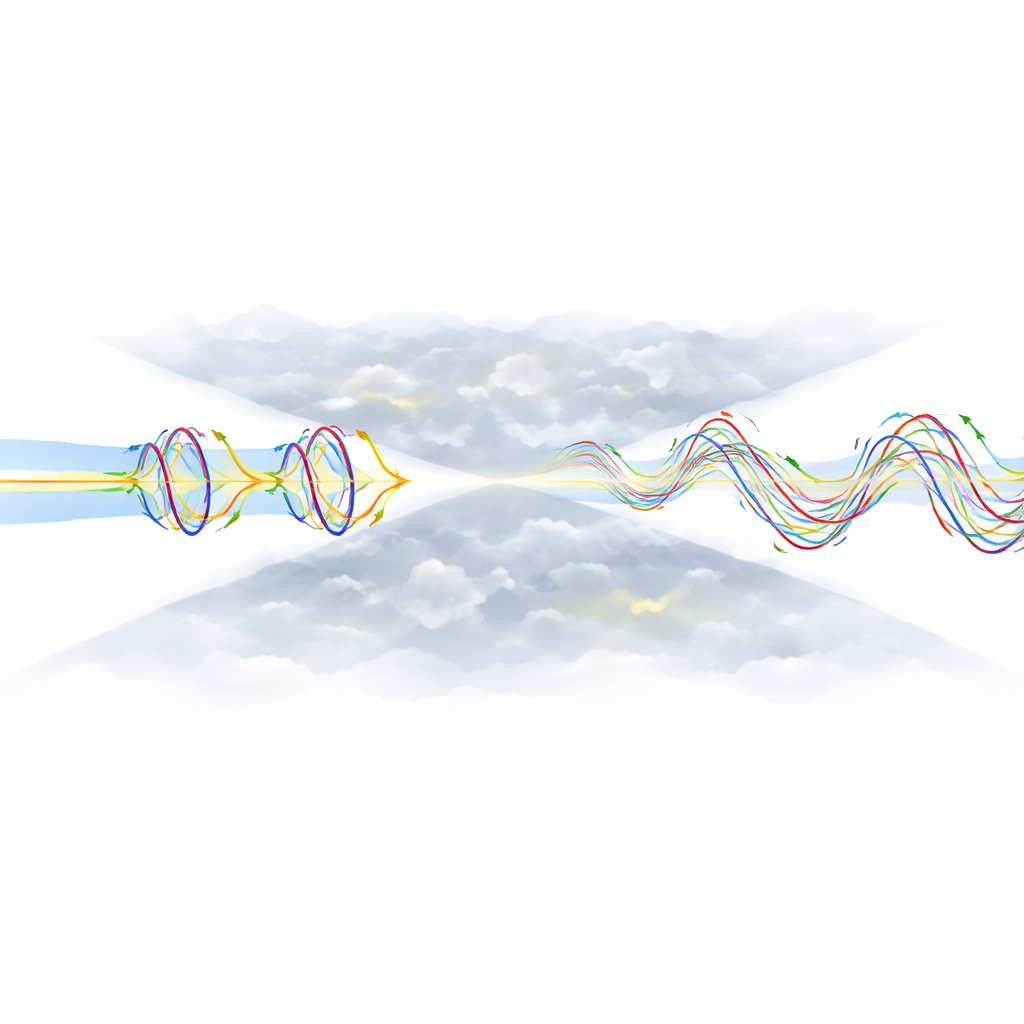
The researchers investigated skyrmions in two regimes. In the classical case, they created vector beams whose polarization and spatial shape are inseparably linked. In the quantum case, they produced pairs of entangled photons in which one photon carries the spatial twist (orbital angular momentum) while the other carries polarization. In both situations, the essential ingredient is nonseparability: spatial structure and polarization cannot be described independently. This shared structure allows the authors to treat classical and quantum skyrmions within one common framework, and to ask whether a turbulent atmosphere—where only the spatial part is disturbed while polarization remains untouched—changes the underlying topology or merely reshapes it.
Quantum Entanglement Fades, but Topology Holds
On the quantum side, the team generated entangled photons using a nonlinear crystal and carefully shaped their spatial modes to form nonlocal skyrmions. They then sent one photon of each pair through simulated atmospheric turbulence, implemented with programmable phase patterns on a spatial light modulator. By reconstructing the full two-photon state through quantum tomography, they measured both the strength of entanglement and the skyrmion’s topological charge as turbulence increased. As expected, the entanglement degraded: random mixing of spatial modes leaked probability into unwanted channels and turned a pure quantum state into a more mixed one. Yet, when they computed the skyrmion number from the spatially varying polarization of the partner photon, that number stayed essentially constant. Mathematically, the turbulence acted like a smooth, orientation-preserving reshaping of the coordinate grid, which can distort textures but cannot change how many times they wrap around the polarization sphere.
Classical Beams Survive Long, Rough Journeys
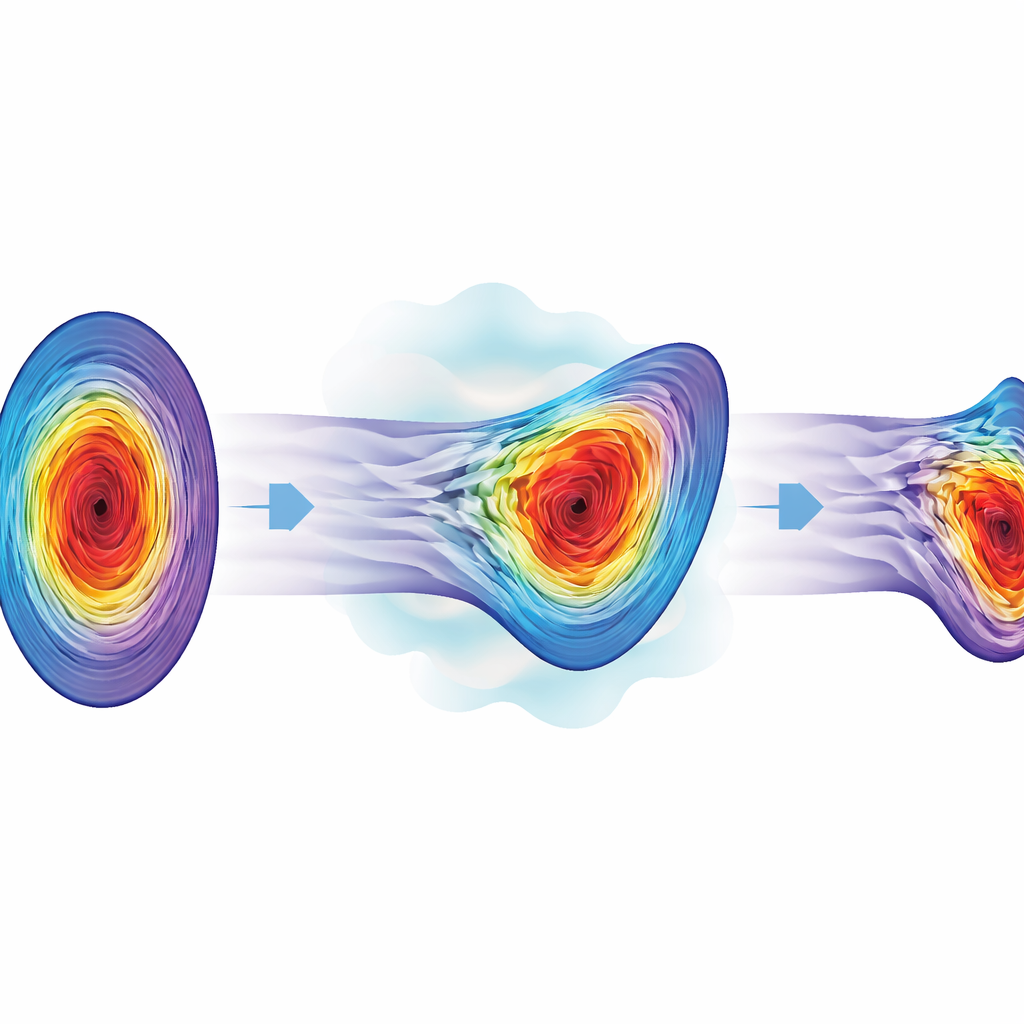
In the classical experiments, the group sculpted skyrmion beams with controllable topological charges ranging from one to five. Using a combination of digital holograms, interferometers, and polarization-sensitive cameras, they directly measured how the polarization pattern evolved as the beams passed through different models of turbulence. They probed three scenarios: near-field distortions right at the shaping device, far-field distortions after long propagation, and numerically simulated “thick” turbulence built from multiple phase screens spread over an effective 100-meter path. Across a wide range of conditions, the measured skyrmion number matched the encoded value with only minor deviations, even when the intensity patterns were badly warped. Only for the most complex, higher-charge skyrmions and the strongest distortions did the extraction of the topological number become unreliable, largely because small measurement errors make it harder to count all the relevant singular points in a very intricate pattern.
From Robust Patterns to Robust Links
Putting theory, experiment, and simulation together, the authors show that optical skyrmions—whether encoded in classical beams or in quantum entangled photons—exhibit a remarkable resilience: their topological charge is preserved even as turbulence scrambles other details. For quantum technologies, this means that while fragile entanglement may weaken, the global topological information can still be carried reliably through noisy air. For classical systems, it suggests a new class of light-based information carriers whose “message” is encoded in how many times the pattern winds, not in fine spatial features that are easily blurred. This topological robustness could underpin future free-space links, satellite-to-ground channels, and sensing schemes that keep working in the face of atmospheric chaos.
Citation: Guo, Z., Peters, C., Mata-Cervera, N. et al. Topological robustness of classical and quantum optical skyrmions in atmospheric turbulence. Nat Commun 17, 2085 (2026). https://doi.org/10.1038/s41467-026-68751-3
Keywords: optical skyrmions, atmospheric turbulence, structured light, quantum communication, topological photonics