Clear Sky Science · en
Efficient implementation of a quantum algorithm with a trapped ion qudit
Smarter Quantum Bits for Faster Searches
Today’s quantum computers struggle to scale up because controlling many fragile quantum bits is technically demanding. This research shows a different path: instead of adding more two-level quantum bits (qubits), it packs more information into a single particle that can hold many levels at once, called a “qudit.” By doing so, the team runs a key quantum search algorithm with high accuracy on just one trapped ion, hinting at more compact and efficient quantum machines.
From Two-Level Bits to Many-Level States
Most quantum devices use qubits, which, like classical bits, have two basic levels. But many physical systems naturally offer more than two internal states. A qudit uses d levels instead of just two, so one particle can stand in for several qubits. This boost in information density could cut down the hardware needed for a given task and reduce the number of complex, error-prone operations between particles. The challenge is learning how to drive and read out all these levels precisely enough to run real algorithms.
A Single Ion as a Tiny Quantum Data Rack
The authors use a single barium ion (specifically 137Ba+) trapped above a microfabricated chip. Thanks to its internal structure, this ion has 24 long-lived states to choose from. The researchers carefully pick sets of five and eight of these states to act as their qudits, balancing three needs: transitions between chosen states must be strong, insensitive to magnetic-field noise, and well separated in frequency from unwanted states that could cause leakage. They then prepare and measure the ion’s state using a laser and radio-frequency pulses in a way that keeps errors from state preparation and readout small enough for demanding tests of quantum algorithms. 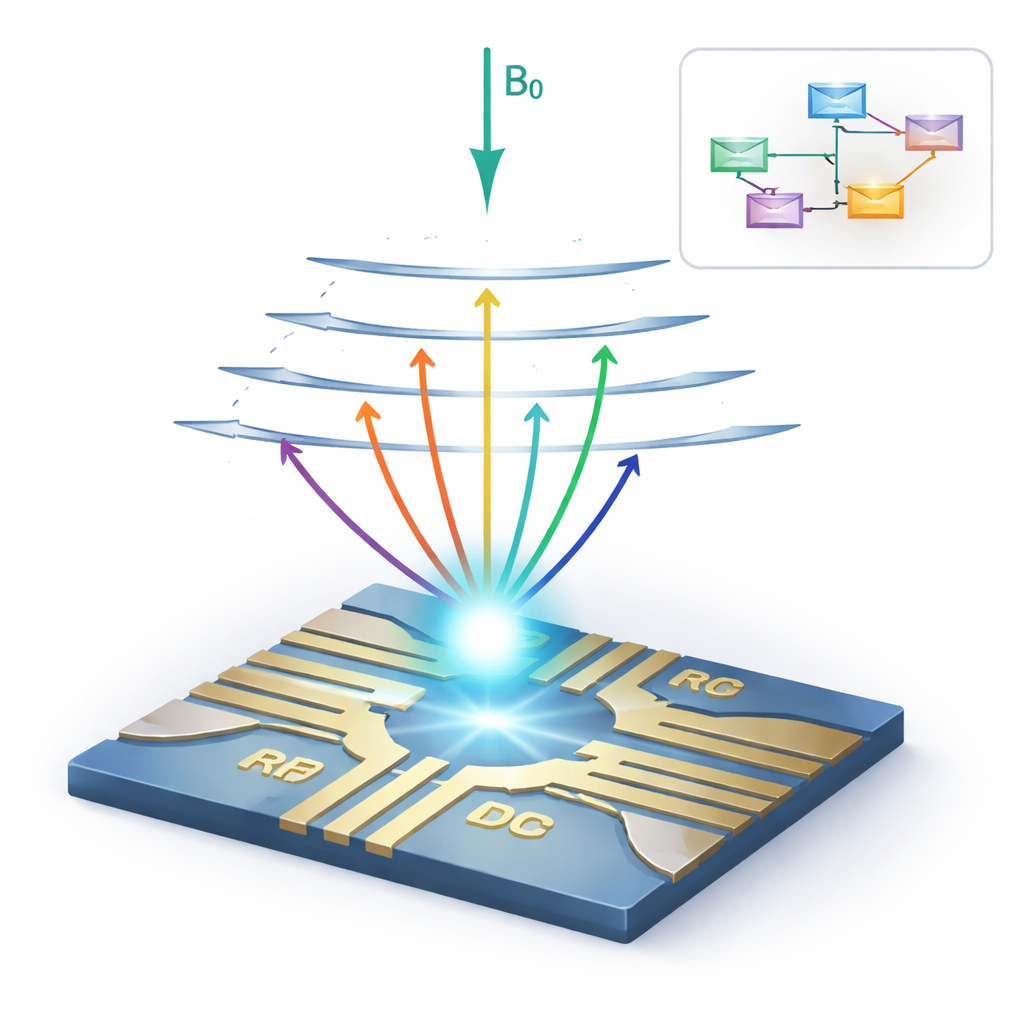
Orchestrating Many Tones to Steer the Qudit
Controlling several energy levels at once is far more complex than flipping a single qubit. The team sends up to seven synchronized radio-frequency tones through electrodes near the ion. Each tone is tuned to one specific transition between neighboring levels. By adjusting the strengths and phases of these tones, they effectively generate a single “spin-like” rotation acting across the entire multi-level system. Importantly, with this scheme any desired operation on the qudit can be built from a number of pulses that grows only linearly with the number of levels, rather than quadratically as in more naive approaches. They use spectroscopy and Rabi oscillations for a rough calibration, then refine the pulse settings with randomized benchmarking and numerical optimization until gate errors are minimized.
Running a Quantum Search Inside One Particle
To put their control to the test, the researchers implement Grover’s search algorithm, a famous quantum routine that finds a marked item in an unsorted database with fewer steps than any classical method. Here, different levels of the ion represent the database entries. The algorithm starts by creating an equal superposition over all qudit states, then repeatedly applies two operations: an “oracle” that flips the phase of the marked state and a “reflection” that boosts its probability at the expense of the others. Using only single-qudit pulses—no entangling gates at all—they run a single Grover iteration on five-level and eight-level versions of the qudit. For five levels, the algorithm succeeds about 96.8% of the time, extremely close to the theoretical optimum, and the full probability pattern matches theory at the 99.9% level. For eight levels, the success rate is 69%, still competitive with or better than multi-qubit demonstrations that require many more gates. 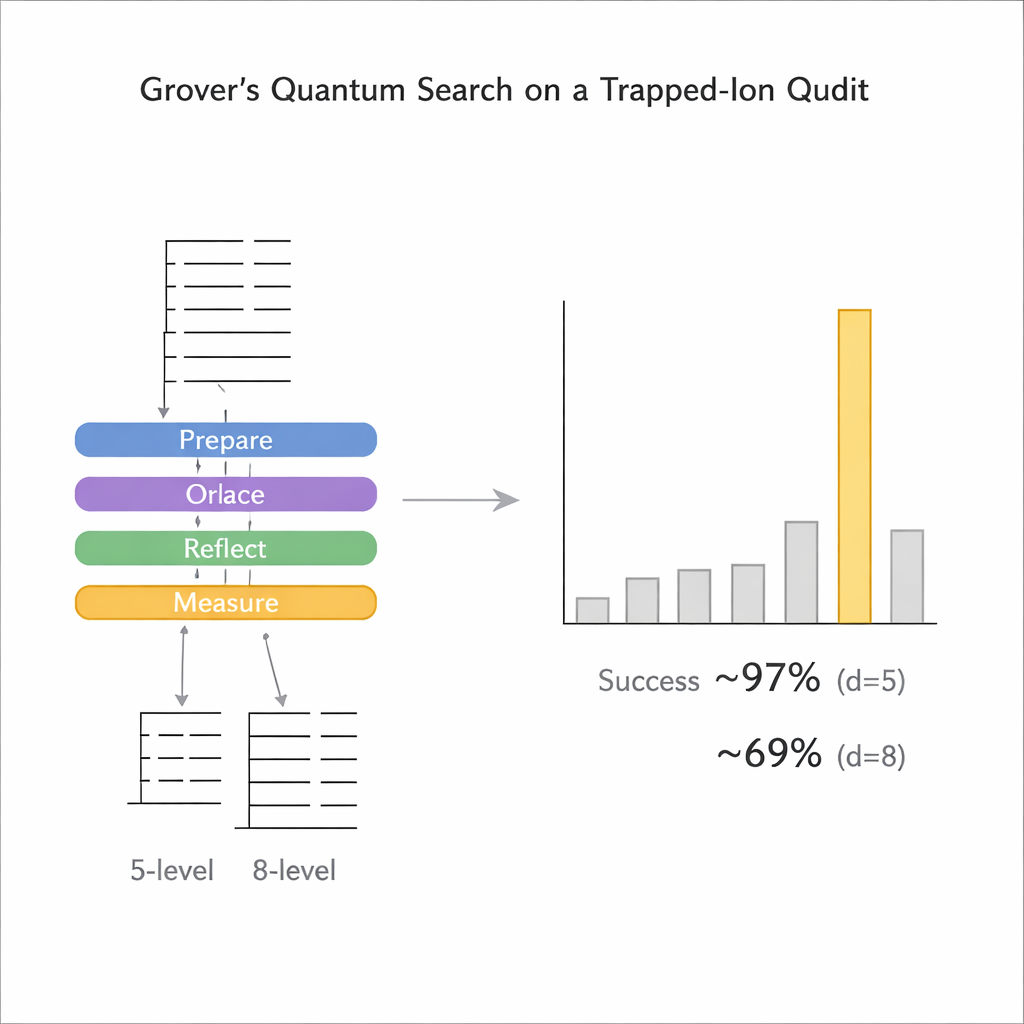
What Limits Performance and What Comes Next
The main imperfections come from decoherence, where fluctuations in magnetic fields slowly degrade the delicate superpositions in the ion, and from small off-target excitations of states outside the chosen qudit. Simulations that include these effects match the observed performance, confirming that the control method itself is sound. The authors argue that combining moderate-size qudits—each with, say, five to ten levels—across several ions could support more powerful algorithms without exploding hardware costs. Future work will focus on designing efficient entangling gates between qudits and exploring how these higher-dimensional units can simplify error correction and large-scale architectures.
Why This Matters for Future Quantum Computers
For a non-specialist, the key message is that quantum computers do not have to be built from identical two-level units. By exploiting many-level systems like qudits, engineers can pack more computational power into fewer physical devices and reduce the number of fragile multi-particle operations. This study shows that a single trapped ion qudit can run a flagship quantum search algorithm with performance rivaling or beating qubit-based setups, all while using fewer steps. It is an early but promising demonstration that smarter use of quantum states could be just as important as simply building bigger machines.
Citation: Shi, X., Sinanan-Singh, J., Burke, T.J. et al. Efficient implementation of a quantum algorithm with a trapped ion qudit. Nat Commun 17, 1911 (2026). https://doi.org/10.1038/s41467-026-68746-0
Keywords: trapped ion qudit, Grover search, multi-level quantum systems, quantum algorithms, quantum hardware efficiency