Clear Sky Science · en
Abyssal hydrothermal alteration drives the evolution from simple alkanes to prebiotic molecular complexity
Hot Springs at the Bottom of the Sea
Far beneath the ocean surface, where sunlight never reaches, hot fluids gush out of rocky chimneys on the seafloor. These deep‑sea hot springs, or hydrothermal vents, are not just geological curiosities—they may have been the chemical engines that helped turn simple carbon molecules into the rich organic stew from which life emerged. This study explores how these natural reactors can gradually transform basic ingredients like simple hydrocarbons into far more complex, life‑ready molecules.
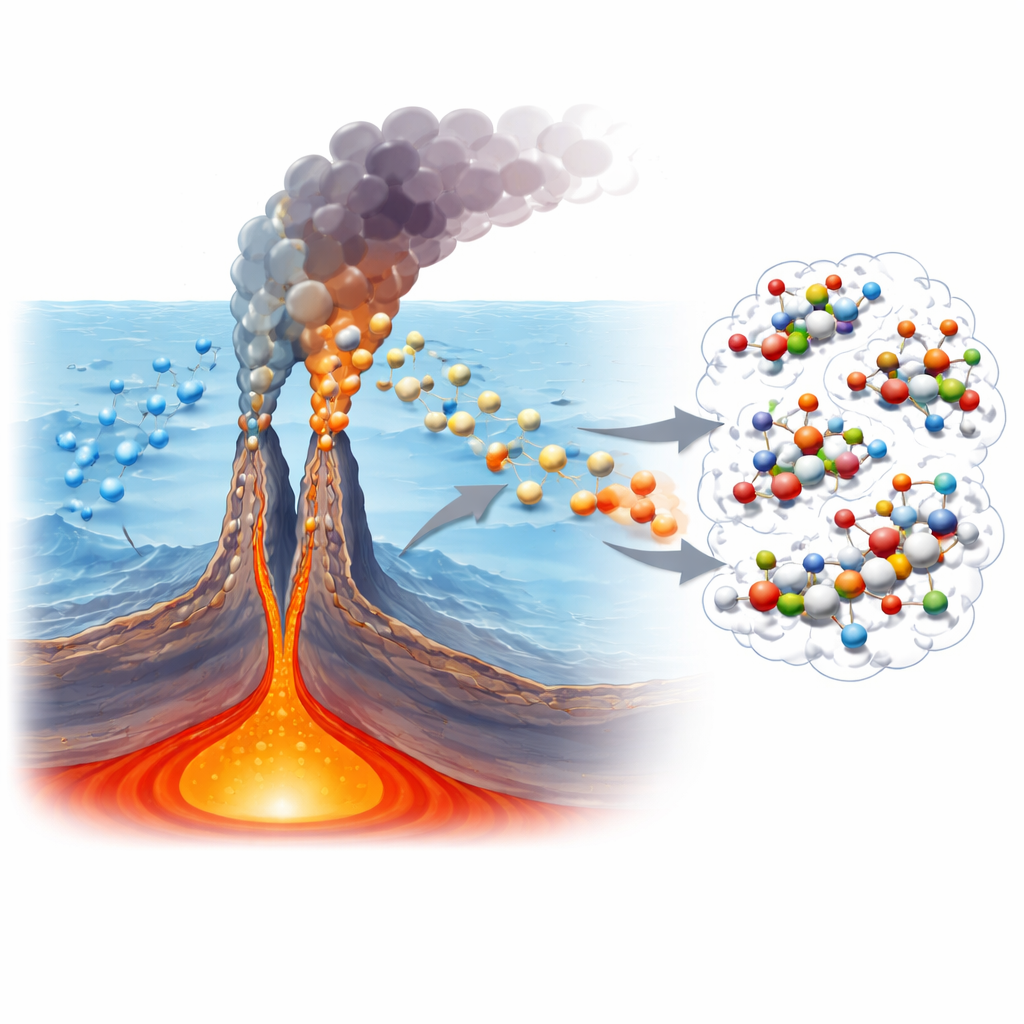
Where Fire Meets Ocean
The vents examined in this work lie along the ultraslow‑spreading Indian Ridge, a deep crack in the seafloor where Earth’s interior meets the ocean. Here, seawater seeps into the crust, heats up to hundreds of degrees Celsius, reacts with rocks and metals, and then erupts back out through chimney‑like structures. These fluids carry reduced carbon compounds such as methane and simple alkanes, along with hydrogen, sulfide, and metals—exactly the kind of chemical energy many scientists think powered the earliest steps toward life. Yet, until now, there has been a major mystery: how do these basic ingredients evolve into more complex, functional molecules that could serve as precursors to amino acids, nucleic‑acid bases, and other building blocks of biology?
Reading the Chemical Family Tree
To tackle this question, the researchers borrowed tools from modern metabolomics—the study of small molecules in living systems—and applied them to rocks from active and inactive vent chimneys at three sites: Longqi, Edmond, and Kairei. Using high‑resolution mass spectrometry, they broke complex mixtures into individual molecular “fingerprints” and then used computational methods to cluster related structures. The result is a kind of chemical family tree that maps how molecules are related to one another by their structures, much as evolutionary trees link related species. Instead of tracing biological ancestry, this “geochemical phylogeny” traces how heat, minerals, and changing redox conditions reshape carbon compounds over time.
From Straight Chains to Complex Webs
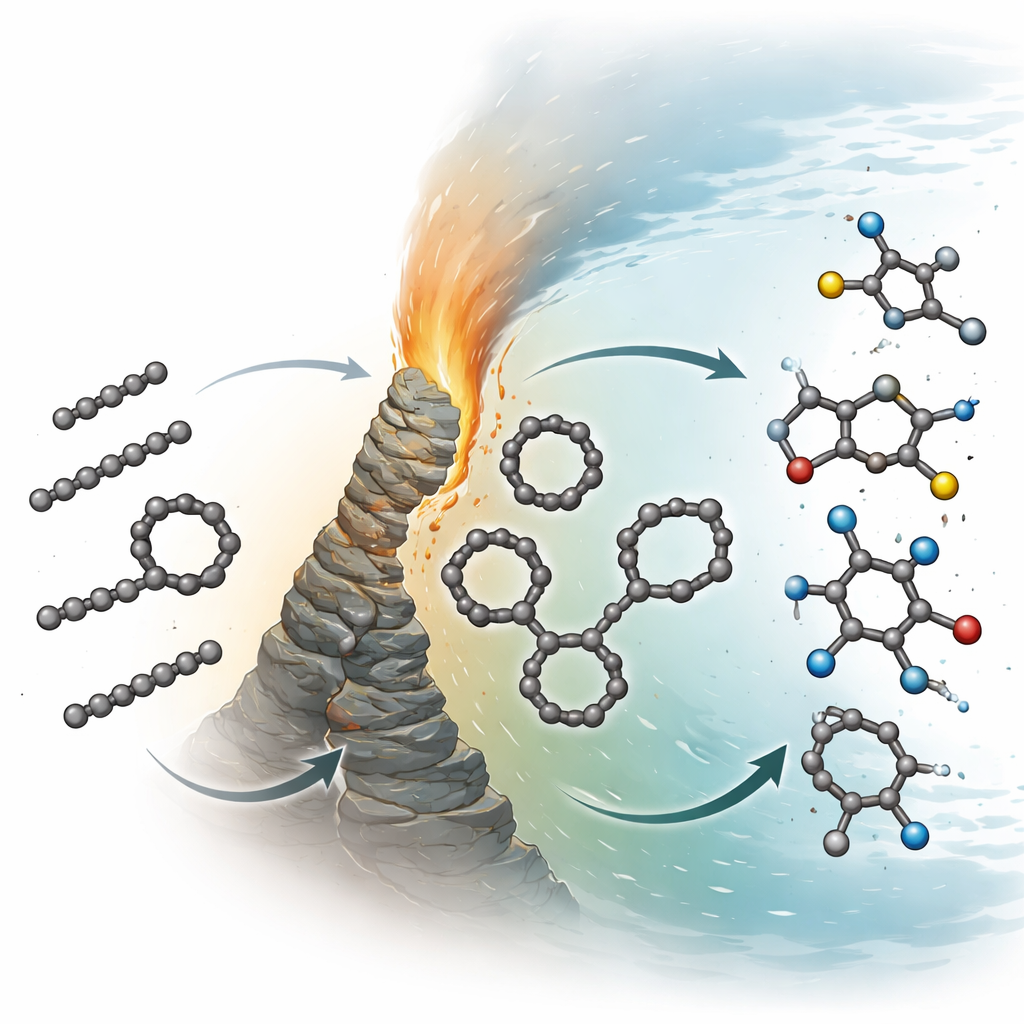
The molecular tree reveals a striking, orderly progression. At one end, the vent samples are dominated by simple, straight and branched alkanes—basic chains of carbon and hydrogen. Moving along the tree, these chains give way to ring‑shaped and fused‑ring aromatics, which appear more strongly in hotter, active vents. Further along still, the molecules pick up nitrogen, sulfur, and oxygen, forming heterocyclic rings, amides, acids, and other polar compounds that interact more readily with water and minerals. This trend—chain to ring to heteroatom‑rich structures—suggests that hydrothermal conditions do not simply destroy organics; they drive a stepwise increase in complexity and chemical versatility.
When Vents Go Quiet, Nitrogen Moves In
Another key finding emerges when comparing hot, vigorously venting sites to nearby chimneys that have cooled and fallen silent. Ultrahigh‑resolution measurements of intact molecules show that active vents are relatively poor in nitrogen‑bearing organics, even though they are rich in reduced carbon. As vents cool and become inactive, the overall diversity of molecules increases, and nitrogen‑containing compounds become far more abundant. This pattern, seen consistently across multiple fields, indicates that vent shutdown and cooling favor reactions that introduce nitrogen and additional oxygen—such as amination and nitration—allowing more stable, nitrogen‑rich molecules to accumulate and persist in the chimney walls.
Why This Matters for Life Here and Elsewhere
Seen together, these results paint abyssal hydrothermal vents as dynamic reactors that can transform simple carbon chains into ever more functional and polar molecules, including nitrogen‑rich species that edge closer to the chemistry of amino acids and nucleobases. Rather than a chaotic jumble, the chemistry follows recognizable pathways shaped by temperature, mineral surfaces, and redox gradients, with hot, active vents favoring initial carbon reduction and ring formation, and cooler, waning vents locking in more complex, nitrogen‑bearing structures. This progressive, reproducible evolution from simple alkanes to prebiotic‑like complexity helps close the gap between deep‑Earth carbon and life’s first building blocks—and offers a blueprint for what scientists might look for when searching for past or present life in hydrothermal environments on Mars and icy ocean worlds.
Citation: Liu, Q., Xu, H., Wang, J. et al. Abyssal hydrothermal alteration drives the evolution from simple alkanes to prebiotic molecular complexity. Nat Commun 17, 2415 (2026). https://doi.org/10.1038/s41467-026-68745-1
Keywords: hydrothermal vents, origin of life, prebiotic chemistry, organic molecules, deep sea geology