Clear Sky Science · en
Low-pressure storms drive nitrous oxide emissions in the Southern Ocean
Storms that change the climate balance
Far from land, powerful low-pressure storms circle Antarctica every few days, whipping up waves in the Southern Ocean. We already know this ocean is a key player in slowing climate change by soaking up carbon dioxide. This study reveals that the same storm systems also act like giant vacuum cleaners for another gas—nitrous oxide—that warms the planet and eats away at the ozone layer. Understanding this hidden storm-driven “leak” helps us better judge how much the ocean really protects us from climate change.
A hidden greenhouse gas in stormy seas
Nitrous oxide (N₂O) is a potent greenhouse gas with nearly 300 times the warming power of carbon dioxide, molecule for molecule, over a century. It is also now the main man-made threat to the ozone layer. The ocean as a whole releases N₂O to the atmosphere, but scientists have long struggled to pin down how much, especially in the remote and turbulent Southern Ocean. Early estimates suggested this region was responsible for up to 40 percent of all marine N₂O emissions. More recent work, using coarse averages and sparse measurements from ships, seemed to cut that contribution in half. Those conflicting numbers left a big question mark over how this remote ocean really affects the climate.
Robots, machine learning, and a data gap
Traditional measurements come from research ships, which rarely sail straight through the heart of violent Southern Ocean storms. To fill this gap, the authors turned to a fleet of robotic profiling floats known as Biogeochemical Argo (BGC-Argo). These instruments drift with the currents, diving down to 2,000 meters and resurfacing about every 10 days to report temperature, salinity, oxygen, nitrate, and more. They cannot measure nitrous oxide directly, so the team trained machine-learning models on high-quality N₂O data collected from research cruises. By learning how N₂O relates to the variables the floats do measure, the models could then estimate N₂O in surface waters across tens of thousands of float profiles—capturing conditions during calm spells and intense storms alike. 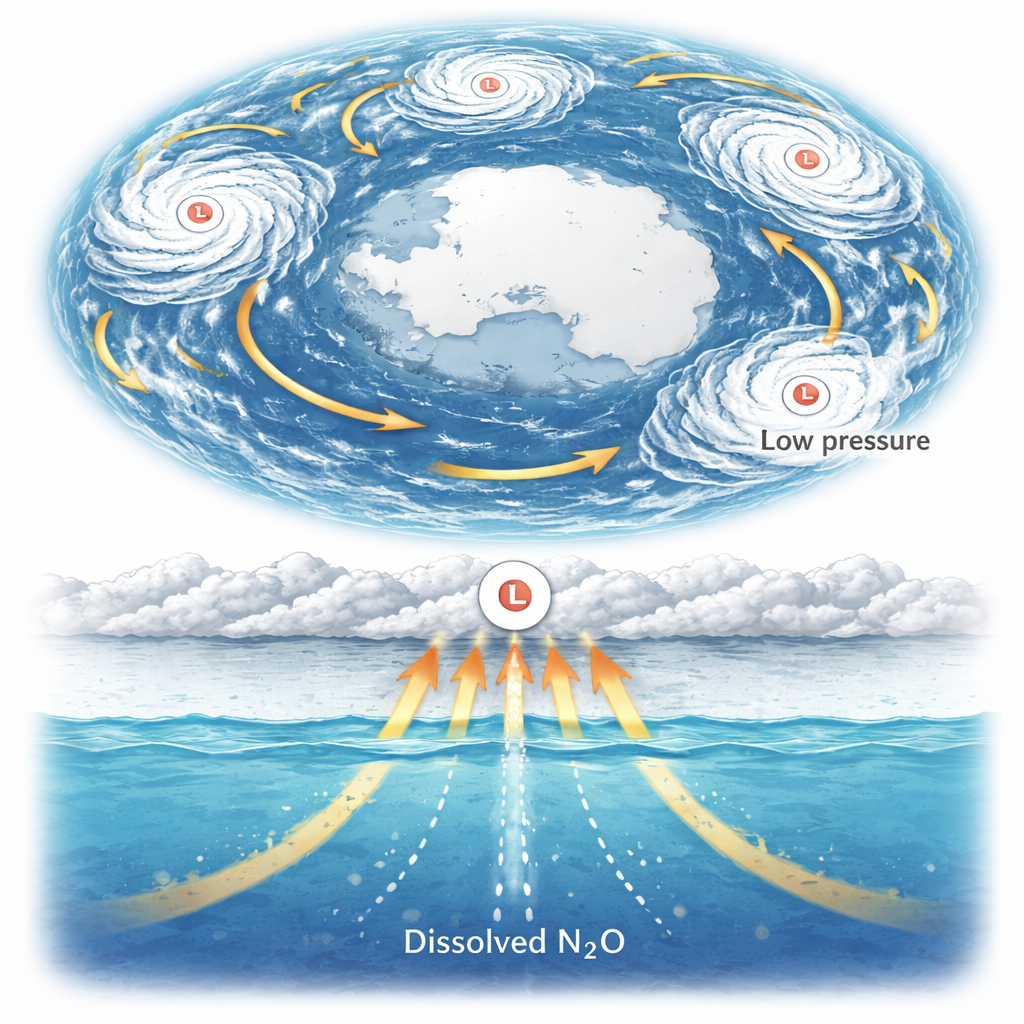
When low pressure sucks gas out of the sea
Armed with these machine-learning estimates and weather reanalysis data, the authors calculated how much N₂O moves between ocean and atmosphere at each float location. They found that the strongest bursts of N₂O release cluster under the centers of low-pressure storms, where winds are fierce and barometric pressure can drop by as much as 8 percent below the standard 1 atmosphere. Lower air pressure reduces the amount of N₂O the air can “hold” at equilibrium, increasing the imbalance between water and air and driving gas out of the sea. The authors dub this the “Hoover Effect”: storms effectively suck N₂O from the ocean into the atmosphere. Only a small fraction of float profiles—about 10 percent—account for half of the annual N₂O emissions, showing that brief, intense storm events dominate the total.
Storms nearly double the Southern Ocean’s N₂O emissions
To test how much low pressure matters, the team recalculated N₂O fluxes as if the air above the Southern Ocean always sat at 1 atmosphere, while keeping winds and ocean conditions the same. Under this simplified assumption, the Southern Ocean releases about 0.9 teragrams of nitrogen as N₂O per year. When they instead used the real, stormy pressure values, the estimated flux jumped to 1.6 teragrams per year—an 88 percent increase. That means roughly half of the N₂O emitted from this region is driven purely by the dips in air pressure within storms, especially when combined with strong winds. Seasonal patterns also emerged: emissions peak during the Southern Hemisphere autumn, when winds strengthen and water mixed from below brings slightly more N₂O to the surface, while sea ice in winter can temporarily cap emissions in the most polar waters. 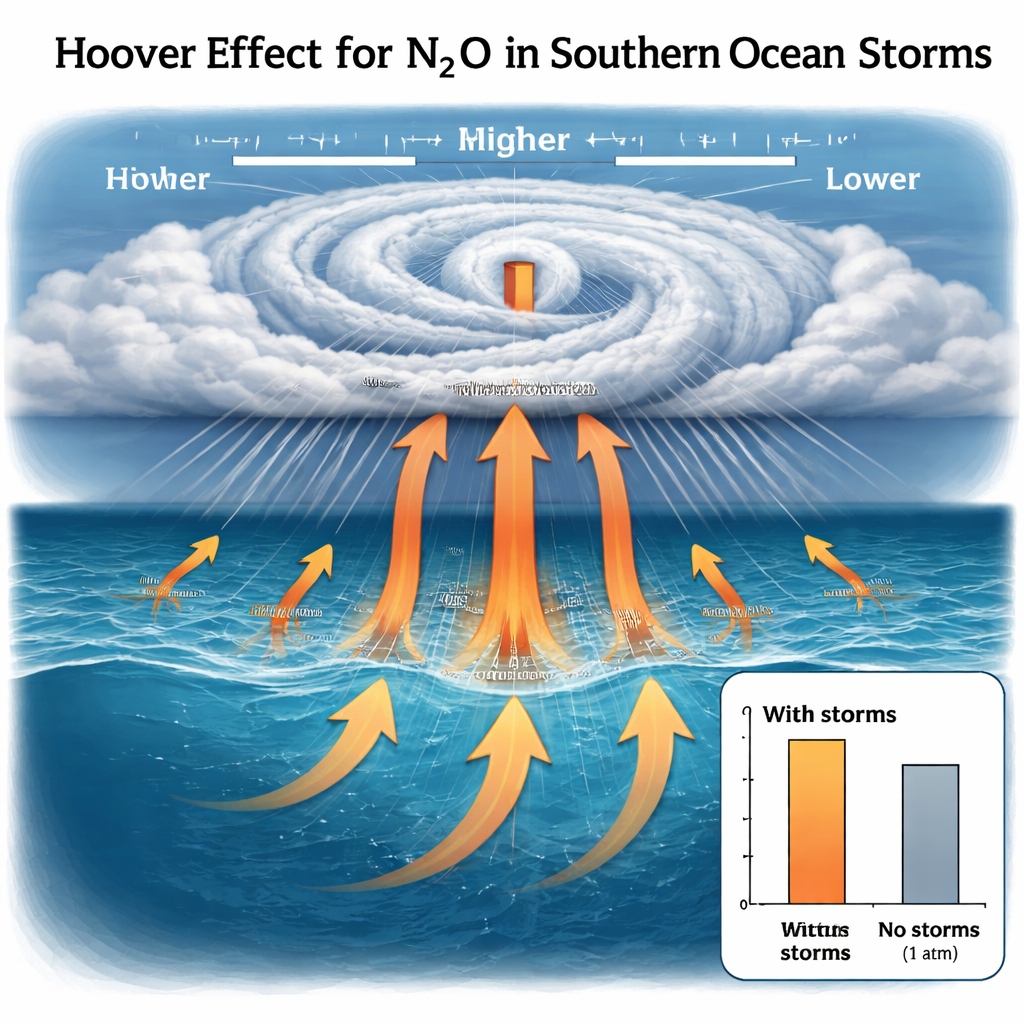
Why this matters for the planet’s future
By revising the Southern Ocean’s N₂O output upward, this work suggests the region is responsible for nearly 40 percent of all marine nitrous oxide emissions—far more than recent estimates implied. Converted into carbon dioxide “equivalents,” these emissions cancel out roughly 7 percent of the Southern Ocean’s annual carbon dioxide uptake. In other words, the ocean’s help in slowing climate change is partially offset by its own N₂O outgassing, especially during storms. Sensitivity tests in the study further indicate that stronger winds, less sea ice, or slightly lower average pressure in a warming climate could all boost future N₂O release. For a general reader, the message is clear: the wild weather over the Southern Ocean is not just a backdrop to climate change—it is an active player, quietly pumping a powerful greenhouse gas into the air and reshaping the balance of the planet’s climate system.
Citation: Kelly, C.L., Chang, B.X., Emmanuelli, A.F. et al. Low-pressure storms drive nitrous oxide emissions in the Southern Ocean. Nat Commun 17, 2037 (2026). https://doi.org/10.1038/s41467-026-68744-2
Keywords: Southern Ocean, nitrous oxide, storms, greenhouse gases, climate change