Turning a Chemical Workhorse Into a Greener Process
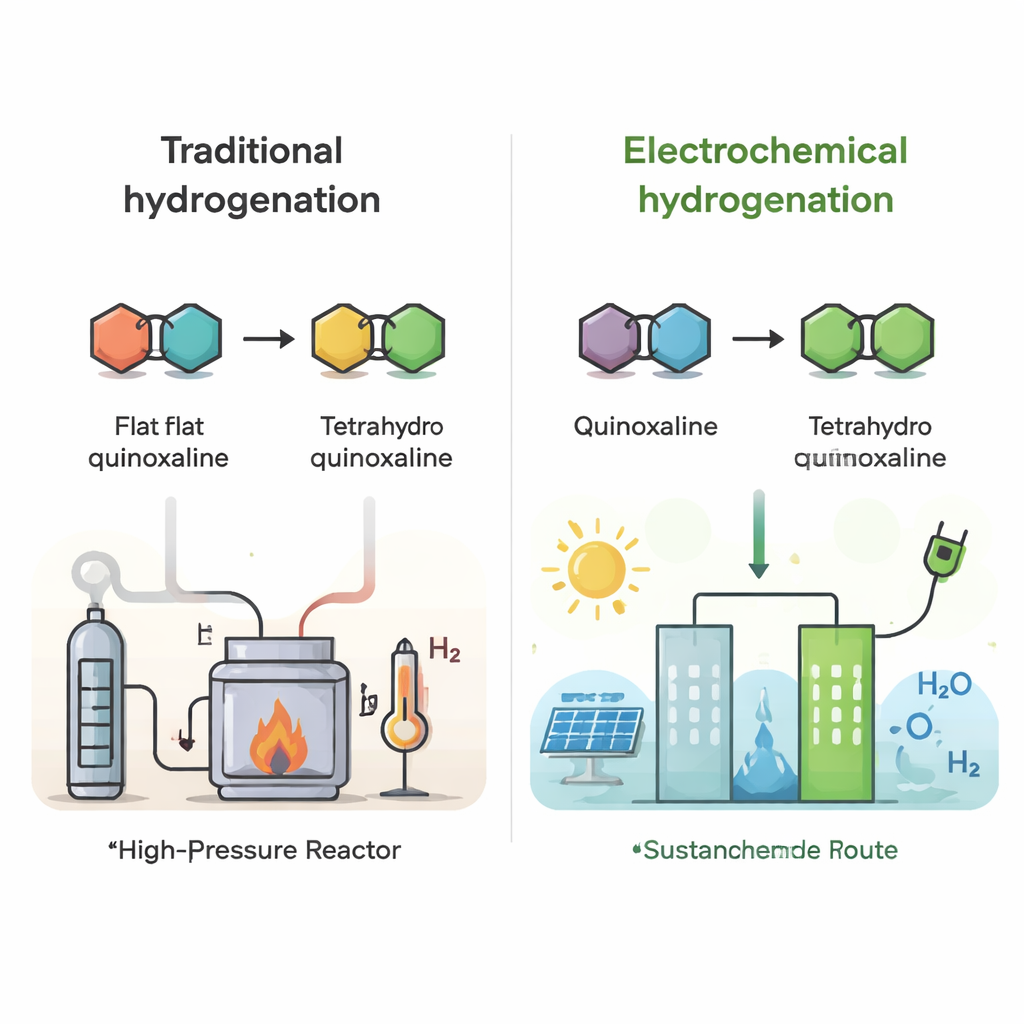
Many medicines and liquid hydrogen carriers rely on a simple ring-shaped molecule called quinoxaline, which must be “hydrogenated” – loaded with hydrogen – to become more useful and safer to store. Today, this step usually needs high temperatures, high pressures, and bottled hydrogen gas, all of which cost energy and money. This paper explores a way to do the same transformation using electricity and water instead, aiming for cleaner hydrogen chemistry that could plug directly into renewable power.
Why Hydrogenating Quinoxaline Matters
Quinoxaline and related nitrogen-containing rings are central building blocks in pharmaceuticals and in liquid organic hydrogen carrier (LOHC) systems, which store hydrogen in a stable liquid form. Converting quinoxaline into its hydrogen-rich partner, 1,2,3,4-tetrahydroquinoxaline, is especially important for hydrogen storage. Conventional industry uses compressed hydrogen gas or organic hydrogen donors at high temperature and pressure, consuming large amounts of energy and creating by‑products. Electrochemical hydrogenation offers an appealing alternative: use electricity from renewable sources and water as a “green” hydrogen feed, operating at room temperature and normal pressure. But in practice, these electrochemical processes have struggled with low reaction rates, poor efficiency, and limited durability, largely because splitting water to supply hydrogen at the electrode surface is slow.
Using Single Atoms to Tame Interfacial Water Figure 1.
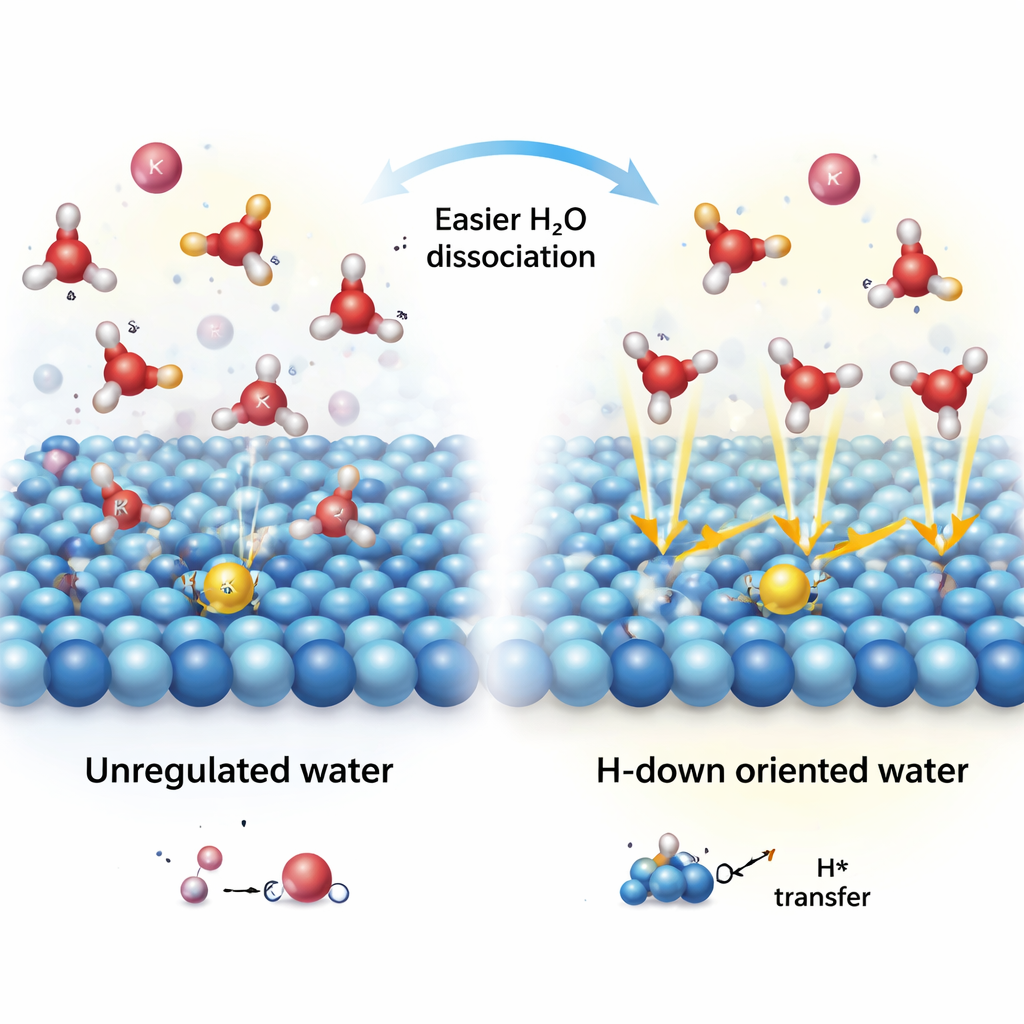
The authors focus on what happens in the thin layer of water right at the catalyst surface, where molecules, ions, and electric fields interact. They design a catalyst made of cobalt oxide (Co3O4) nanosheets sprinkled not with Ru nanoparticles, but with isolated ruthenium atoms embedded directly into the lattice. These “single-atom” Ru sites slightly distort the local crystal structure and redistribute electronic charge, creating tiny, asymmetric electric fields at the surface. Computer simulations show that these fields reorient nearby water molecules into an “H‑down” configuration, tilting their hydrogen atoms closer to the surface without moving the oxygen much. This subtle rotation shortens the distance between hydrogen and the catalytic sites and weakens parts of the hydrogen‑bond network in the interfacial water layer, making it easier to break water’s O–H bonds and release reactive hydrogen at the right place.
Optimizing the Microenvironment for Fast, Selective Reactions
To see whether this controlled water layer really matters, the team compared catalysts with different Ru single‑atom loadings. They used in situ Raman spectroscopy to watch how water’s vibrational signals changed under operating voltages, separating tightly bound water from more weakly bound “K·H2O” species associated with potassium ions. Catalysts with the optimal Ru level showed a higher fraction of this loosely bonded water, which requires less energy to split, and they maintained this population even as the voltage became more negative. Additional tests using heavy water (D2O) revealed smaller kinetic isotope effects on Ru‑doped samples, indicating faster water dissociation. Electron paramagnetic resonance measurements supported the picture of more abundant reactive hydrogen on the Ru‑modified surfaces. Together, these techniques linked a carefully tuned hydrogen‑bond network at the interface to enhanced hydrogen supply and, ultimately, better hydrogenation performance.
Industrial-Level Performance From a Tailored Surface Figure 2.
Electrochemical tests showed how strongly microenvironment tuning pays off. In a standard cell, the best-performing catalyst, containing about 0.7% Ru single atoms, converted quinoxaline to 1,2,3,4-tetrahydroquinoxaline with nearly 100% selectivity and a Faradaic efficiency of 82% at a high current density of 200 mA per square centimeter, far beyond most earlier reports. The same material worked well for other nitrogen-containing rings, hinting at broad applicability. When scaled into a membrane electrode assembly – the type of architecture used in fuel-cell hardware – the system ran steadily for more than 100 hours at 200 mA per square centimeter, producing grams of product with minimal performance loss. A simple economic analysis suggested that, under reasonable assumptions, this electrochemical route could be profitable when compared on a per-ton basis.
How Water Control Enables Greener Hydrogen Chemistry
For non-specialists, the core message is that the “invisible” organization of water molecules at a solid surface can make or break an electrochemical reaction. By implanting single ruthenium atoms into cobalt oxide, the researchers create tiny electric fields that nudge interfacial water into a favorable orientation, loosen parts of its hydrogen‑bond network, and deliver hydrogen to catalytic sites with just the right balance of speed and selectivity. This lets the reaction run quickly, cleanly, and stably at conditions relevant to industry, using only electricity and water instead of hot reactors and pressurized hydrogen. Beyond quinoxaline, the strategy offers a blueprint for designing catalysts that engineer their surrounding water microenvironment to drive a wide range of sustainable electrochemical transformations.
Citation: Meng, L., Dai, Ty., Li, J. et al. Interfacial water regulation on Ru single atoms doped Co3O4 toward efficient electrochemical hydrogenation of quinoxaline.
Nat Commun17, 1895 (2026). https://doi.org/10.1038/s41467-026-68740-6