Clear Sky Science · en
MiRNAs shape mouse age-independent tissue adaptation to spaceflight via ECM and developmental pathways
Why space travel changes our bodies
As journeys to the Moon and Mars move from science fiction to serious planning, one big question remains: how does long-term spaceflight reshape the body at the molecular level? Astronauts lose bone and muscle, their hearts and immune systems change, and some of these problems resemble age-related diseases on Earth. This study uses mice living for several weeks on the International Space Station to uncover how tiny gene regulators called microRNAs help organs across the body adapt—or possibly malfunction—during life in orbit.
A whole-body look at mice in orbit
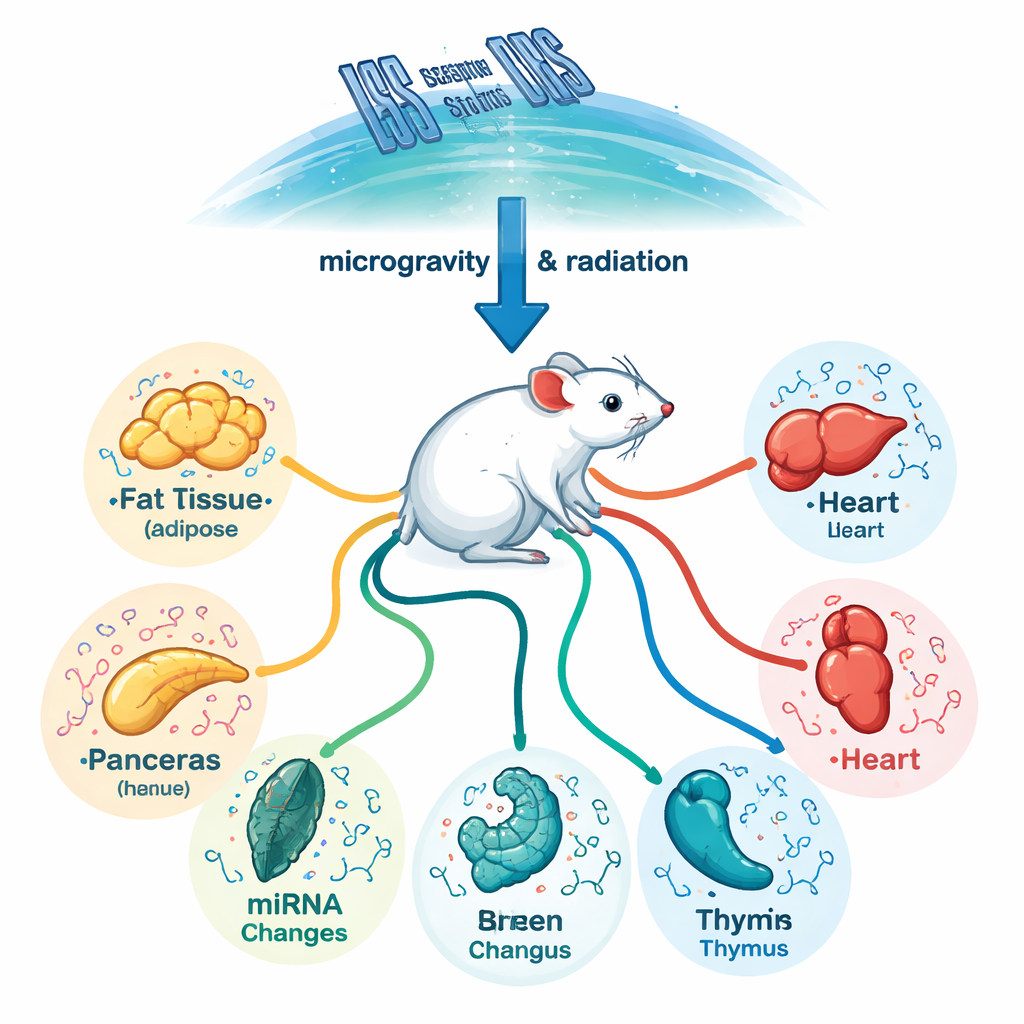
To move beyond single-organ studies, researchers examined 686 samples from 13 different organs in female mice flown on the space station for three to six weeks. They compared these animals to two groups of Earth-bound controls: one kept under normal lab conditions and another housed in special cages that mimicked the station’s cramped quarters, temperature, humidity, and elevated carbon dioxide. This careful design allowed the team to tease apart which changes came from space itself—microgravity and radiation—and which came from the unusual housing and handling the mice experienced. They focused on microRNAs, short stretches of RNA that do not make protein but instead tune the activity of many genes at once.
MicroRNAs as master switches in key organs
Each organ had its own distinct microRNA “dial setting,” but spaceflight shifted these dials in specific patterns. Fat depots under the skin and around the organs, along with liver, pancreas, spleen, and thymus, showed the strongest space-driven changes, while brain, kidney, and some fat stores were more sensitive to housing conditions on Earth. The team found 73 microRNAs whose levels changed consistently in space-exposed animals, often in an organ-specific way. Families of related microRNAs—especially MIR-17/92 and MIR-1/133—stood out as major players. These families have been linked on Earth to heart function, cancer, and metabolism, suggesting that a relatively small set of regulatory molecules may coordinate many of the body’s responses to life off the planet.
Remodeling tissues and repairing damage
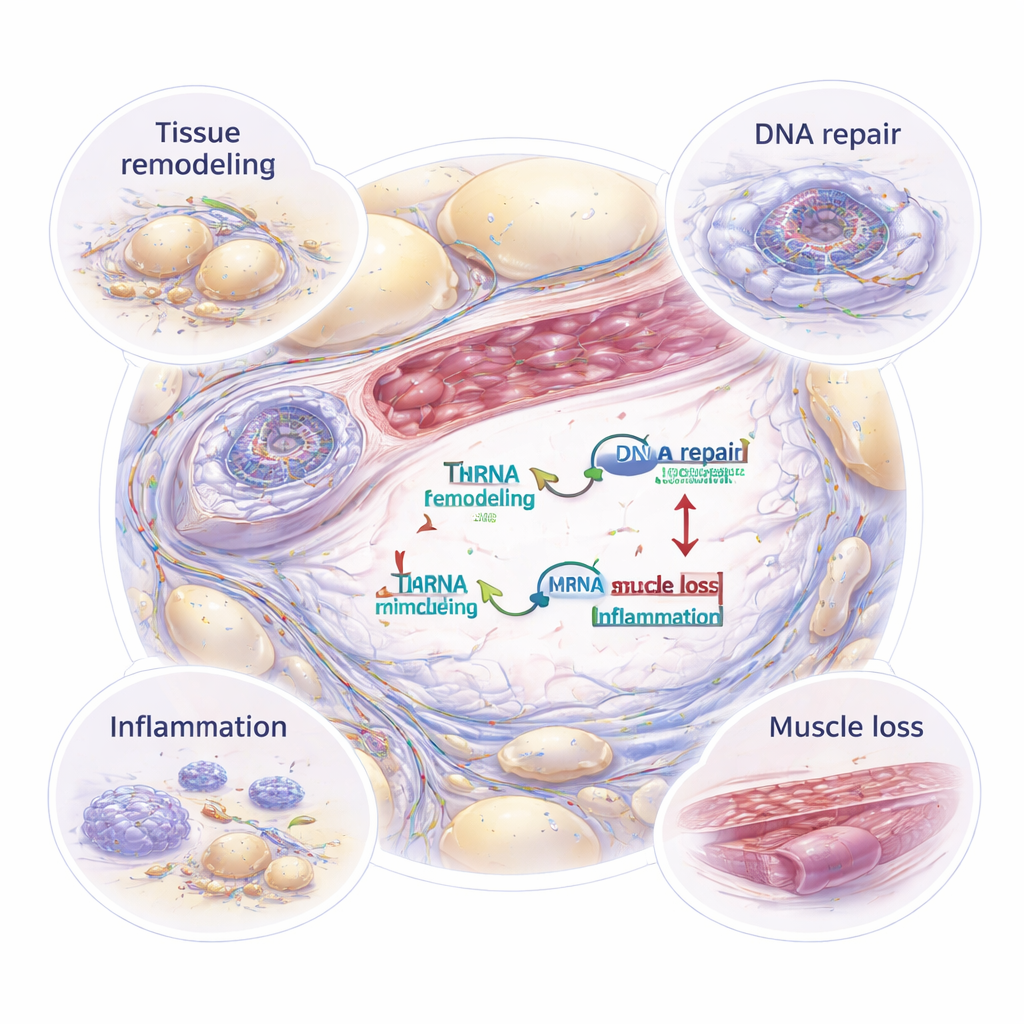
Because microRNAs work by adjusting the levels of messenger RNAs—the direct blueprints for proteins—the researchers combined their microRNA data with single-cell gene activity maps from the same animals. This revealed thousands of gene changes that matched altered microRNAs, especially in fat tissue, liver, lung, heart, and spleen. The affected genes clustered in pathways that reshape tissue architecture and handle stress: building and breaking down the extracellular matrix that holds cells together, guiding cell growth and movement, tuning nerve and synapse structure, and responding to DNA damage from radiation. In fat tissue, for example, microRNAs influenced genes involved in blood vessel growth and the physical scaffolding of cells, pointing to large-scale remodeling of metabolic organs. In the thymus and other immune organs, microRNAs targeted transcription factors that control DNA repair and immune cell maturation, hinting at complex consequences for infection defense and possibly cancer risk.
Space stress versus simple aging
Many astronauts’ symptoms echo the frailty of aging, so the team asked whether spaceflight simply speeds up the normal aging clock. They compared young adult mice (about three months old) with middle-aged ones (about eight months old) and then cross-referenced their findings with a large atlas of age-related microRNA changes in mice on Earth. Age did matter, but less than spaceflight itself: in most tissues, space caused similar shifts in both age groups. Only a few organs, notably pancreas, diaphragm (the main breathing muscle), and a specific abdominal fat depot, showed clear age-dependent responses. In these tissues, three microRNA families—MIR-8, MIR-15, and MIR-154—were especially active and targeted genes that control cell growth, muscle maintenance, and cancer-related processes. Surprisingly, the overall pattern did not match a simple acceleration of normal aging; some microRNAs followed aging-like trends, while others took distinct, space-specific paths.
What this means for future explorers
To a non-specialist, the core message is that weeks in orbit push many organs into a coordinated remodeling program, steered by a small group of microRNAs that adjust hundreds of genes at once. These changes help tissues respond to microgravity and radiation but may also nudge them toward disease-like states seen in diabetes, heart problems, and cancer. Importantly, the study finds more evidence for a distinctive “space state” than for simple rapid aging, and older mice still mounted robust responses. If similar patterns hold in humans, this suggests that targeted drugs or gene therapies aimed at a few key microRNA families could one day protect astronauts’ organs—and that even middle-aged explorers might safely join long missions—provided we learn how to guide these molecular switches in the right direction.
Citation: Grandke, F., Rishik, S., Wagner, V. et al. MiRNAs shape mouse age-independent tissue adaptation to spaceflight via ECM and developmental pathways. Nat Commun 17, 1387 (2026). https://doi.org/10.1038/s41467-026-68737-1
Keywords: spaceflight biology, microRNA, tissue remodeling, extracellular matrix, aging and space