Clear Sky Science · en
Biomarker-integrated prognostic stagings for Alzheimer’s Disease
Why this research matters to families
Alzheimer’s disease does not strike everyone in the same way or at the same speed. Some people live for years with only mild forgetfulness, while others decline quickly. This study asks a question that matters deeply to patients, families, and doctors: can we use simple blood tests and brain scans, together with basic clinical information, to place a person on a clear risk ladder that shows how fast their memory and daily function are likely to change over the coming years?
Following people across the memory spectrum
The researchers followed more than 1,200 adults in South Korea who spanned the full range of the Alzheimer’s pathway: those with normal thinking, those with mild memory problems, and those already living with dementia. Everyone underwent detailed memory testing, brain imaging, and a panel of blood tests that detect proteins linked to brain cell injury and Alzheimer’s pathology. The team then tracked how quickly each person’s day-to-day abilities changed over time using a standard clinical rating scale, and defined three milestones along the way: very mild, mild, and moderate dementia. By watching who reached which milestone, and when, they were able to see which combinations of markers best foretold future decline.
Different warning lights at different stages
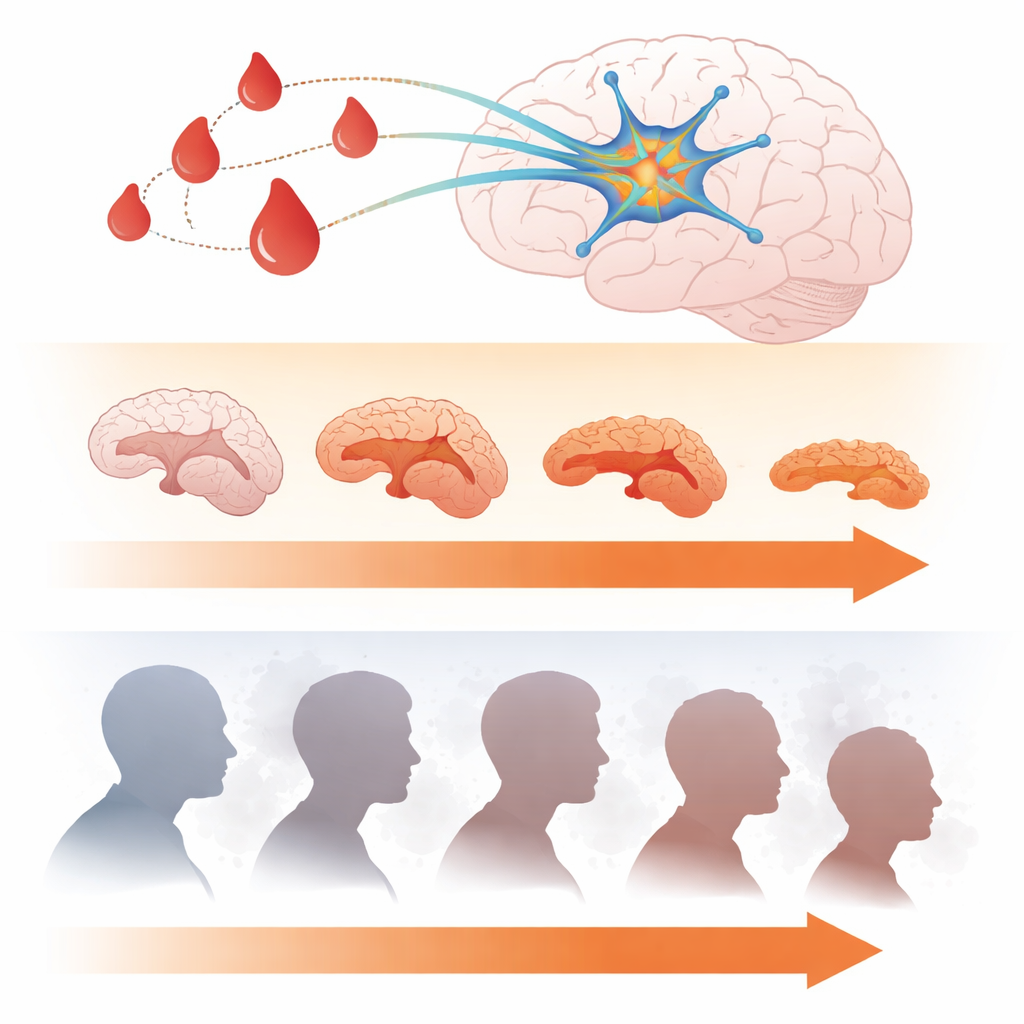
A key finding is that the strongest “warning light” is not the same for everyone; it depends on where a person currently sits on the cognitive spectrum. Among people who still tested as cognitively unimpaired, a blood marker called GFAP—released when support cells in the brain become reactive—was the most powerful predictor of who would later show early dementia symptoms. In those with mild cognitive impairment, the size of a deep memory structure in the brain, the hippocampus, was the main factor: more shrinkage meant a higher chance of progressing. For people already diagnosed with dementia, age itself mattered most, with younger patients tending to worsen more quickly, likely reflecting a more aggressive form of disease. Across all stages, another blood marker, phosphorylated tau‑217, added an extra layer of prognostic information, acting as a consistent “second opinion” on risk.
Building a six-step risk ladder
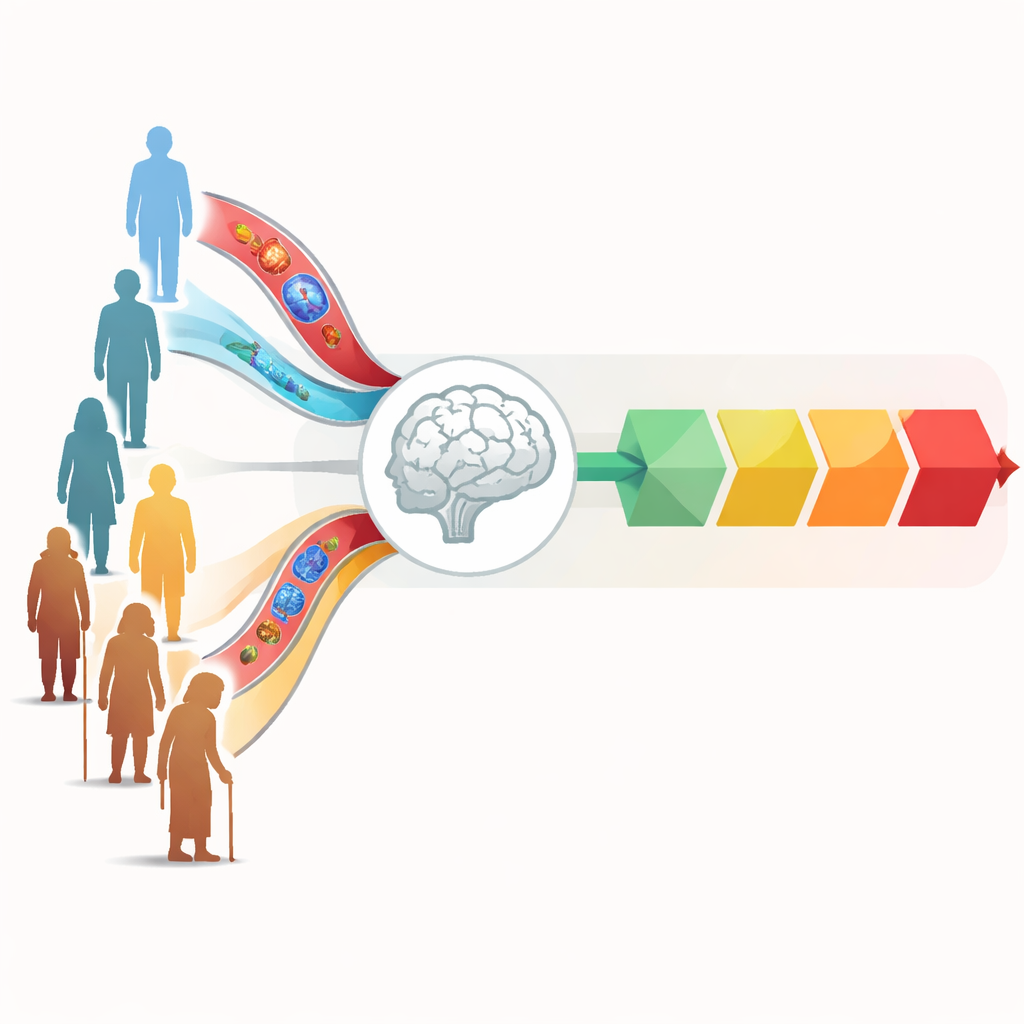
To turn these patterns into something clinicians can actually use, the team first grouped participants within each cognitive category into risk subgroups that shared similar chances of reaching the next dementia milestone. They then merged these data-driven groupings into a single, six-step staging system that runs from Stage 0 (lowest risk of near-term decline) through Stage IVB (highest risk and most advanced impairment). Lower stages were defined mostly by who progressed to very mild or mild dementia, while the highest stages were anchored by who went on to develop moderate dementia. When the researchers drew survival curves—charts showing how long people stayed below each dementia threshold—these stages separated cleanly, with sharp jumps in risk at several key transition points. People in higher stages also had steadily worse scores on standard memory tests, reinforcing that the ladder truly reflects clinical severity.
Putting the system to the test elsewhere
Any staging tool must work beyond the group it was designed in. The authors therefore applied their system to a separate, well-known research cohort from the Alzheimer’s Disease Neuroimaging Initiative in North America. Using the same types of blood markers, brain measurements, and clinical data, they assigned nearly 300 participants to stages and again tracked their outcomes. Even though fewer people in this dataset had advanced dementia, the same overall pattern emerged: higher stages were linked to faster progression to mild dementia and steeper declines in thinking and daily function. This external check suggests that the staging framework captures general features of disease behavior rather than quirks of a single study sample.
What this means for care and research
The authors emphasize that their framework is about prognosis, not diagnosis or treatment choice. It does not replace biological definitions of Alzheimer’s disease based on detailed brain scans or spinal fluid tests, and it is not a gatekeeper for new antibody drugs that require proof of amyloid in the brain. Instead, it offers a practical way to blend cognitive status, age, basic risk factors, blood biomarkers, and routine imaging into a single, easy-to-understand stage. For families, this kind of tool could eventually help clarify expectations about how quickly a loved one might change. For researchers and trial designers, it provides a common language to compare participants and track how interventions affect the pace of decline. As larger, more diverse datasets and newer biomarkers become available, this six-stage ladder may serve as a starting framework for ever more precise prediction of an individual’s journey along the Alzheimer’s continuum.
Citation: Shin, D., Lee, S., Kim, J.P. et al. Biomarker-integrated prognostic stagings for Alzheimer’s Disease. Nat Commun 17, 2235 (2026). https://doi.org/10.1038/s41467-026-68732-6
Keywords: Alzheimer’s disease, biomarkers, dementia progression, risk staging, prognosis