Clear Sky Science · en
Suppressing electron-phonon coupling and energy loss in organic solar cells by modulating donor-acceptor penetrated-interface
Making Solar Panels Waste Less Energy
Solar panels made from flexible organic materials are getting impressively efficient, but they still waste too much of the Sun’s energy as invisible heat. This paper explores a hidden culprit inside these devices—the tiny contact zones where two materials meet—and shows how reshaping those nanoscale interfaces can cut energy losses and push organic solar cells closer to their full potential.
The Hidden Borders Inside Organic Solar Cells
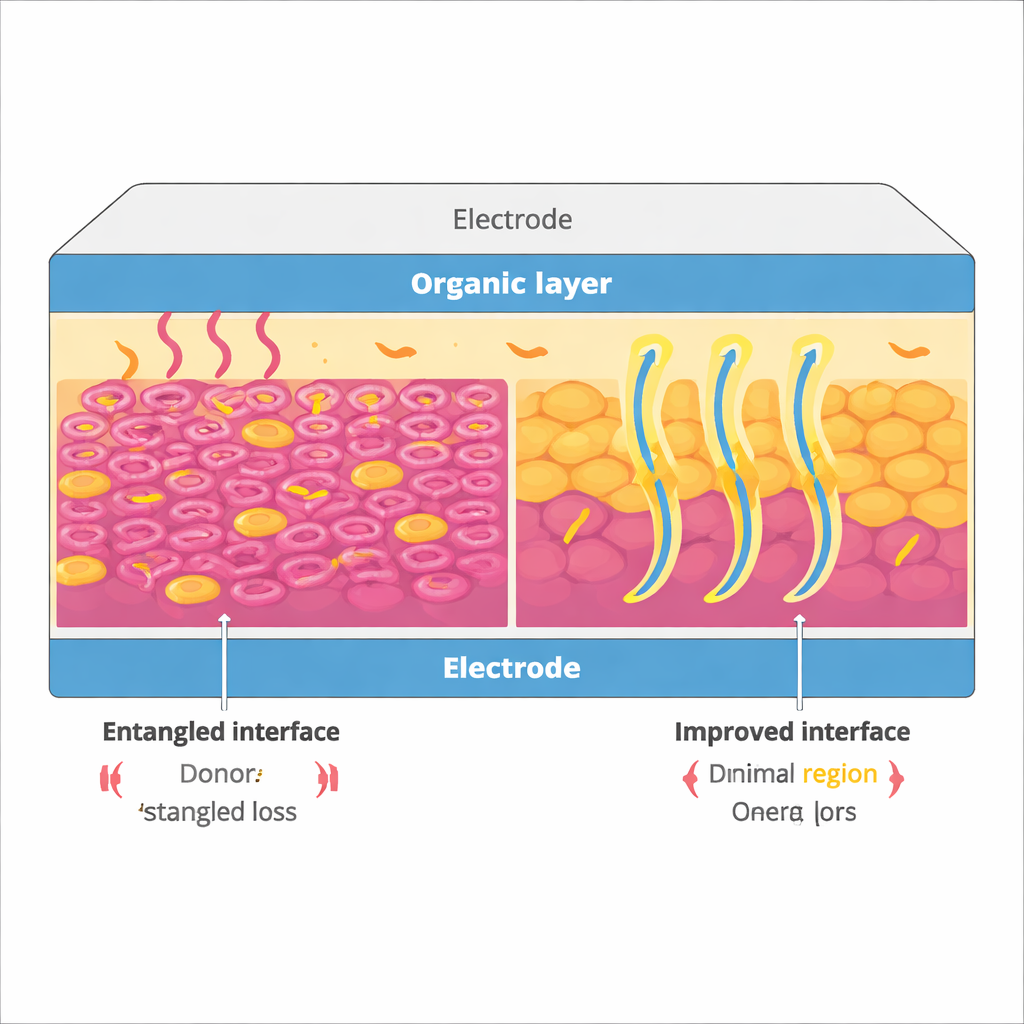
Organic solar cells rely on a blend of two ingredients: a donor material that gives up electrons and an acceptor that takes them. Where these two touch, a special “border region” forms, and it is here that sunlight is first turned into separated electrical charges. The authors examined seven high-performance organic solar cell systems and discovered that these border regions are not all the same. They identified two main types: an “entangled interface,” where donor and acceptor chains are thoroughly mixed in a soft, disordered tangle, and a “penetrated interface,” where acceptor-rich clusters extend into a donor-rich surrounding, creating a more structured contact area. These subtle structural differences turn out to strongly influence how much energy is lost as heat.
Two Kinds of Interfaces, Two Ways to Lose Energy
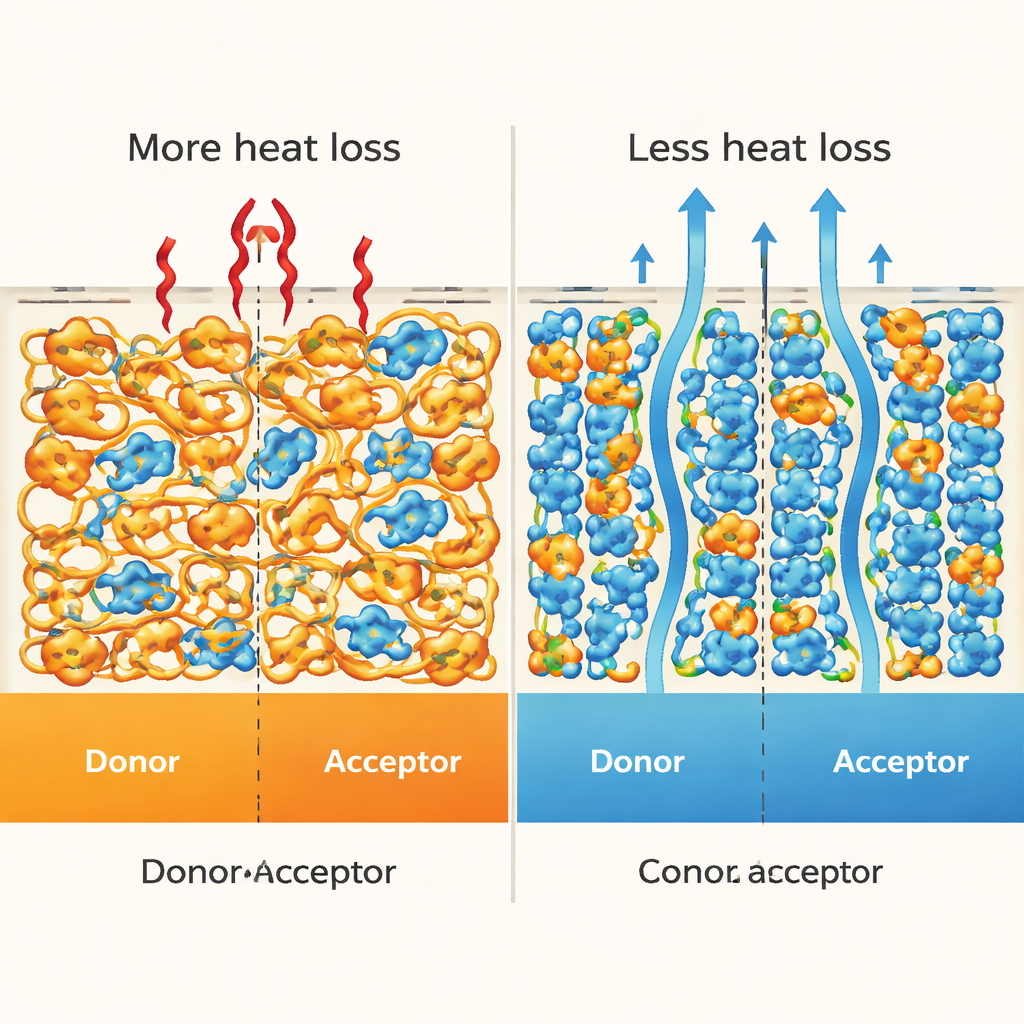
In the entangled interface, the molecules wiggle and vibrate more freely. When an absorbed photon creates an excited state, these vibrations can couple to the electrons, providing many ways for the energy to dissipate as heat instead of being converted into useful voltage. This process—electron–phonon coupling—is like trying to pass a ball along a line of people who are all fidgeting; much of the motion ends up as random jostling rather than forward progress. In contrast, the penetrated interface, built from short-range acceptor aggregates with donor chains threading through them, restricts some of that motion. The molecules are slightly more ordered and better packed, which reduces how strongly electronic excitations “feel” the lattice vibrations, and therefore how much energy is thrown away non-radiatively.
Seeing Structure and Motion at the Nanoscale
To probe these effects, the researchers combined advanced X-ray scattering with computer simulations and ultrafast laser spectroscopy. The X-ray measurements revealed how domains and interfaces grow as the donor–acceptor mixing ratio is changed, showing that systems based on polymer acceptors naturally form larger, more developed penetrated interfaces than systems based on small-molecule acceptors. Simulations of molecular motion and electronic structure confirmed that penetrated interfaces have lower “reorganization energy” and a smaller Huang–Rhys factor—technical measures of how strongly electronic states are tied to molecular vibrations. Time-resolved optical experiments tracked how quickly excited states split into free charges, finding that in materials rich in penetrated interfaces, charges separate faster and fewer states fall back to the ground state by emitting heat.
Cutting Voltage Loss by Tuning the Interface
Because open-circuit voltage is limited by how much energy escapes non-radiatively, the team translated their microscopic findings into device-level performance. By comparing similar solar cells that differ mainly in how their interfaces form, they showed that cells dominated by penetrated interfaces suffer about 60 millielectronvolts less non-radiative voltage loss than those dominated by entangled interfaces—a meaningful gain for state-of-the-art devices. They further demonstrated a practical route to engineer more of the favorable penetrated interface: adding a polymer acceptor into a small-molecule–based system to reshape the blend. This ternary “three-component” device reached high efficiency and a higher operating voltage without resorting to processing additives or complex fabrication tricks.
Why This Matters for Future Solar Technology
For a non-specialist, the key message is that better solar cells do not only depend on discovering new molecules, but also on arranging existing ones more cleverly. By deliberately favoring penetrated interfaces that naturally damp harmful vibrations while still allowing charges to move freely, manufacturers could design organic solar cells that waste less energy and generate higher voltages. This work provides a clear physical picture and a set of design guidelines: promote structured, penetrated contact regions between donor and acceptor polymers to weaken the link between electrons and heat-producing vibrations. In the long run, such nanoscale interface engineering could help make flexible, lightweight solar technologies more efficient and more competitive with traditional silicon panels.
Citation: Luo, Y., Hai, Y., Li, Y. et al. Suppressing electron-phonon coupling and energy loss in organic solar cells by modulating donor-acceptor penetrated-interface. Nat Commun 17, 2026 (2026). https://doi.org/10.1038/s41467-026-68731-7
Keywords: organic solar cells, interface engineering, energy loss, electron phonon coupling, polymer photovoltaics