Clear Sky Science · en
Defect-interface coupling for stable lattice-oxygen-driven oxygen evolution at industrial current densities
Turning Water into Fuel
Hydrogen fuel promises clean power with only water as the exhaust, but making that hydrogen efficiently and cheaply is still a major hurdle. This study tackles one of the toughest parts of splitting water into hydrogen and oxygen: building an oxygen-making electrode that is both powerful and long‑lived under true industrial conditions. By designing a new kind of layered material that controls how oxygen atoms move inside a crystal, the researchers show a way to produce hydrogen at high rates while keeping the catalyst stable for thousands of hours.
A Faster Path for Making Oxygen
In water‑splitting devices, the step that releases oxygen from water usually slows everything down and wastes energy. Most existing catalysts work by holding short‑lived chemical fragments on their surface, passing electrons step by step before oxygen gas is formed. This route is limited by a stubborn relationship between those fragments, which means a certain amount of extra voltage is always needed. An alternative route lets oxygen atoms from deep inside the solid itself help form oxygen gas, breaking that limitation and potentially lowering energy use. However, whenever these internal oxygen atoms are pulled out and pushed back in, the solid can gradually fall apart.
Building a Two‑Part Oxygen Maker
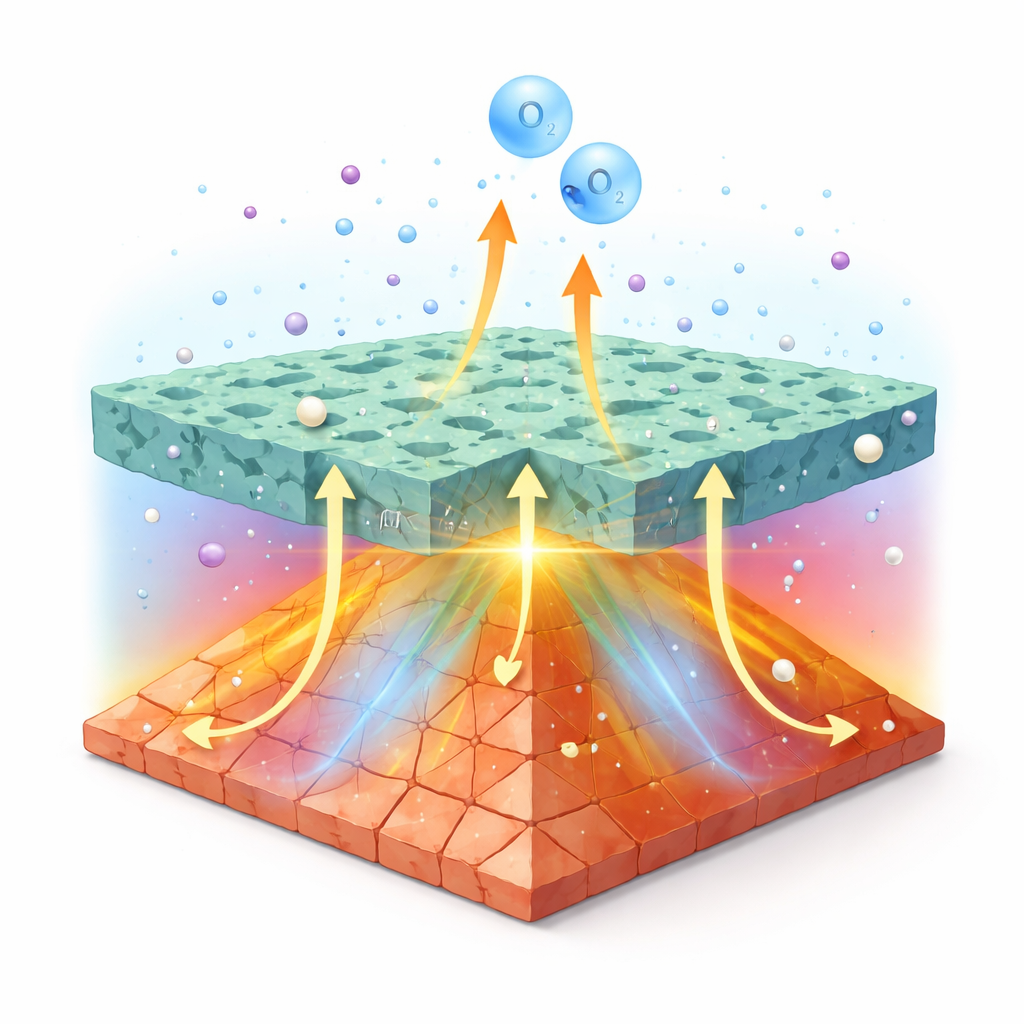
The team created a new catalyst by growing extremely thin, disordered sheets of a nickel–iron compound directly on top of tiny pyramids of an iron–molybdenum oxide. Together, these two components form a tightly coupled structure on a porous nickel support. The thin sheets contain many missing oxygen sites and sit on a well‑ordered pyramid base. Using electron microscopes, X‑ray techniques, and spectroscopy, the researchers show that nickel, iron, and molybdenum are arranged so that electrons naturally flow from the sheets into the pyramid, creating a built‑in internal electric field. At the same time, the high level of oxygen vacancies reshapes the way electrons are shared between metals and oxygen, priming the material to let internal oxygen atoms join in the reaction.
Pushing Industrial‑Scale Performance
When tested in alkaline solution, this layered catalyst drives the oxygen‑forming reaction at very high current densities, comparable to those required in industry, while needing less extra voltage than common nickel–iron hydroxides or even commercial iridium oxide. The textured nanosheet coating and pyramid shapes help liquid and gas move freely, so bubbles do not cling to the surface and block the reaction. Measurements of surface area, reaction rates per active site, and charge‑transfer resistance all point to a catalyst that not only has many active regions but also allows electrons and ions to move quickly during operation. Long‑term tests at two amperes per square centimeter show that the operating voltage drifts only slightly over 3,000 hours, whereas a simpler nickel–iron catalyst degrades much more rapidly.
Seeing Oxygen Move from Inside Out
To uncover how the material works, the researchers monitored reaction by‑products and vibrational fingerprints while the catalyst was operating. Using water enriched in a heavier form of oxygen, they showed that oxygen atoms stored inside the solid are indeed released as part of the oxygen gas—direct proof that lattice oxygen is involved. Infrared and Raman measurements reveal the build‑up of key oxygen‑containing intermediates and show that the new material relies more heavily on the internal‑oxygen route than the conventional surface‑only route. Computer simulations back this picture: they show that the combination of abundant oxygen vacancies and the internal electric field reshapes the electronic bands in a way that weakens metal–oxygen bonds just enough to let lattice oxygen take part in the reaction while keeping the structure repairable.
Staying Strong Under Harsh Conditions
Durability often fails where activity succeeds, especially because iron can dissolve from these catalysts in strong alkaline solutions, taking valuable oxygen atoms with it. Here, the pyramid support provides mechanical strength, the nanosheets bind water‑derived fragments that quickly refill missing oxygen, and the internal electric field steers electrons along fast pathways that prevent the iron from becoming over‑oxidized and washing away as highly reactive species. Chemical analysis of the electrolyte confirms that the new catalyst loses far less iron than standard nickel–iron hydroxides even in extra‑concentrated alkali and at higher current.
From Lab Device to Sun‑Driven Hydrogen
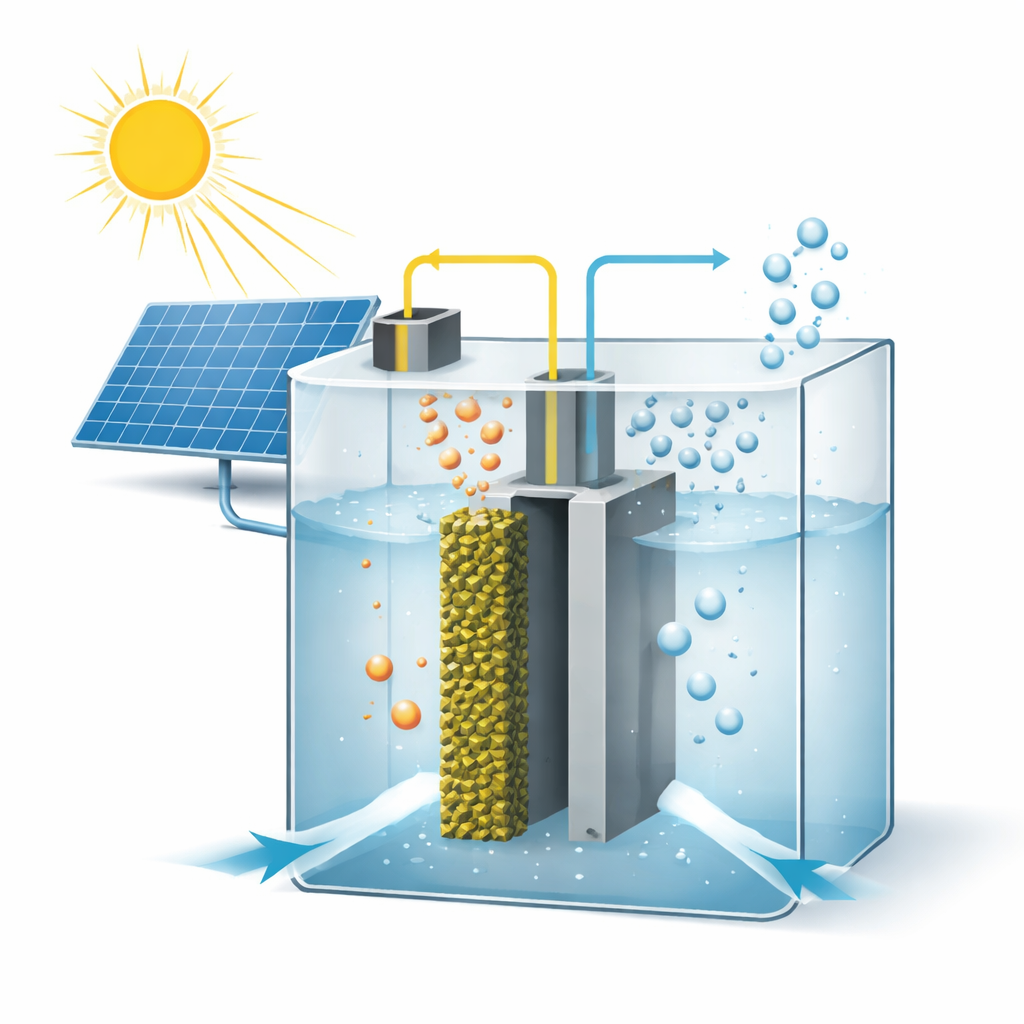
To show real‑world promise, the authors paired their oxygen‑making electrode with a matching hydrogen‑producing electrode in a full anion‑exchange water‑electrolysis cell. This device reaches industrial‑level currents at lower voltage than a cell built with precious‑metal catalysts and remains stable for extended operation. Finally, they wired the electrolyzer to an efficient perovskite–silicon tandem solar cell. Under simulated sunlight, this integrated setup converts more than 20% of incoming solar energy into the chemical energy of hydrogen, maintaining most of its performance for well over one hundred hours.
What This Means for Clean Hydrogen
The study demonstrates that carefully combining crystal defects with a smartly chosen interface can unlock fast, lattice‑oxygen‑driven oxygen evolution without sacrificing stability. In clear terms, it shows that we can design solid materials where oxygen atoms from deep inside help speed up water splitting, yet the structure heals itself and resists long‑term damage. This approach could guide the next generation of robust, low‑cost electrodes needed to make green hydrogen at scale, especially when powered directly by sunlight.
Citation: Liu, S., Sun, M., Dai, L. et al. Defect-interface coupling for stable lattice-oxygen-driven oxygen evolution at industrial current densities. Nat Commun 17, 2135 (2026). https://doi.org/10.1038/s41467-026-68730-8
Keywords: water electrolysis, hydrogen production, oxygen evolution catalyst, renewable energy, solar-to-hydrogen