Clear Sky Science · en
Vertical chiral emission from an intrinsically achiral metasurface enabled with anisotropic continuum
Why twisting light matters
Light is more than just brightness and color—it also has a “twist” that can be right-handed or left-handed, known as circular polarization. Controlling this twist is vital for technologies ranging from 3D displays and secure communications to advanced chemical analysis and next‑generation sensors. This article reports a surprising way to generate strongly twisted light using a flat, carefully patterned surface that is itself not twisted at all, overturning a long‑held assumption in nanophotonics.
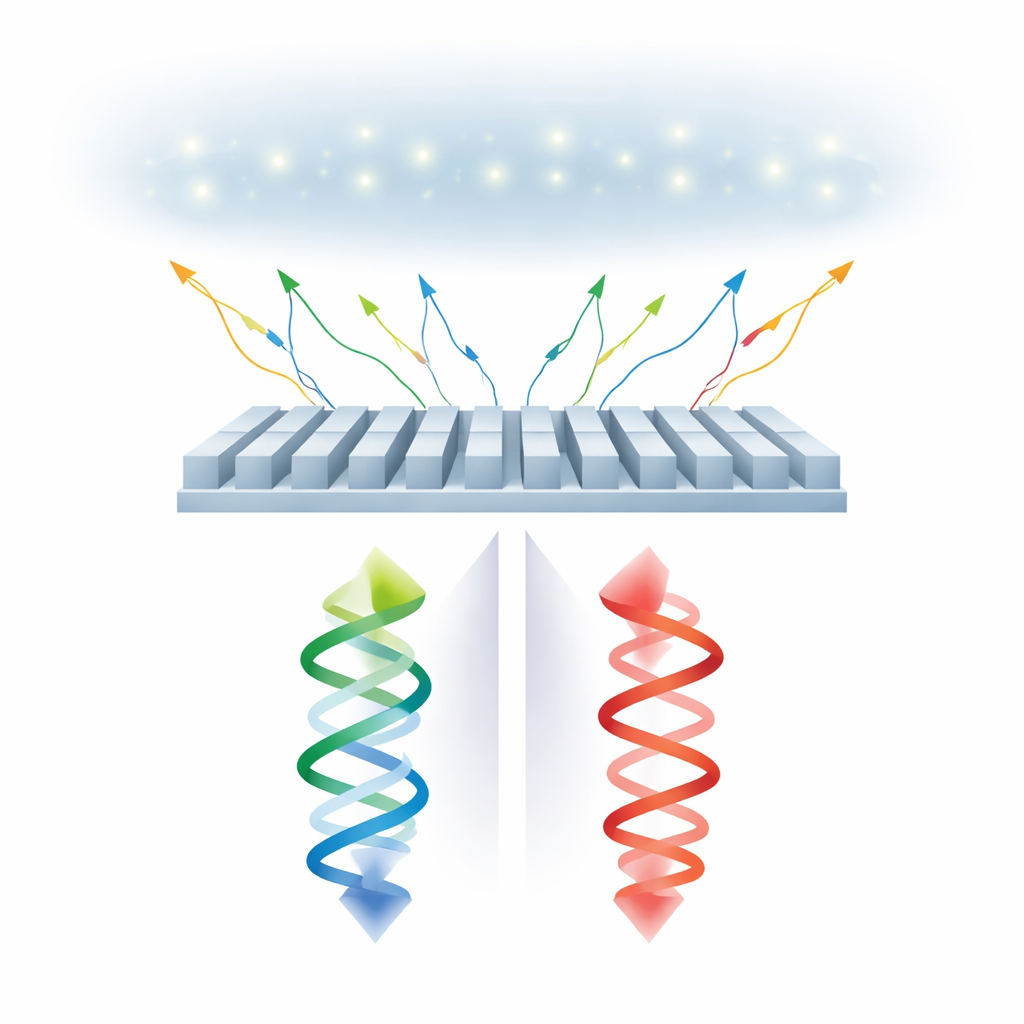
Turning flat patterns into sources of twisted light
Traditionally, to make light come out with a preferred twist, engineers build tiny three‑dimensional structures that themselves lack mirror symmetry—objects that look different from their own mirror image. These so‑called chiral structures interact differently with right‑handed and left‑handed circularly polarized light, but they are hard to fabricate and tune. The authors ask a bold question: can a completely mirror‑symmetric, intrinsically non‑chiral flat surface still emit highly twisted light straight up and down? Their answer, demonstrated both in theory and experiment, is yes.
A new playing field called the anisotropic continuum
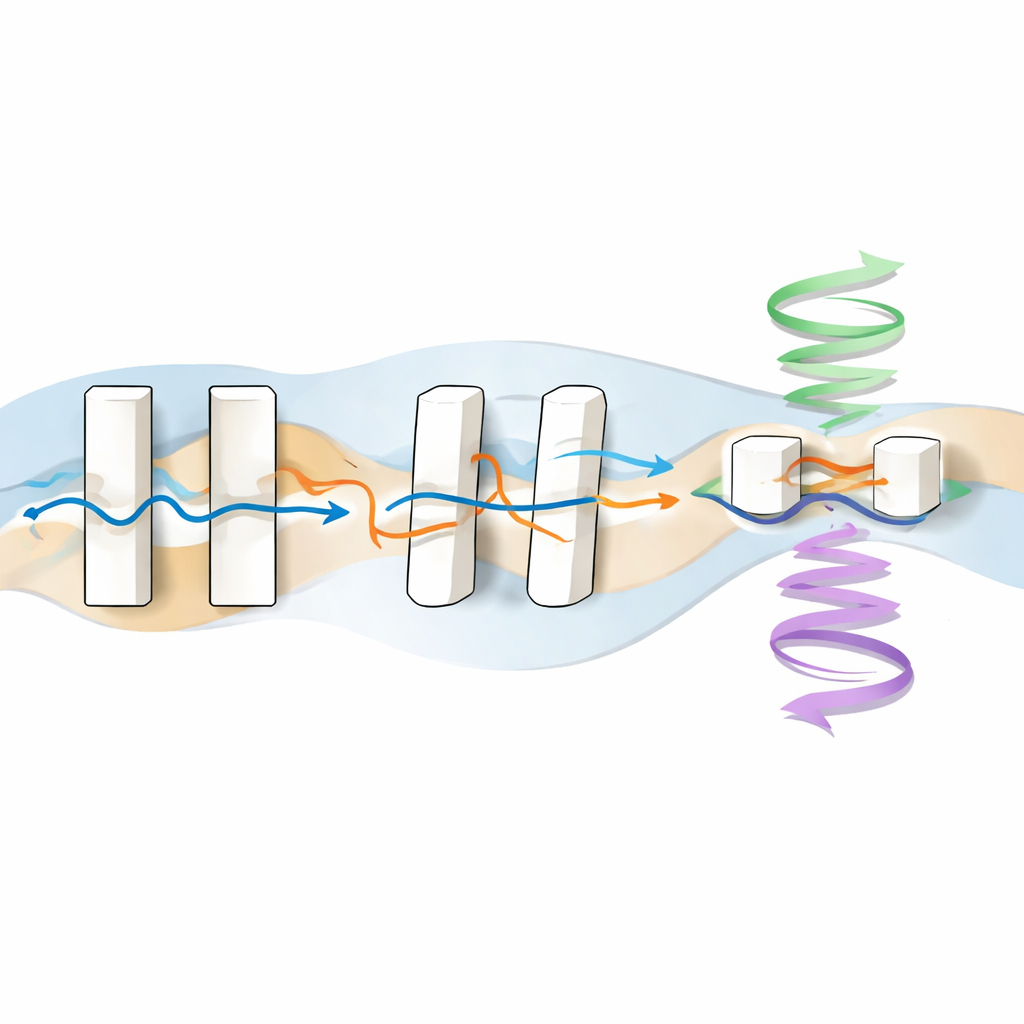
The key idea is to treat the background light environment not as a passive backdrop, but as an active ingredient. The team introduces the concept of an anisotropic continuum: a broad band of allowed light states that responds differently to light vibrating along two perpendicular directions. When a special, long‑lived mode of the metasurface—essentially trapped light—sits inside this anisotropic background, the two polarization components of the emitted light can acquire a fixed phase delay between them. By adjusting the geometry so that this delay is one‑quarter of a cycle, and by balancing the strengths of the two components, the combined light becomes perfectly circularly polarized.
How a symmetric surface learns to twist
To realize this in practice, the researchers design a surface made of pairs of tiny silicon bars (dimers) etched vertically into a glass‑like environment that is the same above and below. This preserves mirror symmetry across the horizontal plane, so by ordinary reasoning the structure should not prefer left‑handed over right‑handed emission. They first tune the overall size of the bars so that the trapped mode experiences the right phase relationship set by the anisotropic continuum. Then they introduce gentle in‑plane distortions—slight shifts and asymmetries within each pair—to let the trapped mode leak out into both polarization directions. These in‑plane tweaks do not break the up‑down mirror symmetry, but they are enough, together with the anisotropic continuum, to convert the trapped mode into a bright source of circularly polarized light.
Seeing opposite twists above and below
To test the concept, the team covers the silicon surface with a thin layer of fluorescent organic dye. When they shine green laser light onto the sample, the dye emits near‑infrared light that is funneled into the metasurface mode and then released vertically. By analyzing the polarization of the emitted glow, they find that the light leaving upward is strongly right‑handed, while the light leaving downward is strongly left‑handed. The degree of circular polarization reaches about +0.83 upward and −0.9 downward, meaning that almost all of the emission on each side carries a single handedness. This opposite twist above and below reflects the fact that a mirror‑symmetric structure must not produce a net handedness overall, even though each direction separately can be highly chiral.
What this means for future photonic devices
The study shows that breaking mirror symmetry out of the plane is not a strict requirement for generating highly twisted light in the normal direction. Instead, by engineering the interplay between a flat metasurface, its in‑plane asymmetries, and an anisotropic continuum, one can continuously tune the emitted polarization from linear, to elliptical, to nearly perfectly circular—while keeping the structure vertically symmetric. This new design principle could simplify the creation of compact, efficient sources and controllers of polarized light for applications such as polarized fluorescence, thermal radiation control, chiral sensing, and spin‑selective photodetectors, using fabrication methods compatible with existing semiconductor technologies.
Citation: Sun, Y., Hu, Z., Liu, M. et al. Vertical chiral emission from an intrinsically achiral metasurface enabled with anisotropic continuum. Nat Commun 17, 2217 (2026). https://doi.org/10.1038/s41467-026-68728-2
Keywords: circularly polarized light, dielectric metasurface, photonic chirality, nanophotonics, polarized emission