Clear Sky Science · en
Outsourcing of energetically costly amino acids at the origin of animals
Why this matters for everyday life
Every bite of food you eat contains amino acids, the building blocks of proteins. Some of these you can make yourself, while others must come from your diet and are called “essential” amino acids. This paper asks a deceptively simple question with big implications: why did our animal ancestors stop making many of these costly ingredients and instead start relying on the outside world for them? The answer, the authors argue, lies in a deep evolutionary reshaping of life’s energy budget.
The hidden energy price of protein building blocks
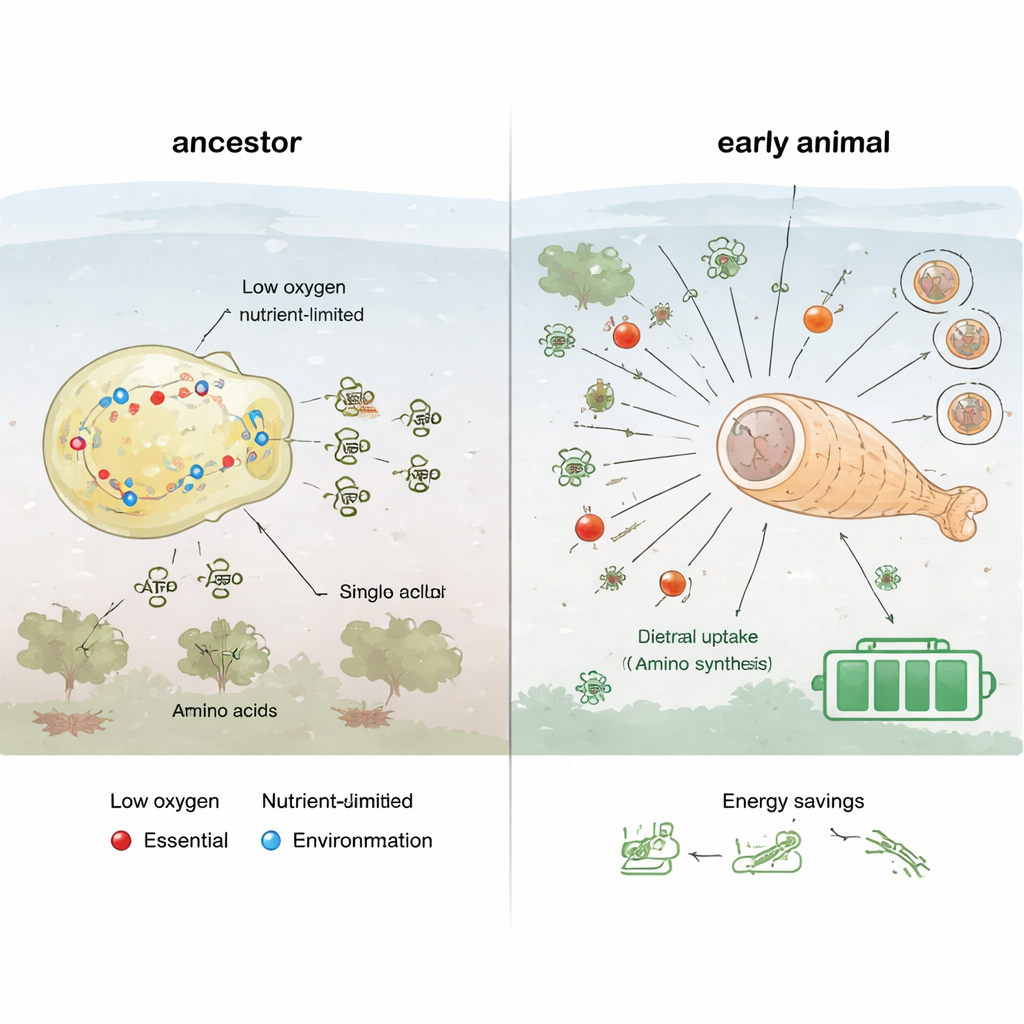
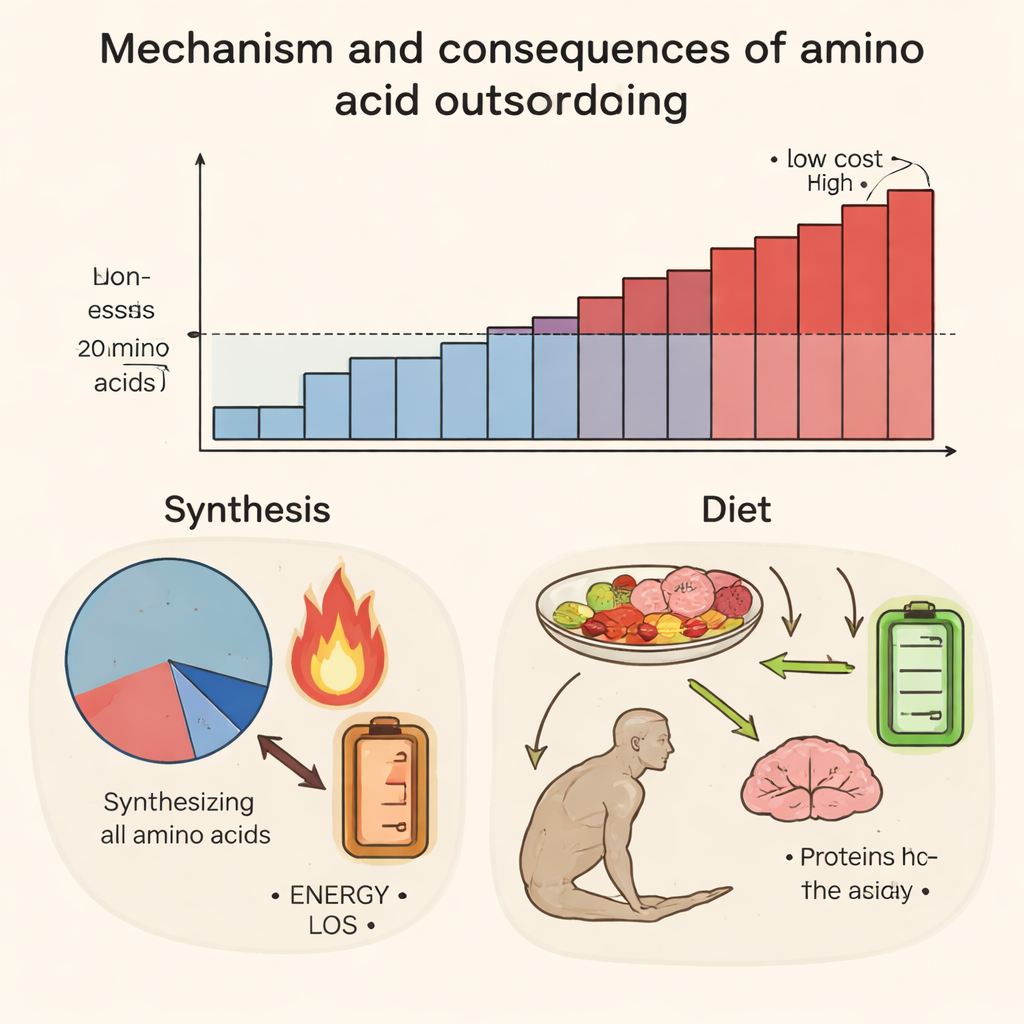
Cells pay an energy bill every time they build an amino acid. Using detailed biochemical data, the authors calculated how much energy it takes to make each of the 20 standard amino acids under different modes of metabolism, from low-oxygen fermentation to oxygen-powered respiration. They distinguished between “direct” costs (the fuel burned to build an amino acid) and “opportunity” costs (the extra energy that could have been earned by burning the same starting materials instead of turning them into amino acids). Under conditions that resemble the high-respiration lifestyle of animals, the amino acids we label as essential turned out to be, as a group, far more expensive to make than the non-essential ones.
Breathing more oxygen makes some amino acids especially pricey
When the authors compared all 20 amino acids, ordered by their energy cost, they found a striking pattern: almost all of the cheapest amino acids are ones animals still make on their own, whereas almost all of the most expensive ones are the essential amino acids we now obtain from food. This split became sharper as they modeled more efficient, oxygen-based respiration, which is characteristic of animal cells. Under high respiration, the gap in total energy cost between cheap and costly amino acids widened dramatically. In other words, once oxygen-rich environments became common and cells could harvest more energy from food, the relative penalty for manufacturing the most expensive amino acids soared, making them prime candidates for “outsourcing.”
Did evolution choose outsourcing over chance?
To test whether this pattern could be a fluke, the team developed a probabilistic method they call the combinatorial phenotype selection test. They asked: if you randomly picked nine or eleven amino acids to be “essential,” how often would you get a set whose average energy cost is as high as the real essential set in animals? Simulating all possible combinations showed that the actual animal set sits at the very expensive tail of the distribution and is extremely unlikely to have arisen by chance. This supports the idea that natural selection, acting on energy savings, helped determine which amino acids animals stopped making for themselves. They also examined how many different reactions and pathways each amino acid participates in (its “pleiotropy”). Amino acids deeply embedded in many processes were less likely to be outsourced, suggesting a trade-off between saving energy and keeping critical metabolic functions in-house.
From single cells to animals with costly proteins
The researchers then mapped amino acid-making pathways across 167 species, from single-celled relatives of animals to diverse animal groups. Non-animal relatives mostly retained the ability to make all 20 amino acids, while animals showed a consistent loss of pathways for the same costly subset. Importantly, animals did not respond to this loss by avoiding these expensive building blocks. Instead, animal proteins actually use energetically pricey amino acids more frequently than their single-celled cousins. Once production was shifted to the environment—via food—evolutionary pressure to minimize their use inside proteins eased, allowing animal genes to explore a wider range of sequence possibilities without paying the full energy cost.
A new view of how animals came to be
To a lay reader, the key message is that the origin of animals may not have been a freak accident, but an energy-management revolution. As oxygen rose and food sources became rich in amino acids, early animals could save substantial energy by dropping the most expensive manufacturing steps and importing those ingredients instead. That freed energy may then have been redirected into hallmark animal features such as movement, nerve signaling, and complex tissues. The familiar divide between “essential” and “non-essential” amino acids thus reflects a deep evolutionary bargain: what we now must eat are precisely the amino acids that once became too costly for our ancestors to make on their own.
Citation: Kasalo, N., Domazet-Lošo, M. & Domazet-Lošo, T. Outsourcing of energetically costly amino acids at the origin of animals. Nat Commun 17, 1921 (2026). https://doi.org/10.1038/s41467-026-68724-6
Keywords: essential amino acids, animal evolution, metabolism and energy, protein biosynthesis, oxygen and respiration