Clear Sky Science · en
Room-temperature polariton condensate in a quasi-2D hybrid perovskite
A New Kind of Laser at Everyday Temperatures
Lasers power our internet, medical devices, and factory tools, but most advanced laser concepts work only at very low temperatures and in highly specialized materials. This study shows that a relatively simple, layered crystal called a hybrid perovskite can host an exotic light state—called a polariton condensate—at room temperature. That brings futuristic, ultra‑efficient, and compact light sources a step closer to real‑world technologies such as on‑chip communications and low‑power optical computing.
Stacking Crystals Like a Layer Cake
The researchers work with quasi‑two‑dimensional halide perovskites, materials that naturally form in thin layers like a stack of sheets. In these crystals, inorganic slabs that carry electrical charges are separated by organic molecules acting as spacers. This structure behaves much like a man‑made stack of quantum wells used in high‑end lasers, but here it grows chemically on its own. Because the layers confine electrons and holes so strongly, light‑matter particles called excitons remain stable even at room temperature. Their strength can be tuned simply by choosing how many layers are stacked and by slightly modifying the organic spacers, offering a powerful handle on color and optical response that is far easier to engineer than in many other modern semiconductors.
Building a Tiny Adjustable Light Trap
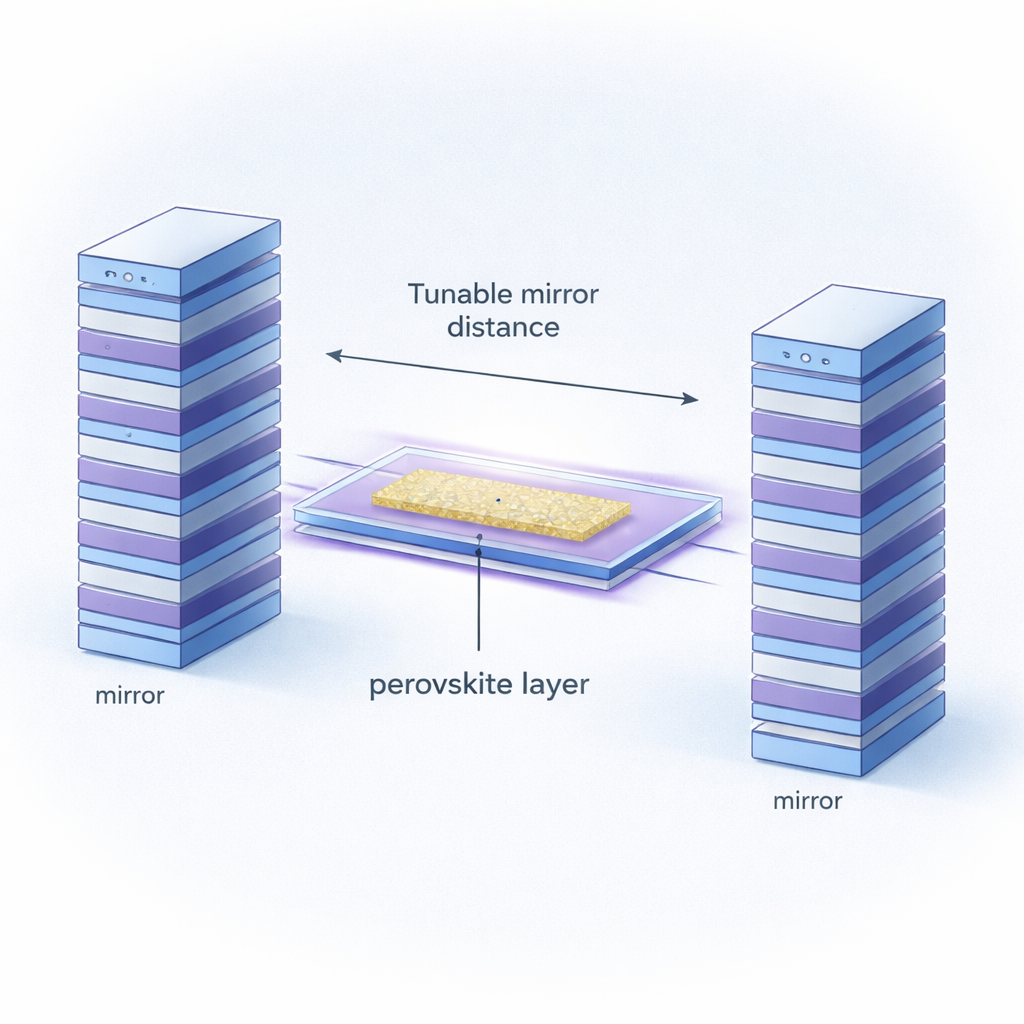
To turn these layered crystals into an active optical device, the team sandwiches a thin flake of the perovskite between two highly reflective mirrors, forming what is known as an open optical microcavity. Unlike a solid, fixed cavity, the distance between these mirrors can be precisely adjusted with piezoelectric stages, letting the researchers tune how light bounces back and forth. The top mirror also contains tiny bowl‑shaped indentations that act like three‑dimensional traps for light, concentrating it into well‑defined modes. A perovskite flake, just a few hundred nanometers thick and protected by ultra‑thin boron nitride layers, is placed on the bottom mirror so that these trapped light modes overlap with the crystal. White‑light measurements confirm that inside this cavity, light and excitons mix so strongly that they form new hybrid particles: exciton‑polaritons.
Watching Light Particles Condense
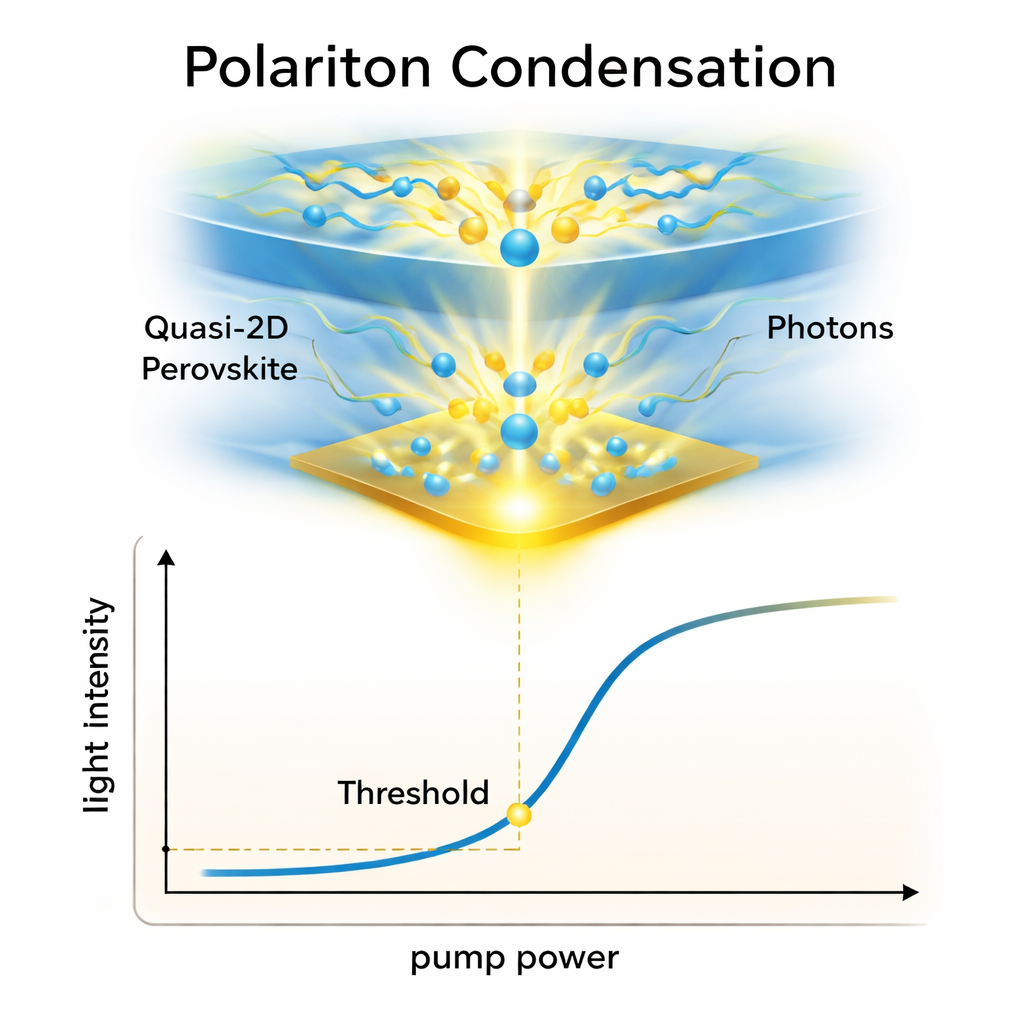
Next, the researchers strike the device with very short green laser pulses and gradually increase the pulse energy. They monitor the light emitted by the cavity and see a nearly thousand‑fold jump in brightness once the pump power crosses a well‑defined threshold. At the same time, the emission energy shifts slightly and its spectral width narrows—classic signs that polaritons are not just emitting light independently, but are collectively piling into a single quantum state known as a condensate. Importantly, this condensation occurs at particle densities below the point where the material would normally break up excitons, showing that the effect truly belongs to the polariton regime rather than ordinary lasing in a dense plasma of charges.
Probing Coherence in Space and Time
To test how ordered this new light state really is, the team passes the emitted light through a Michelson interferometer, which overlaps the image with a mirrored, time‑delayed copy of itself. From the resulting interference fringes they can map how well different parts of the emission stay in step—its spatial and temporal coherence. Above the threshold, the condensate light becomes highly correlated across distances of more than ten micrometers, far beyond the size of the underlying mirror indentation. The coherence persists for about a picosecond, which is long on the scale of these ultrafast processes. This behavior matches the expectations for a bosonic condensate, where many particles share the same quantum wave and stimulate each other to emit light in unison.
Toward Practical Quantum Light Devices
In simple terms, this work shows that carefully engineered layered perovskites can host a special kind of laser‑like state at everyday temperatures, in a structure that is easier to assemble and integrate than many rival materials. Because these crystals can be peeled, stacked with other two‑dimensional materials, and electrically tuned, they offer a flexible playground for designing compact, low‑power polariton lasers and quantum light circuits on a chip. The demonstration of room‑temperature polariton condensation in this platform suggests that practical devices based on such quantum light states may be within reach in the near future.
Citation: Struve, M., Bennenhei, C., Pashaei Adl, H. et al. Room-temperature polariton condensate in a quasi-2D hybrid perovskite. Nat Commun 17, 1261 (2026). https://doi.org/10.1038/s41467-026-68723-7
Keywords: polariton condensation, hybrid perovskites, room-temperature lasers, microcavity photonics, quantum light