Clear Sky Science · en
Interfacial engineering via dipolar fullerene derivative for efficient tin halide perovskite indoor photovoltaics
Powering gadgets from room light
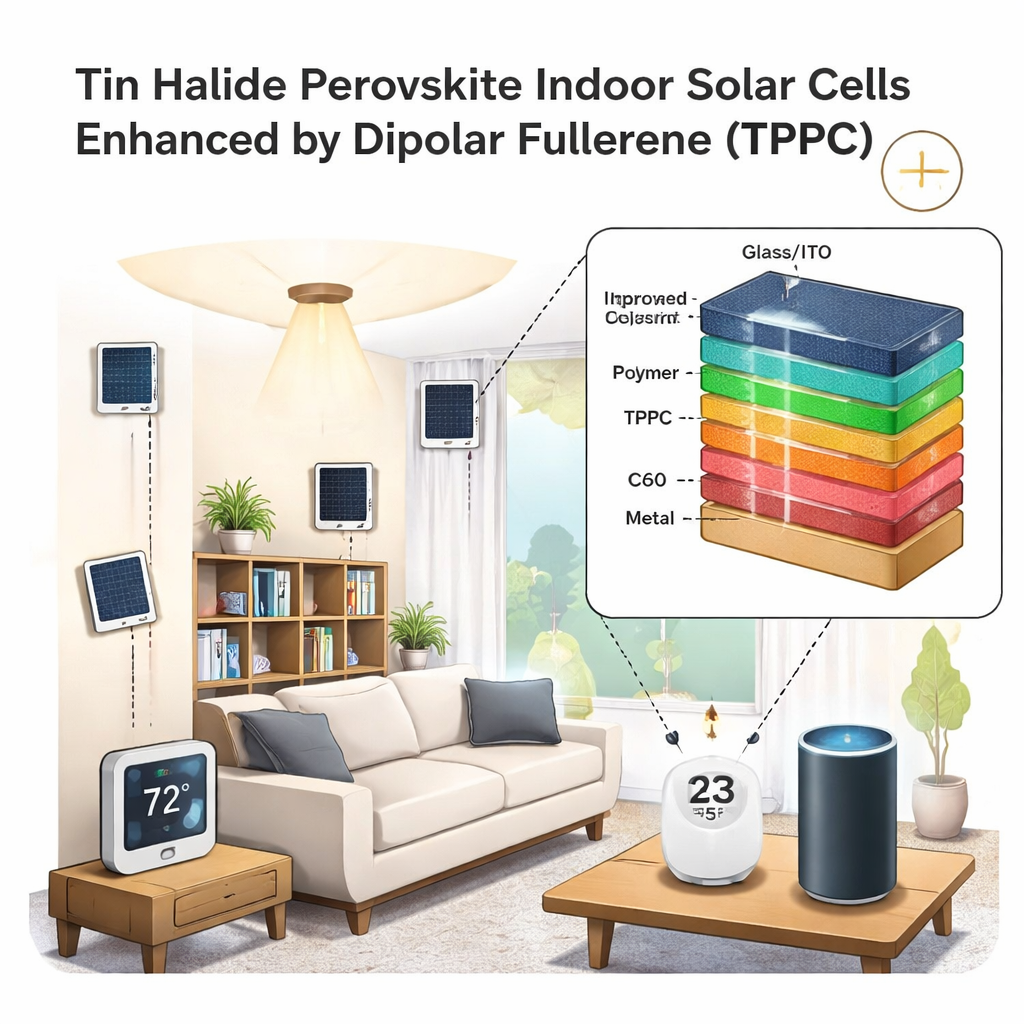
Imagine your smoke detectors, smart thermostats and tiny home sensors running for years without ever changing a battery—just by sipping energy from ordinary indoor lighting. This paper explores a new way to build compact solar cells that work especially well under soft, indoor light while avoiding toxic lead, a concern for electronics used inside homes and offices.
Why new solar materials are needed indoors
Conventional rooftop-style solar cells are designed for intense sunlight, not dim room lamps. A newer class of materials called perovskites can be tuned to match the color and brightness of indoor light and made using relatively simple solution processes. Many top-performing versions, however, contain lead, raising safety questions for widespread indoor use. Tin-based perovskites are a promising, less toxic alternative with similar light-harvesting abilities and even a theoretical efficiency limit above 50% under indoor conditions. Yet, in practice, their indoor performance has lagged because tin easily oxidizes and wastes energy, and because it is difficult to collect the electric charges efficiently at the interfaces inside the device.
A designer molecule at a critical boundary
The authors tackle these obstacles by focusing on a crucial internal boundary: the contact between the tin perovskite light-absorbing layer and a common electron-transport material called C60 (a spherical carbon molecule, or “fullerene”). They design a tailored fullerene derivative named TPPC that carries four nitrogen-containing “arms” and has a built-in electric dipole. Calculations and spectroscopy show that TPPC grips strongly onto the perovskite surface, especially where tin and iodine are exposed. This interaction acts like a gentle chemical shield, slowing the unwanted oxidation of tin, reducing defects, and leading to smoother, more crystalline films with fewer pinholes—all of which help the solar cell waste less of the captured light energy.
Guiding energetic charges in the right direction
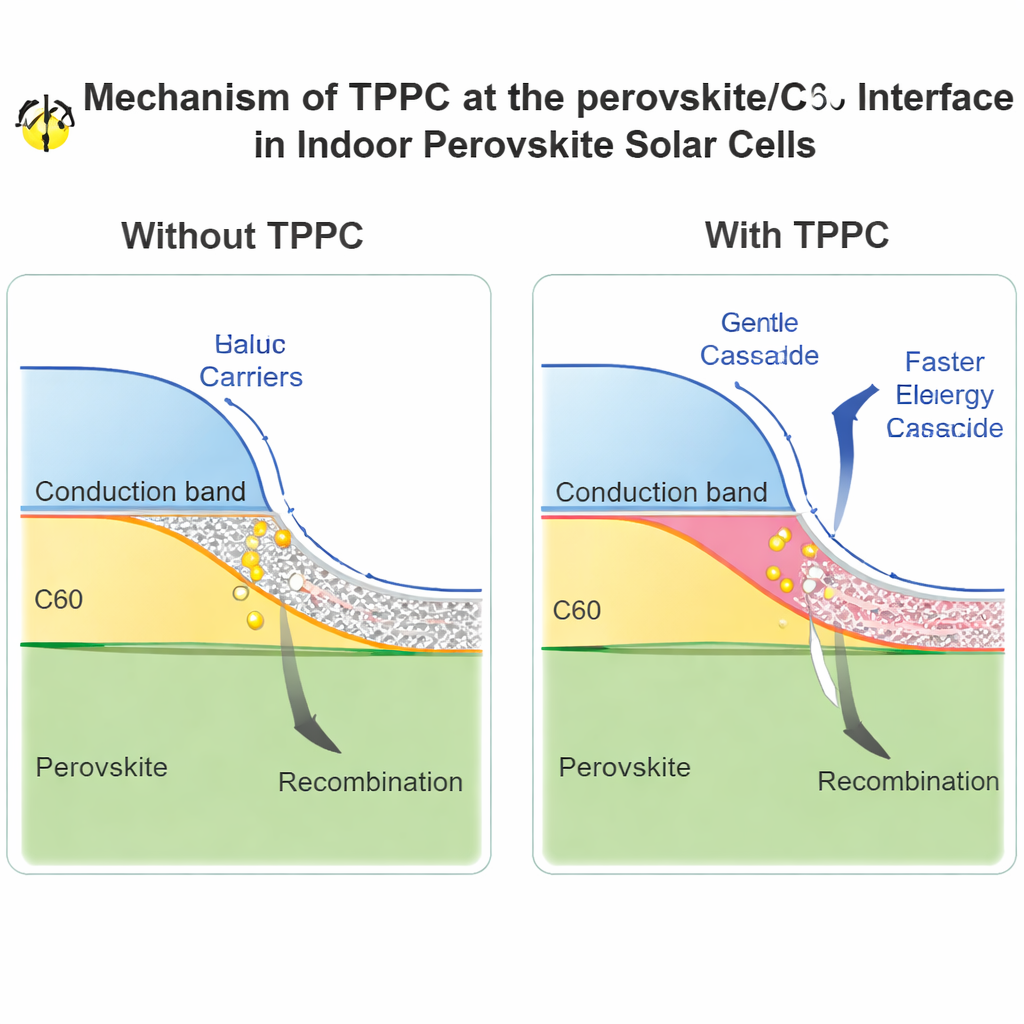
Beyond simply protecting the surface, TPPC reshapes the tiny energy landscape at the perovskite/C60 interface. Because of its dipole, TPPC creates a small step in energy levels that forms a downhill cascade for electrons moving from the perovskite into C60. Measurements of work function and local surface potential show that this treatment effectively strengthens the built‑in electric field pointing toward the electron-collecting side. Optical tests, including photoluminescence and time-resolved emission, reveal that electrons are extracted more quickly and with less energy loss when TPPC is present. Ultrafast laser experiments further show that “hot carriers”—electrons that briefly carry extra energy just after light absorption—can be tapped more effectively before they cool down and lose that bonus energy as heat.
From lab concept to record indoor performance
To see what this means for real devices, the team builds complete solar cells with the stack glass/ITO, a conductive polymer, tin perovskite, TPPC, C60, a buffer layer and a silver electrode. Under a warm white indoor LED at 1000 lux—similar to typical room lighting—the untreated tin perovskite cells reach a power conversion efficiency of about 15%. With the TPPC interlayer, that jumps to 22.49%, with a much higher output power density, setting a new benchmark for lead‑free indoor perovskite devices. Larger cells more than one square centimeter still achieve nearly 18% efficiency in the lab and about 16% in independent certification tests, showing that the approach scales beyond tiny test pixels.
Stability and what it means for everyday devices
Indoor solar cells must not only be efficient but also stable over years of operation. Encapsulated TPPC-treated devices keep about 91% of their original efficiency after more than 2000 hours of continuous operation under simulated indoor light, and 90% after hundreds of hours of heating tests. Additional electrical measurements show faster charge transport, fewer traps where charges can get stuck, and less ion migration within the perovskite, all of which contribute to the improved lifetime. In plain terms, the new TPPC molecule helps the solar cell grab more useful energy from each photon and hang on to that performance longer.
Bringing light-powered electronics closer to reality
For non-specialists, the main message is that a carefully engineered molecular “bridge” at one internal boundary of a tin-based perovskite solar cell can dramatically improve how well it works under everyday indoor lighting. By protecting the material, guiding energetic charges toward the right side, and cutting energy losses, the TPPC layer pushes lead‑free indoor solar cells to efficiencies that start to rival or surpass many lead-based options. This kind of interfacial engineering could accelerate the arrival of maintenance-free, light-powered sensors and gadgets that quietly harvest the glow of our lamps and screens.
Citation: Xiao, H., Cui, E., Wang, J. et al. Interfacial engineering via dipolar fullerene derivative for efficient tin halide perovskite indoor photovoltaics. Nat Commun 17, 1908 (2026). https://doi.org/10.1038/s41467-026-68719-3
Keywords: indoor photovoltaics, tin perovskite, fullerene interface, hot carrier dynamics, lead-free solar cells