Clear Sky Science · en
Dynamic thermal management under variable operating conditions through magnetic field control
Why keeping gadgets cool really matters
From satellites and electric cars to our everyday electronics, many devices face wild swings in temperature as they turn on and off or move through harsh environments. If these temperature swings get too big, parts can age faster, lose performance, or even fail. This paper explores a new way to keep such devices in a safer, steadier temperature range by using tiny magnetic particles and an external magnet to steer how heat moves—without touching the device at all.
A clever heat sponge that can change its mind
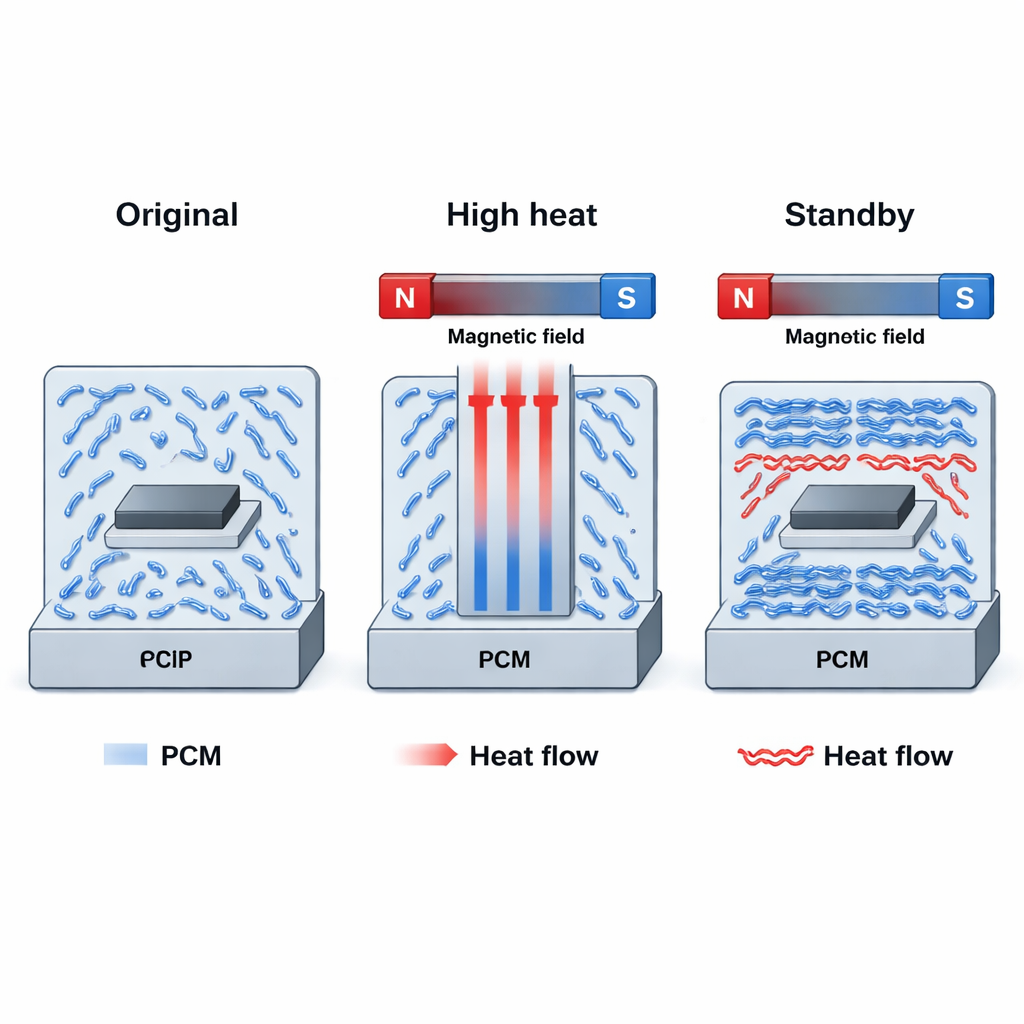
The heart of the approach is a “heat sponge” made from a phase change material, or PCM. PCMs absorb a lot of energy as they melt and release it as they freeze, naturally smoothing out temperature spikes. They are already used as passive thermal buffers, but on their own they conduct heat poorly and cannot adapt to changing conditions. The authors mix a common PCM, n-eicosane, with specially prepared nanoparticles: carbon nanotubes coated with magnetic iron oxide. These tiny rods conduct heat much better than the PCM and respond to magnetic fields, turning the once-static PCM block into a heat sponge whose internal heat pathways can be rearranged on demand.
Using magnets to redraw heat pathways
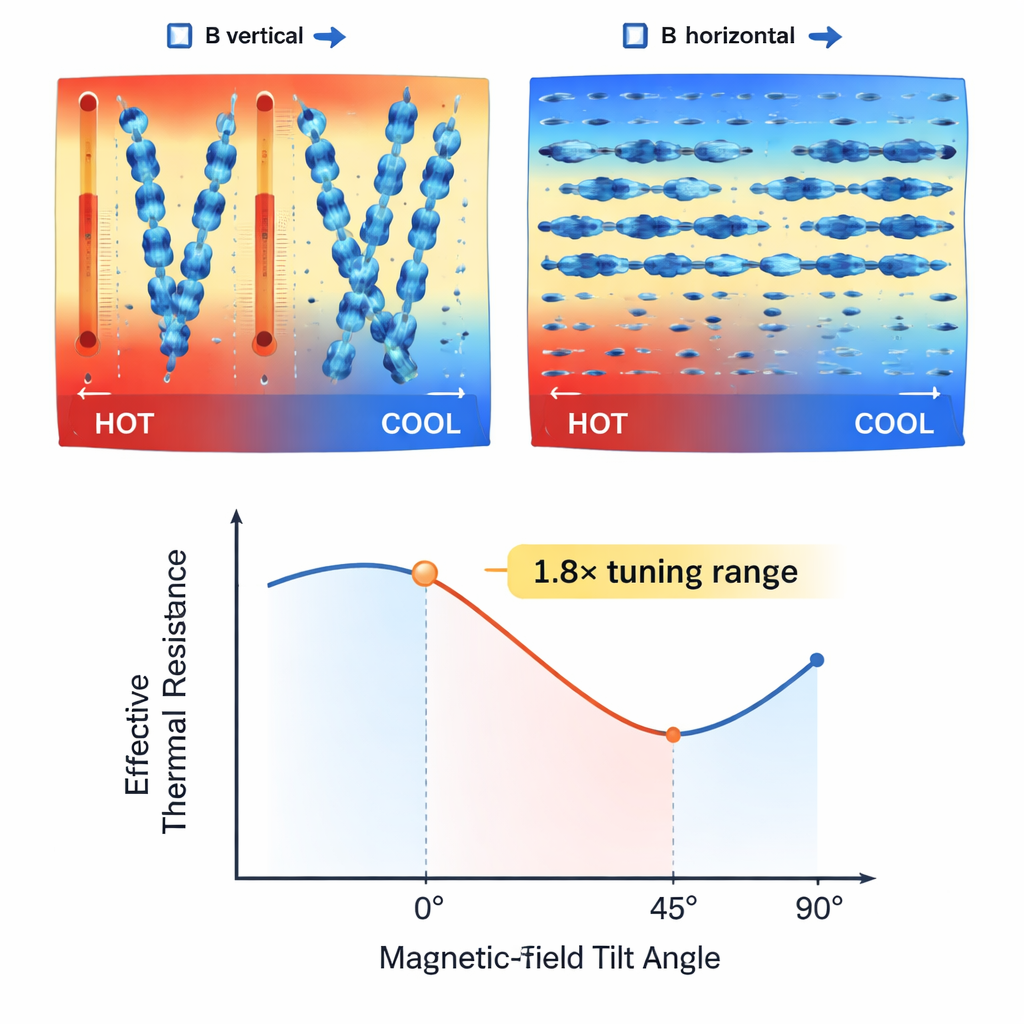
When no magnetic field is applied, the nanoparticles are scattered randomly and simply give the PCM a modest, fixed boost in heat flow. Under a steady magnetic field, however, the particles self-assemble into long, bundle-like chains that line up with the field direction. By rotating the external magnet, the researchers can rotate these bundles relative to the main direction in which heat wants to flow. When the bundles are lined up with the heat flow, they act like express lanes that quickly carry heat away from hot electronics. When the bundles are turned sideways, they block that direct route, forcing heat to travel mainly through the slow PCM and acting more like a blanket than a heat sink.
How much control do we really get?
To see how strong this effect could be, the team combined measurements and computer simulations. They showed that, with the particles aligned for maximum conduction, the effective thermal resistance of the material—how strongly it resists heat flow—drops by about a factor of 1.8 compared with the same composite in its least conductive orientation. In other words, simply turning the magnetic field can almost double how easily heat escapes. Microscopy confirms that the particle chains are long, uniform, and repeatable over many melt–freeze cycles, and bulk tests show that the basic melting temperature and energy-storage capacity of the PCM are largely preserved.
Shifting between cooling and insulating in real time
The real test is whether this tunable material can protect working electronics under realistic, stop-and-go heating. The researchers built a small test rig that mimics a satellite component: a heater represents the electronic device, a cooling plate provides a cold environment, and the composite PCM sits in between. During “work” periods, they point the magnetic field along the heat path so the bundles stand upright and spread heat rapidly. During “standby,” they rotate the field so the bundles lie sideways and slow heat loss. Compared with an otherwise identical PCM that lacks this magnetic steering, the dynamically controlled system cuts the device’s temperature swings by 10.8 °C over repeated cycles—keeping it cooler during operation and warmer during long, cold pauses.
What this means for future electronics
For a non-specialist, the key idea is that this material behaves like an adjustable thermal valve built right into the heat sponge itself. By turning a magnetic field instead of flipping a mechanical switch or running complex control hardware, engineers can let heat flow freely when a device is working hard and then keep that stored heat from leaking away too fast when it rests. Because the method is contactless, reversible, and works over many cycles, it offers a promising path toward smarter thermal protection in demanding settings such as aerospace, advanced batteries, and high-power chips where stable temperatures are crucial for safety and long life.
Citation: He, J., Yang, L., Wang, Q. et al. Dynamic thermal management under variable operating conditions through magnetic field control. Nat Commun 17, 1958 (2026). https://doi.org/10.1038/s41467-026-68715-7
Keywords: thermal management, phase change materials, magnetic nanoparticles, electronics cooling, heat storage