Clear Sky Science · en
Two axes of white matter development
How Brain Wiring Grows Up
From learning to read to navigating friendships, childhood and adolescence depend on the brain’s wiring maturing at the right time. This wiring is made of "white matter"—bundles of insulated nerve fibers that let distant brain regions talk to one another. For years, scientists assumed that each white matter pathway matures more or less evenly along its length. This study overturns that view, showing that brain wiring grows in two coordinated directions, with important implications for thinking, emotion, and mental health in young people.
Inside the Brain’s Communication Cables
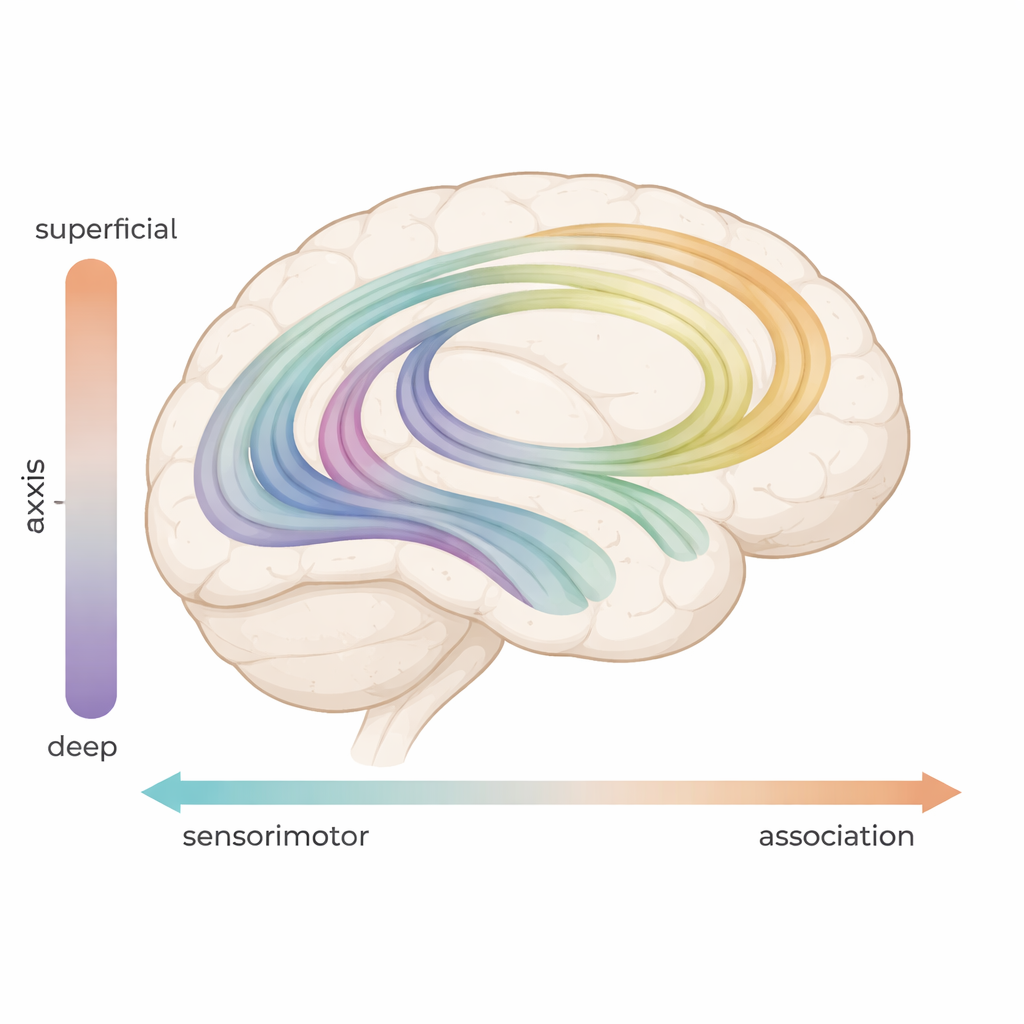
White matter tracts are like highways that connect far‑flung brain regions. As children grow into young adults, changes in these highways—such as more insulation around fibers—help signals travel faster and more reliably. Most earlier research treated each tract as a single unit, averaging measurements along its entire length. Using diffusion MRI scans from 2,716 young people aged 5 to 23, drawn from three large datasets, the authors instead examined 100 points along each major cortico‑cortical tract. This fine‑grained approach let them see how development differs from the deep, central parts of a tract to the more superficial segments that fan out near the brain’s surface.
Growing From the Inside Out
The first major pattern the team uncovered is a deep‑to‑superficial axis of development. Across nearly all studied tracts, the deepest regions—those packed tightly together in the brain’s interior—changed the least during childhood and adolescence. In contrast, the superficial portions close to the cortex showed much larger age‑related changes. This pattern held up across several different MRI measures of tissue structure, suggesting it is a robust feature of how white matter matures. The findings fit with earlier work in animals and infants indicating that deep white matter myelin forms early in life, while the more peripheral regions continue to refine well into later childhood.
Linking Wiring Changes to the Brain’s Functional Ladder
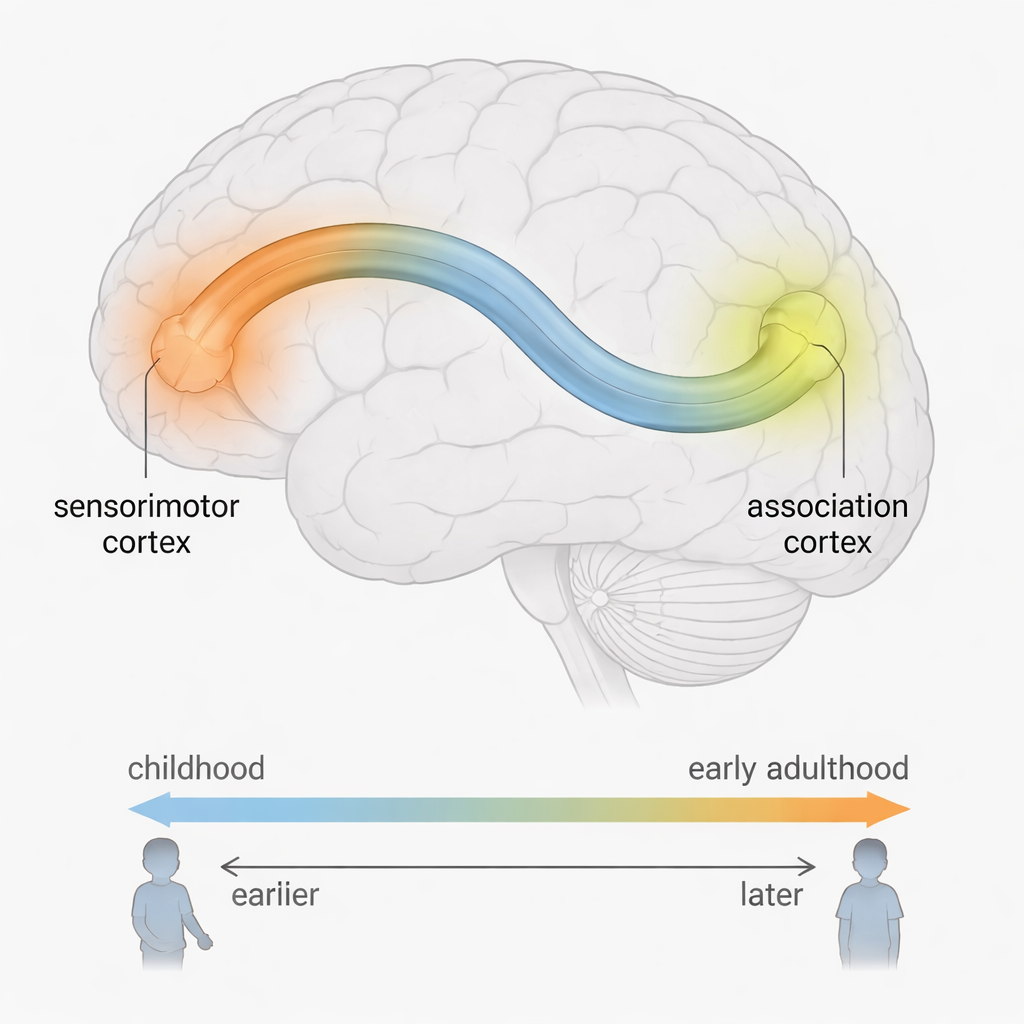
The second pattern appears when the authors ask how the ends of each tract relate to the cortical regions they connect. The cortex itself is organized along a sensorimotor‑to‑association (S‑A) hierarchy: basic sensory and motor areas mature early, while higher‑order regions involved in planning, social thinking, and abstract reasoning develop later. The study shows that superficial white matter near early‑maturing sensorimotor cortex tends to reach maturation sooner, whereas superficial white matter near late‑maturing association cortex keeps changing into early adulthood. In tracts that connect similar types of regions—for example, left and right motor areas linked through the corpus callosum—both ends mature at nearly the same age. But in tracts that bridge far apart levels of the hierarchy, such as those running from visual regions at the back of the brain to frontal association areas, the two ends can mature years apart.
Two Axes Working Together
Taken together, the results reveal that white matter development in youth follows two coordinated axes. One runs from deep to superficial: inner portions of tracts largely finish their rapid growth early in life, while outer portions near the cortex remain more plastic during the school‑age years and beyond. The other follows the cortex’s functional ladder: superficial segments serving simpler sensorimotor regions mature earlier, and those serving complex association regions mature later. The authors suggest that early development of deep segments may help ensure clean, reliable signal transmission by reducing electrical "crosstalk" between tightly packed fibers. Later, more gradual changes in superficial regions may fine‑tune the timing of signals in step with ongoing cortical refinement, supporting increasingly sophisticated thinking and behavior.
What This Means for Growing Minds
For non‑specialists, the key message is that the brain’s wiring does not mature like a single cable being uniformly upgraded. Instead, it grows from the inside out and along a gradient from basic to complex functions. This layered, staggered schedule likely helps children first establish dependable communication channels and then gradually sharpen them as life demands more flexible thinking and emotional control. The work also hints that disruptions to either axis of development could affect how information flows in the brain, potentially contributing to learning difficulties or mental health conditions. By mapping these two axes, the study provides a richer blueprint for understanding how experience, biology, and brain wiring interact as young people grow.
Citation: Luo, A.C., Meisler, S.L., Sydnor, V.J. et al. Two axes of white matter development. Nat Commun 17, 1957 (2026). https://doi.org/10.1038/s41467-026-68714-8
Keywords: white matter development, brain connectivity, adolescent brain, cortical hierarchy, diffusion MRI