Clear Sky Science · en
Sugar rationing during the first 1000 days of life and lifelong risk of heart failure
Why the first spoonfuls of sugar matter
From baby formula to birthday cake, sugar is woven into early childhood. But what if the amount of sugar a baby gets in the first years of life could shape their heart health many decades later? This study takes advantage of an unusual historical event—Britain’s wartime sugar rationing—to explore whether growing up with limited sugar in the first 1,000 days of life can lower the chances of developing heart failure in adulthood.
A natural experiment from wartime Britain
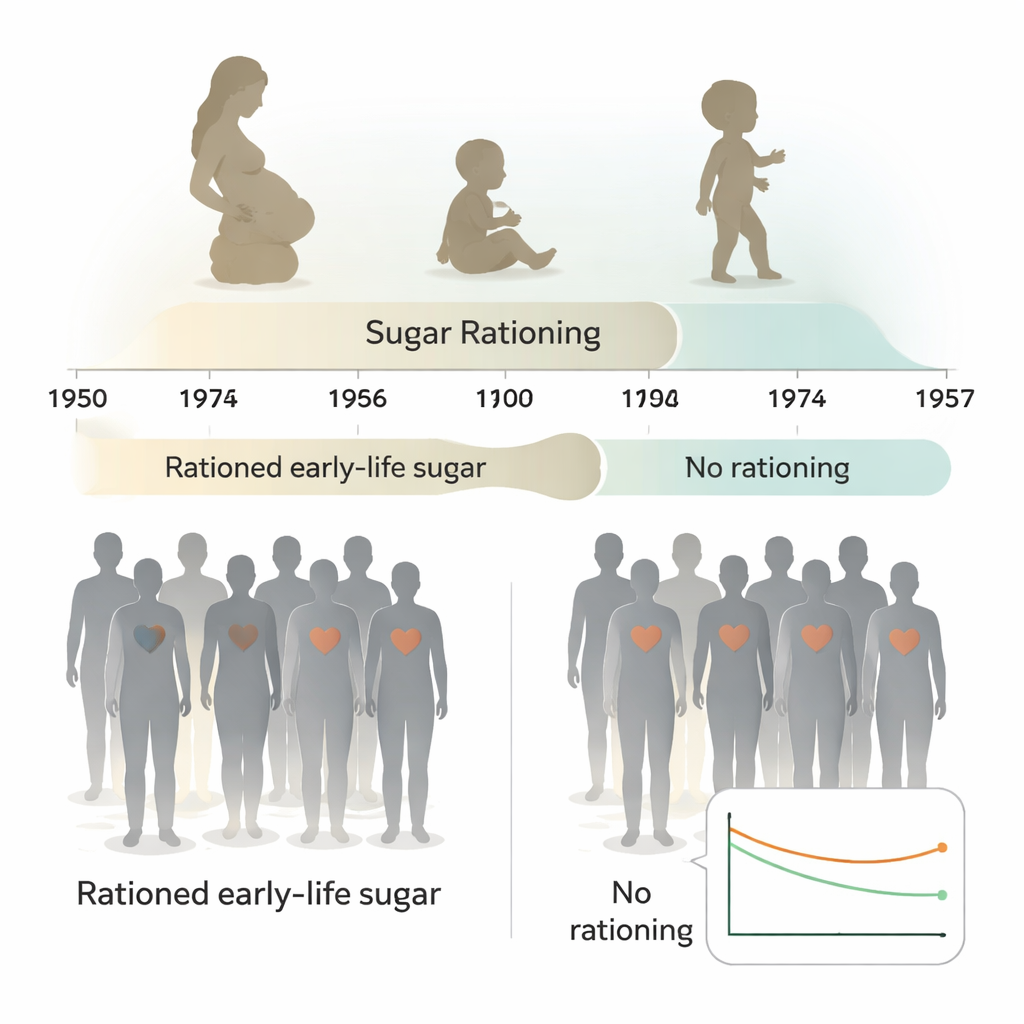
During and after World War II, the United Kingdom strictly limited sugar and sweets for everyone, including pregnant women and young children. Daily sugar rations were roughly in line with today’s dietary advice and were especially strict for children under two. In September 1953, rationing ended, and within a year sugar intake in the general population nearly doubled, while other parts of the diet stayed much the same. Because who experienced rationing depended almost entirely on when they were born, this created a kind of “natural experiment” that allowed researchers to compare people whose earliest months and years were lived under low-sugar conditions with those who grew up just after sugar became plentiful again.
Tracing sugar exposure from the womb to age two
The researchers used data from more than 61,000 adults in the UK Biobank who were born between late 1951 and early 1956. They sorted people into groups based on how much of their first 1,000 days—from conception to age two—fell under sugar rationing. Some were in the womb and then spent up to two years as infants during rationing; others were never rationed because they were born long after restrictions ended. The team then followed medical records to see who developed heart failure and at what age, while accounting for factors such as sex, birthplace, parents’ history of heart disease, and a genetic risk score for heart failure.
Less sugar early, fewer heart problems later
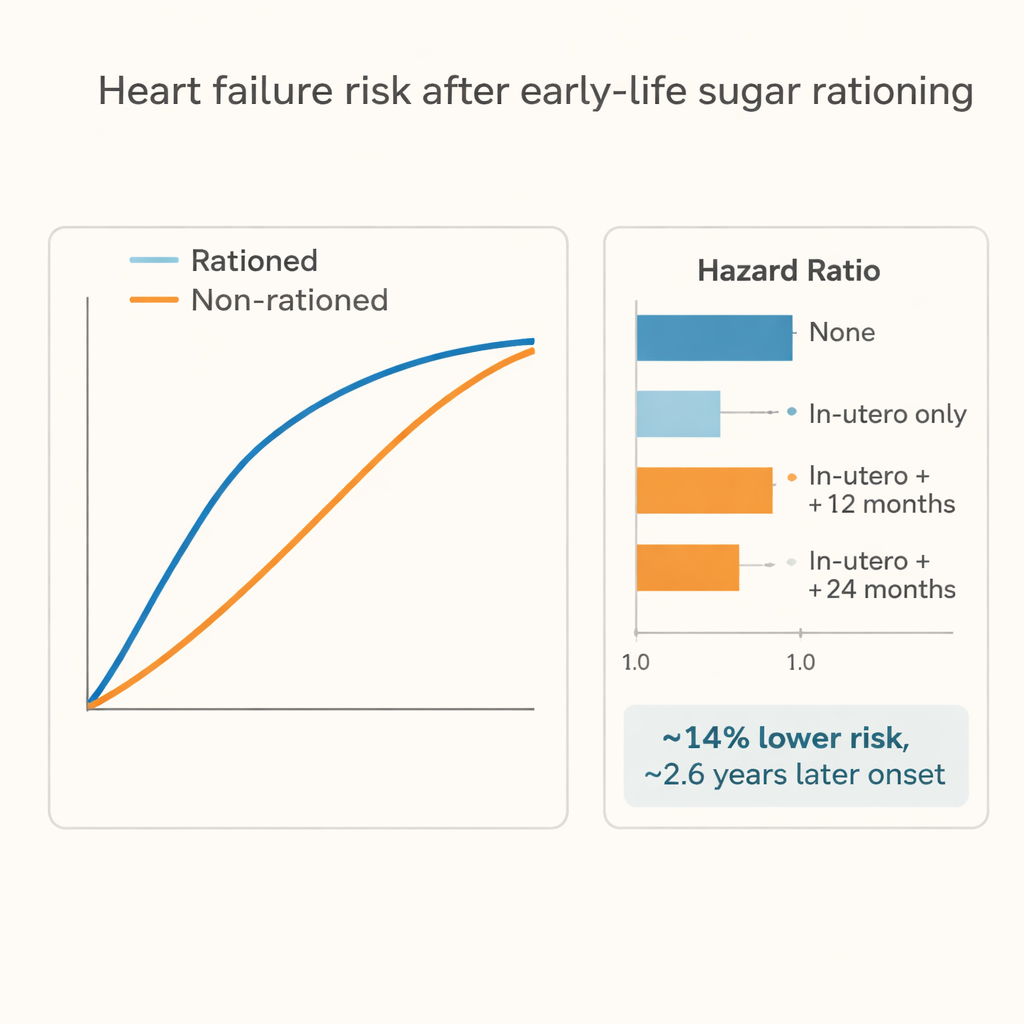
Adults who had been exposed to sugar rationing in their earliest days had about a 14% lower risk of developing heart failure compared with those who were not rationed. On average, they were diagnosed with heart failure about 2.6 years later in life. The longer a person’s early-life exposure to rationing—especially when it covered both pregnancy and the first two years of childhood—the stronger the protection. The researchers estimate that roughly 4–5% of heart failure cases in this birth group might be linked to the lack of early-life sugar restriction. These patterns held up across several kinds of statistical tests and even when the team started tracking people later in life, suggesting that the finding is fairly robust.
Genes and sugar: separate paths to risk
Because some people are genetically more prone to heart failure, the team also asked whether genes might change how much early sugar exposure matters. They found that genetic risk and sugar rationing seemed to act independently: people with high genetic risk still benefited from having had early sugar limits, and those with low genetic risk still faced higher danger if they grew up after rationing ended. When both risks were present—high genetic risk and no rationing—the chances of heart failure were highest, suggesting an added burden when biology and early diet both work against the heart.
What this means for today’s babies
This research cannot prove beyond doubt that cutting sugar in the first 1,000 days directly prevents heart failure—many other social and health differences could be involved, and a true long-term feeding trial would be unethical. Still, the study provides rare, large-scale evidence that keeping sugar low during pregnancy and early childhood may have lifelong benefits for the heart, comparable to managing diabetes or avoiding smoking in some groups. For parents and policymakers, the message is straightforward: protecting babies and toddlers from too much sugar may be a powerful investment in healthier hearts decades down the line.
Citation: Tang, H., Zhang, X., Huang, J. et al. Sugar rationing during the first 1000 days of life and lifelong risk of heart failure. Nat Commun 17, 1894 (2026). https://doi.org/10.1038/s41467-026-68713-9
Keywords: early-life nutrition, sugar intake, heart failure, UK Biobank, cardiovascular risk