Clear Sky Science · en
Abiotic sugar enantiomers in the CI carbonaceous chondrite Orgueil
Space Rocks and Life’s Sweet Ingredients
For decades, scientists have found building blocks of life such as amino acids in meteorites, but sugars—the backbones of RNA and DNA—have remained strangely elusive. This study tackles that mystery by examining a tiny piece of the Orgueil meteorite, a 19th‑century fall that is one of our best analogs for primitive asteroids. By showing that fragile sugars can be made in space and survive the journey to Earth, the work strengthens the idea that meteorites helped stock early Earth with ingredients needed for the first living systems.
Why Sugars from Space Matter
Nucleic acids like RNA and DNA store and transmit genetic information, while proteins carry out most of life’s chemistry. Both depend on small organic building blocks: sugars and nucleobases for RNA and DNA, and amino acids for proteins. One long‑standing question is how enough of these delicate molecules could have formed and accumulated on the young Earth, where conditions were harsh and changeable. Astronomy and meteorite studies suggest that some of the load may have been delivered ready‑made from space, carried in dust, comets, and meteorites. Amino acids and nucleobases have been found repeatedly in such materials, including samples recently returned from the asteroids Ryugu and Bennu. Sugars, however, have been rarely identified in meteorites, despite laboratory experiments showing that interstellar ice chemistry should readily make a variety of them.
Hunting for Sugars in a Grain of Meteorite
To search for these elusive molecules, the authors developed a gentle but highly sensitive procedure to analyze both sugars and amino acids at the same time in just 178 milligrams of the Orgueil meteorite. They first crushed the fragment and used cold methanol and water, together with ultrasonic shaking, to draw out soluble organic compounds without overheating them. Next, they passed the extracts through ion‑exchange columns, which stripped out metal ions and separated neutral sugars from charged amino acids. Each fraction was chemically modified to make it easier to separate and detect, then analyzed with a powerful two‑dimensional gas chromatography–mass spectrometry system capable of telling apart mirror‑image forms of a molecule.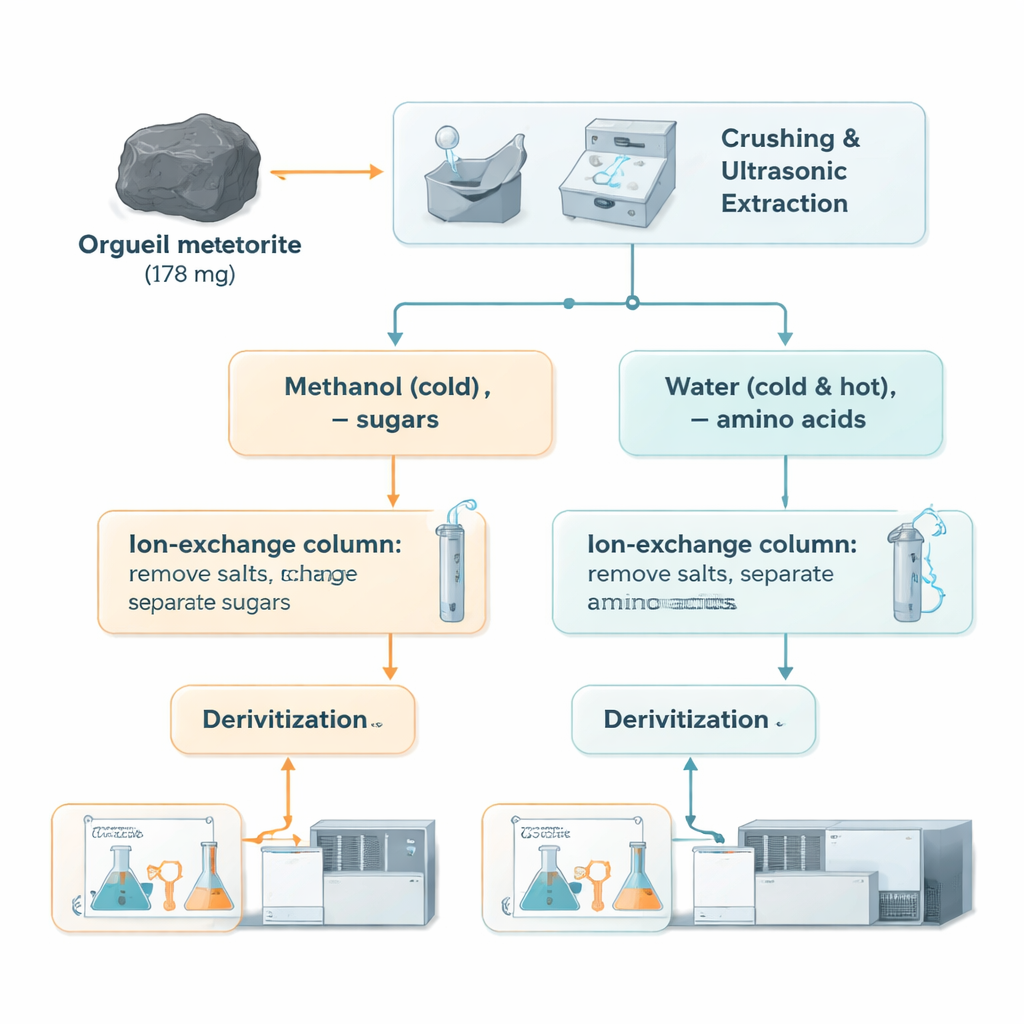
Finding Mirror‑Image Sugars from Space
The team detected five different five‑carbon sugars in Orgueil: four aldoses—ribose, arabinose, xylose, and lyxose—and one ketose, ribulose. For three of them—ribose, lyxose, and ribulose—the two mirror‑image forms appeared in nearly equal amounts, a near‑“racemic” pattern that fits an abiotic, non‑biological origin. That is important because life on Earth strongly favors just one handedness of sugars, so a balanced mixture points away from simple contamination. Arabinose and xylose, by contrast, were skewed toward the same handedness used by biology, hinting at some terrestrial input during the meteorite’s long history on Earth, though the authors note that some non‑biological reactions can also produce uneven mixtures. Overall sugar concentrations ranged from roughly 0.1 to a few parts per billion, but separate recovery tests showed that the meteorite’s clay‑rich matrix traps sugars strongly, so the true amounts are likely much higher.
Comparing Sugars and Amino Acids
In the very same sample, the researchers also cataloged 25 amino acids, including several that are rare or unknown in biology. Many of these appeared as nearly 50/50 mixtures of their two mirror‑image forms, again consistent with a non‑biological source. Others showed modest excesses of the same handedness used by life, broadly matching earlier studies of Orgueil. When the team corrected for how poorly their method recovers different sugars, they found that the real abundances of some five‑carbon sugars may rival those of similarly sized amino acids in the meteorite. This challenges the common assumption that sugars are scarce compared with amino acids in carbon‑rich space rocks and suggests that analytical biases—especially low extraction efficiency—have been hiding much of the meteoritic sugar inventory from view.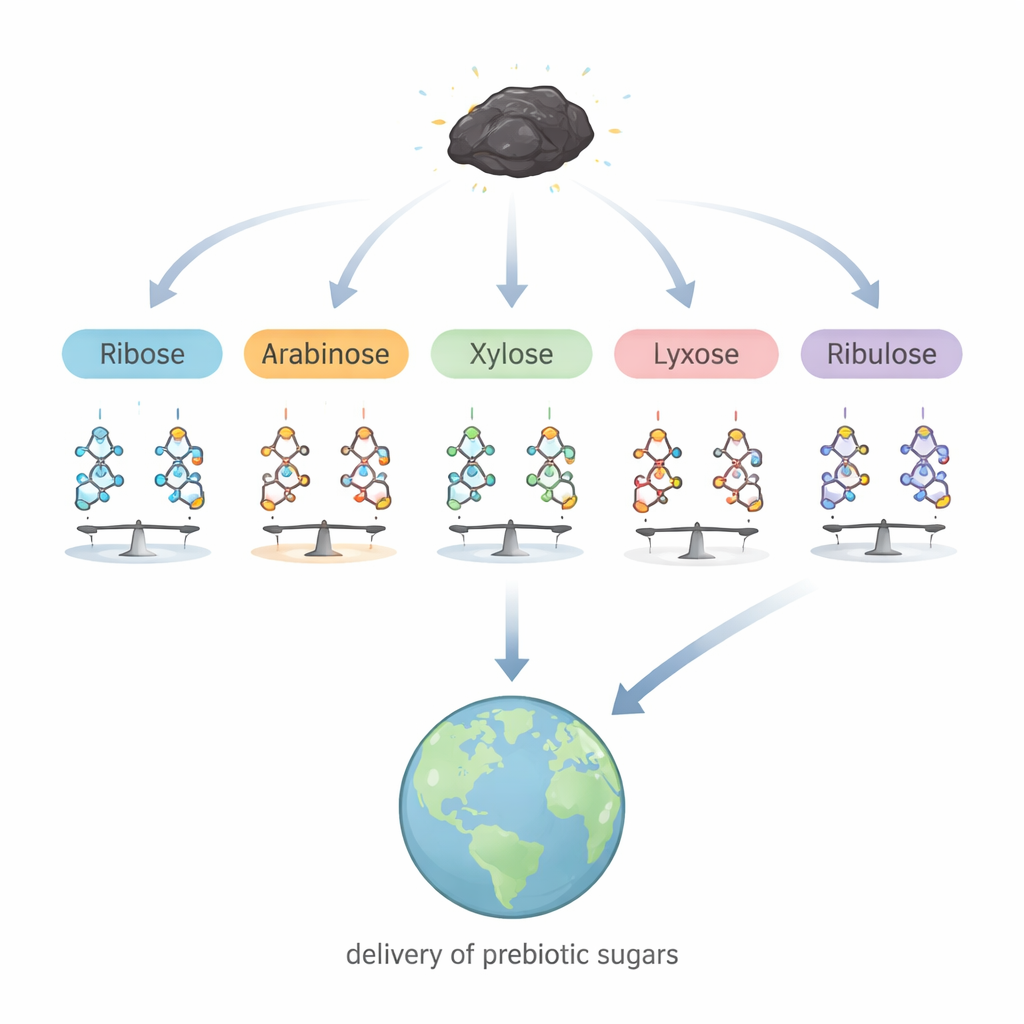
What This Means for the Origin of Life
Taken together, these results show that meteorites like Orgueil can carry multiple types of bio‑relevant sugars, including ribose, the sugar central to RNA. The near‑balanced mixtures of mirror‑image forms support an abiotic origin in space, while recovery tests imply that actual sugar levels are higher than measured. Because the methods work on less than 200 milligrams of material, they are directly relevant to precious asteroid samples from missions such as Hayabusa2 and OSIRIS‑REx. For non‑specialists, the key message is simple: space rocks do not just bring exotic minerals and a few stray molecules—they may have delivered a surprisingly rich suite of sugars alongside amino acids and other organics, helping set the stage for the first genetic polymers and, ultimately, for life on Earth.
Citation: Leyva, V., Robert, M., Pepino, R. et al. Abiotic sugar enantiomers in the CI carbonaceous chondrite Orgueil. Nat Commun 17, 2060 (2026). https://doi.org/10.1038/s41467-026-68709-5
Keywords: meteorite sugars, prebiotic chemistry, origin of life, carbonaceous chondrites, extraterrestrial organics