Clear Sky Science · en
Advances and challenges in non-canonical nucleic acids data storage
Why Storing Data in Molecules Matters
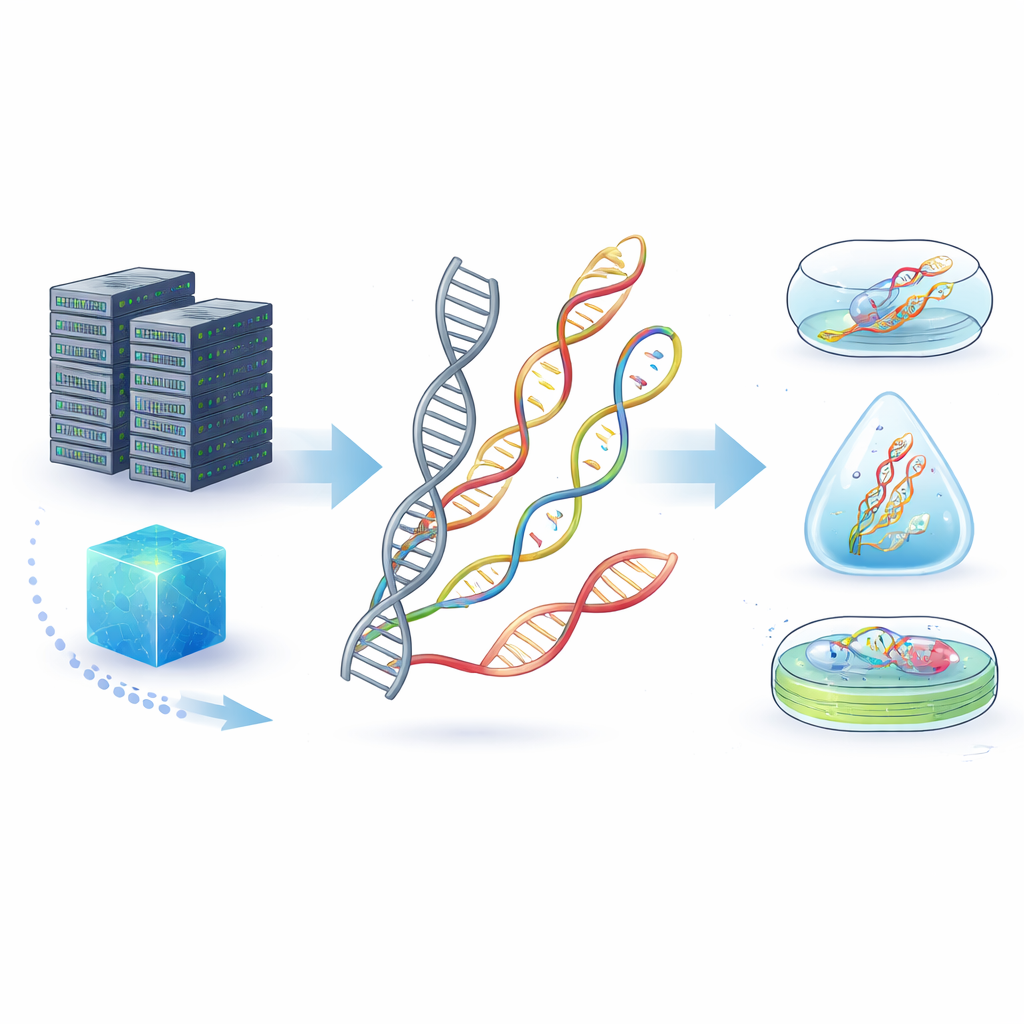
Every photo, message, and movie we create has to live somewhere, and today that “somewhere” is mostly giant warehouses of hard drives that use a lot of electricity and wear out within decades. This article explores a very different approach: using specially engineered genetic molecules as tiny data tapes. By tweaking the familiar building blocks of DNA and RNA, scientists aim to create information storage that is denser, tougher, and more secure than any silicon chip or magnetic disk.
From Fragile DNA to Tough New Molecules
Natural DNA is already an impressive storage medium, packing huge amounts of information into a microscopic space and surviving for tens of thousands of years in fossils. But in everyday conditions—heat, moisture, stray chemicals, or enzymes that chew up DNA—it can degrade quickly. The authors introduce “non-canonical nucleic acids” (ncNAs): DNA- and RNA-like molecules whose bases, sugars, or backbones have been chemically altered, or even mirrored, to give them new properties. These changes can make the molecules harder for enzymes to destroy, more resistant to acid or alkali, and better able to survive harsh real-world environments than ordinary DNA.
Adding New Letters to the Genetic Alphabet
One of the most powerful ideas in the review is expanding the genetic alphabet beyond the usual four letters A, T, G, and C. Chemists have created extra base pairs that still fit into double helices but do not occur in nature. With 8, 12, or more letters to work with, each position along the strand can encode more bits of information, boosting storage capacity well beyond what standard DNA can offer. Some of these new bases are designed to stick together through hydrophobic interactions instead of the usual hydrogen bonds, showing that nature’s rules for pairing can be bent while still keeping information readable.
Rebuilding the Molecular Skeleton
Besides changing the “letters,” researchers also rework the sugar and backbone that hold a genetic strand together. Swapping the usual sugar for alternatives like threose or hexitol, or replacing charged phosphate links with neutral or sulfur-containing ones, can drastically alter how the strand behaves. Many such ncNAs show striking stability in hot, acidic, or enzyme-rich conditions where natural DNA would quickly fall apart. Some mirror-image versions, such as L-DNA, are invisible to normal enzymes and immune defenses, making them promising for ultra-secure data storage and hidden messages, though they are currently difficult and expensive to make and read.
How Data Are Written, Kept, and Read
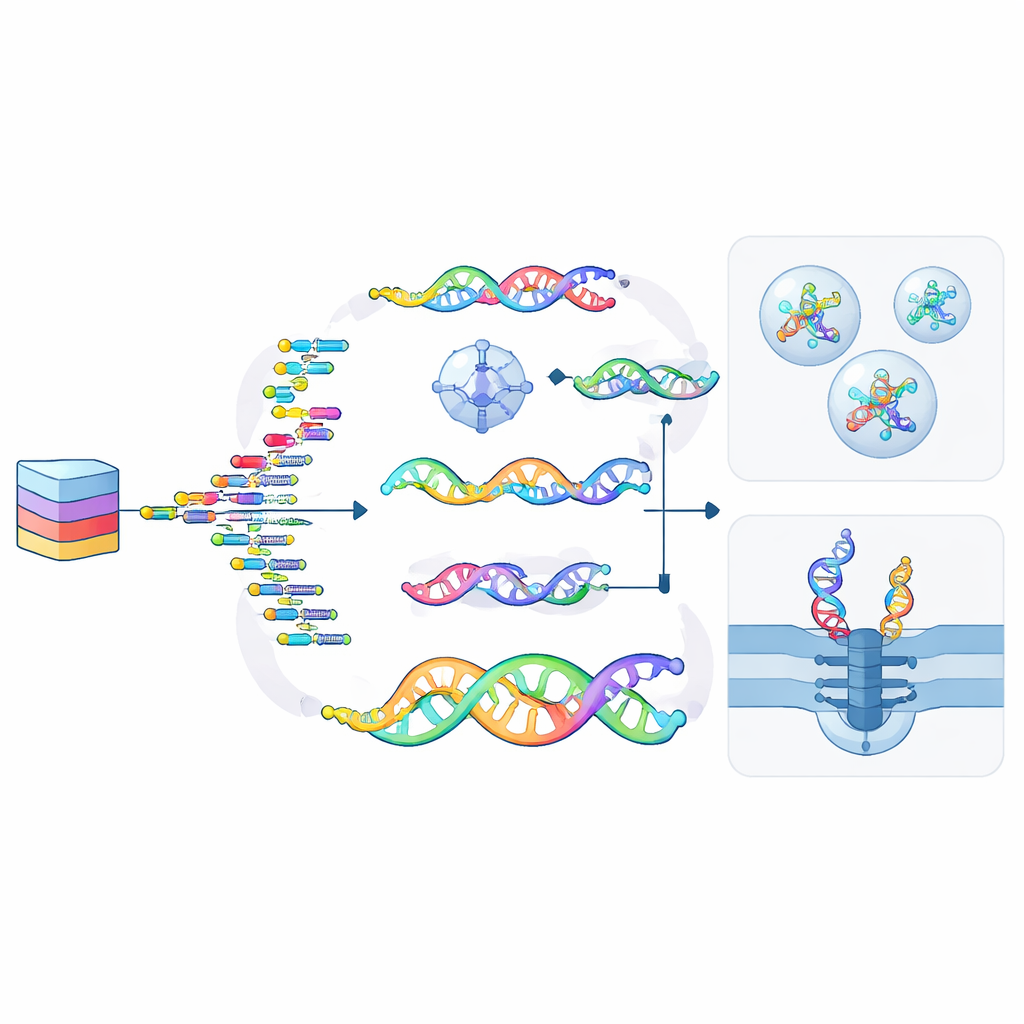
Turning digital files into molecular form follows a four-step cycle: encoding, writing, preservation, and reading. Bits are first translated into sequences or structures, which are then synthesized as ncNA strands using chemical methods or specially engineered enzymes. These strands can be stored outside living cells—encapsulated in glass, silica, or polymers—or inside cells and even modified plants, where natural repair machinery can help maintain them. Reading the data may use familiar DNA sequencing machines, advanced nanopore devices that feel each unit as it passes through a tiny hole, or microscopes that recognize shapes in folded nanostructures. Because many ncNAs cannot yet be sequenced directly, they are often converted back into regular DNA before reading, a step that current research is working to streamline and improve.
New Possibilities: Computation, Security, and Parallel Writing
The article highlights how ncNAs do more than just store data—they can also process it. DNA-based logic circuits and neural networks already exist, and adding chemically distinct alphabets makes it easier to run many operations in parallel without unwanted cross-talk. Certain modifications act like invisible ink, allowing information to be hidden within strands or structures that only special enzymes or conditions can reveal. Others, such as reversible chemical adducts or patterns of methyl groups, behave like movable type on a printing press: they can imprint data onto existing strands in parallel, erase it, and rewrite it without rebuilding the entire molecule from scratch.
Challenges Ahead and What Success Would Mean
Despite the promise, the authors stress that non-canonical nucleic acid storage is still at an early stage. Making long, error-free strands is costly and technically demanding, and many of the most attractive chemistries are not yet compatible with fast, affordable reading technologies. There are also important safety and ethical questions about introducing highly stable, partially unnatural molecules into living systems. Even so, the review outlines a roadmap in which faster synthesis, smarter encapsulation, and artificial-intelligence-enhanced nanopore readers could make ncNA-based storage practical within the coming decades. If that happens, we may one day back up our digital civilization not on spinning disks, but in tiny, robust strands of designer molecules.
Citation: Wang, Y., Pei, Y., Tang, L. et al. Advances and challenges in non-canonical nucleic acids data storage. Nat Commun 17, 2354 (2026). https://doi.org/10.1038/s41467-026-68708-6
Keywords: DNA data storage, non-canonical nucleic acids, molecular memory, unnatural base pairs, nanopore sequencing