Clear Sky Science · en
Spatial heterogeneity and subtypes of functional connectivity development in youth
Why growing brains don’t all follow the same path
Every child’s brain changes rapidly as they grow, but those changes don’t happen in lockstep. Some brain areas mature early, others later, and the exact pattern can differ from one young person to the next. This study asks a simple but powerful question: how do these different growth patterns across the brain relate to thinking skills, and what might be happening at the cellular and genetic level underneath?
Looking at brain “age” region by region
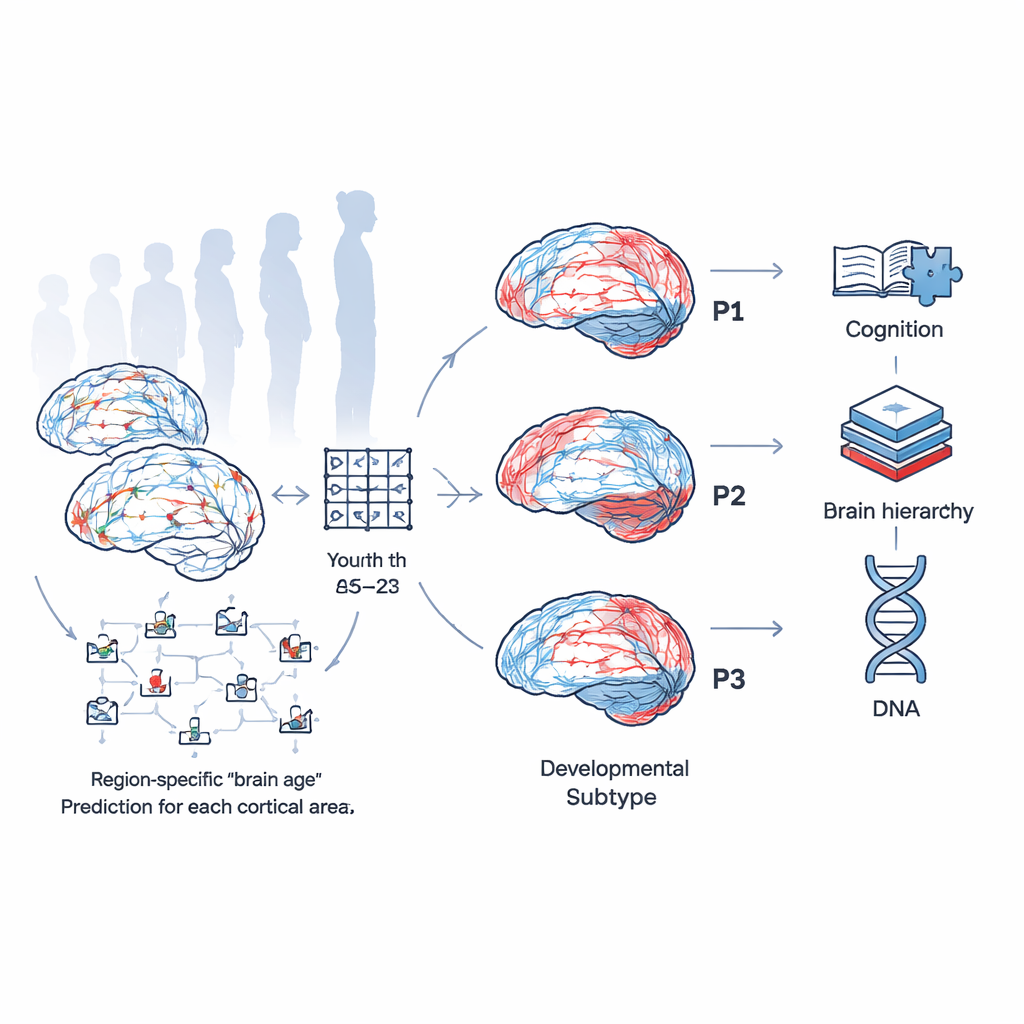
Scientists often talk about a person’s “brain age,” a score estimated from brain scans that shows whether the brain looks younger or older than their real age. Traditionally, this has been a single number for the whole brain. The authors of this study argued that this is too crude: different parts of the cortex mature at different speeds. Using functional MRI scans from over 1,100 children and young adults aged 5 to 23, they built separate computer models for each small cortical region. For every region and every individual, the model predicted a local brain age based on how strongly that region was functionally connected to all the others. Subtracting real age from this prediction yielded a regional brain development index, which tells whether a specific patch of cortex is developing ahead of or behind schedule.
Three patterns of brain development in young people
With these regional scores in hand, the team looked for common patterns across individuals. They discovered three distinct brain development “subtypes.” One subtype showed broadly delayed development across the cortex. A second showed especially advanced development in higher-level association areas, including regions involved in daydreaming, self-reflection, and flexible thinking. A third subtype showed advanced development mainly in sensorimotor areas that support movement and basic sensation. Importantly, these patterns were not simply reflections of age or sex; children the same age could fall into different subtypes depending on how their brain regions were maturing relative to one another.
How brain patterns map onto thinking skills
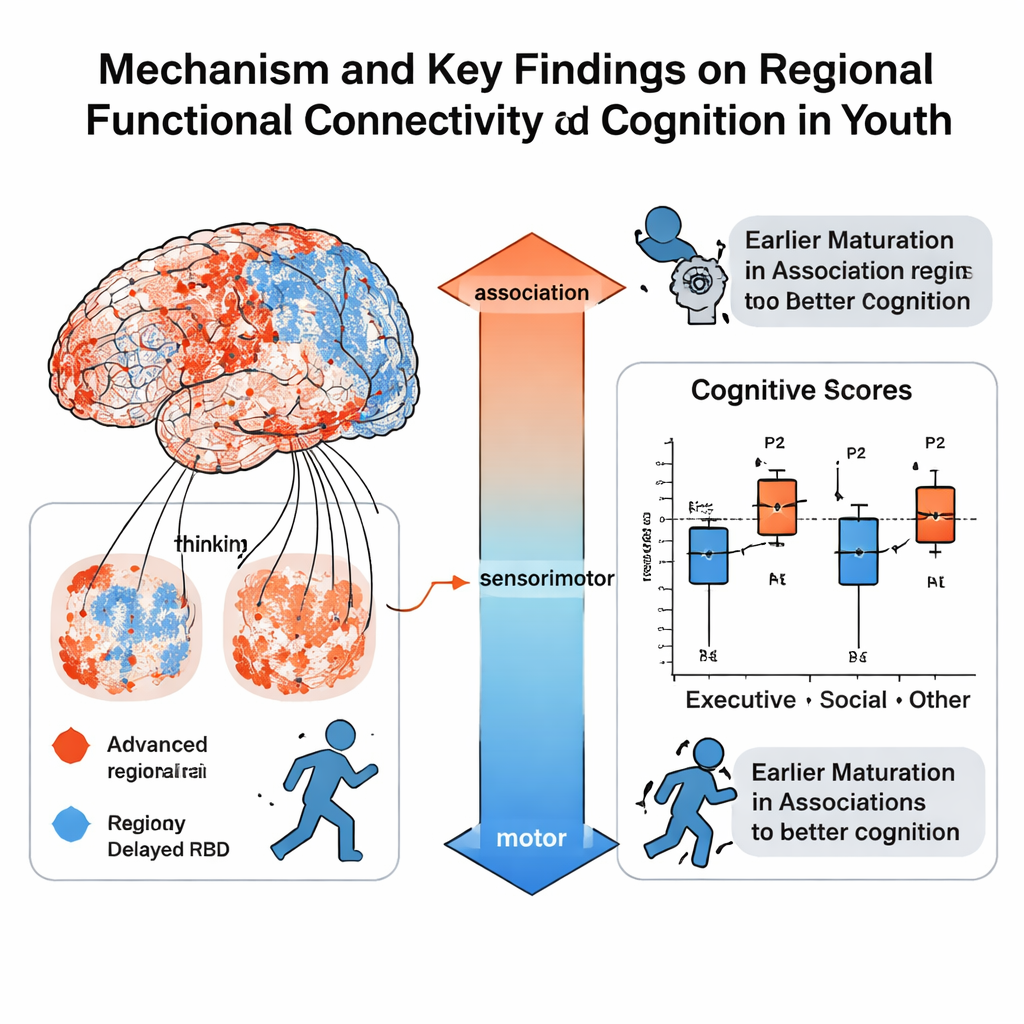
The critical test was whether these brain subtypes mattered for behavior. The researchers compared children’s performance on tasks that measure executive function (planning and self-control), social understanding, and memory. Youth in the subtype with advanced association-region development clearly outperformed those in the other two groups across all three cognitive domains, both in the original Philadelphia cohort and in a second, independent sample from the Human Connectome Project. By contrast, children whose sensorimotor regions were most advanced did not show the same cognitive edge, even though their brains looked globally “older” in some respects. This suggests that where the brain is ahead or behind in its timetable is more important for thinking than overall speed of maturation.
Links to brain hierarchy and microscopic biology
The study also connected these development patterns to the brain’s broader organization and underlying biology. The beneficial subtype aligned with a known axis running from low-level sensorimotor regions to high-level association regions: in these youth, high-level areas tended to be further along in maturation while lower-level regions lagged slightly behind. This pattern also tracked with measures of myelin, the fatty coating that speeds up nerve signals, hinting at structural changes that support more efficient communication. Finally, by comparing the regional development pattern with a large atlas of gene activity in the human cortex, the researchers found that the “high-performing” subtype was enriched for genes involved in neuron differentiation, synapse formation, and myelination—precisely the processes thought to sculpt brain circuits during childhood and adolescence.
What this means for understanding young minds
For non-specialists, the take-home message is that healthy brain development is not just about growing faster or slower overall. Instead, it is about how well the brain’s internal timetable is coordinated: when higher-order thinking regions mature in step with the brain’s natural hierarchy, young people tend to show stronger memory, social skills, and executive abilities. This more fine-grained, region-by-region view of brain “age” could eventually help researchers better understand why some children thrive while others struggle, and may one day guide more personalized approaches to education and mental health—though much more work, especially with long-term follow-up, is needed before it can be used in practice.
Citation: Li, H., Cui, Z., Cieslak, M. et al. Spatial heterogeneity and subtypes of functional connectivity development in youth. Nat Commun 17, 1956 (2026). https://doi.org/10.1038/s41467-026-68707-7
Keywords: brain development, functional connectivity, adolescent cognition, brain age, neuroimaging