Clear Sky Science · en
Experimental witness of quantum jump induced high-order Liouvillian exceptional points
Why sudden quantum jumps can sharpen our measurements
In everyday life, randomness usually blurs what we can see or measure. In quantum physics, random "jumps" of atoms between energy levels are often viewed the same way: as a source of noise that destroys delicate quantum states. This study turns that notion on its head. The authors show that these quantum jumps can actually create special "sweet spots" in an open quantum system where its response to tiny changes is dramatically amplified. Understanding and controlling such behavior could lead to more precise sensors and new ways to steer energy and information in future quantum technologies. 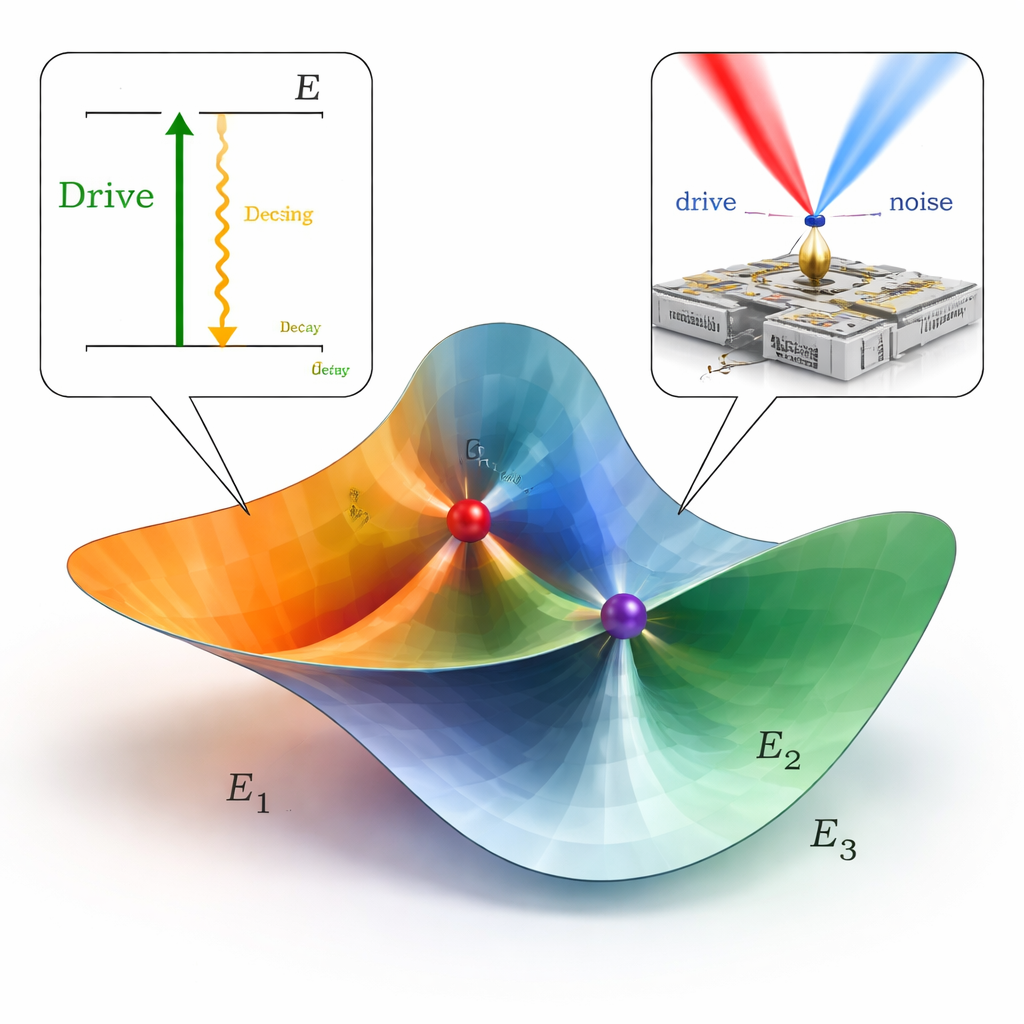
Strange meeting points in quantum landscapes
Many quantum systems can be pictured as a landscape of energy levels that depend on external knobs, such as laser power or loss. In most cases, different energy levels remain distinct. But in non-Hermitian systems—those that include gain, loss, and decoherence—two or more levels can merge together along with their underlying states. These rare mergers are called exceptional points. At such points, the system becomes extremely sensitive: a tiny change in a control parameter can cause a disproportionately large change in its behavior. Exceptional points have already been explored in optical devices, mechanical systems, and circuits, where they enable one-way signal flow, unusual mode switching, and enhanced sensing.
From idealized models to real, noisy quantum matter
Most earlier work treated exceptional points using simplified, effective models that only track the coherent part of quantum evolution and deliberately ignore the random quantum jumps caused by the environment. That approach is good for intuition but incomplete. To fully describe an open quantum system, one must include both coherent evolution and all the jump processes into and out of the system. Mathematically, this is done with a Liouvillian superoperator, which acts not on wavefunctions but on density matrices that encode probabilities. When different modes of this Liouvillian operator merge, the result is a Liouvillian exceptional point. Because the Liouvillian lives in a higher-dimensional space, it can host higher-order exceptional points—where three states meet instead of just two—even in a very simple physical system.
Ion trap as a clean playground for jumps and noise
To explore these ideas experimentally, the authors use a single, ultracold calcium ion held above a microfabricated chip trap. Two of the ion’s internal levels are chosen to form an effective two-level system: a ground state and a long-lived excited state. A narrow laser at 729 nanometers drives transitions between the two, while another laser at 854 nanometers causes the excited state to decay back down. On top of this, the researchers introduce controlled dephasing—random phase fluctuations—by feeding white noise into the 729-nanometer laser through an acousto-optic device. By carefully calibrating how laser power and noise amplitude translate into decay and dephasing rates, they can dial in any desired combination of these two types of dissipation. 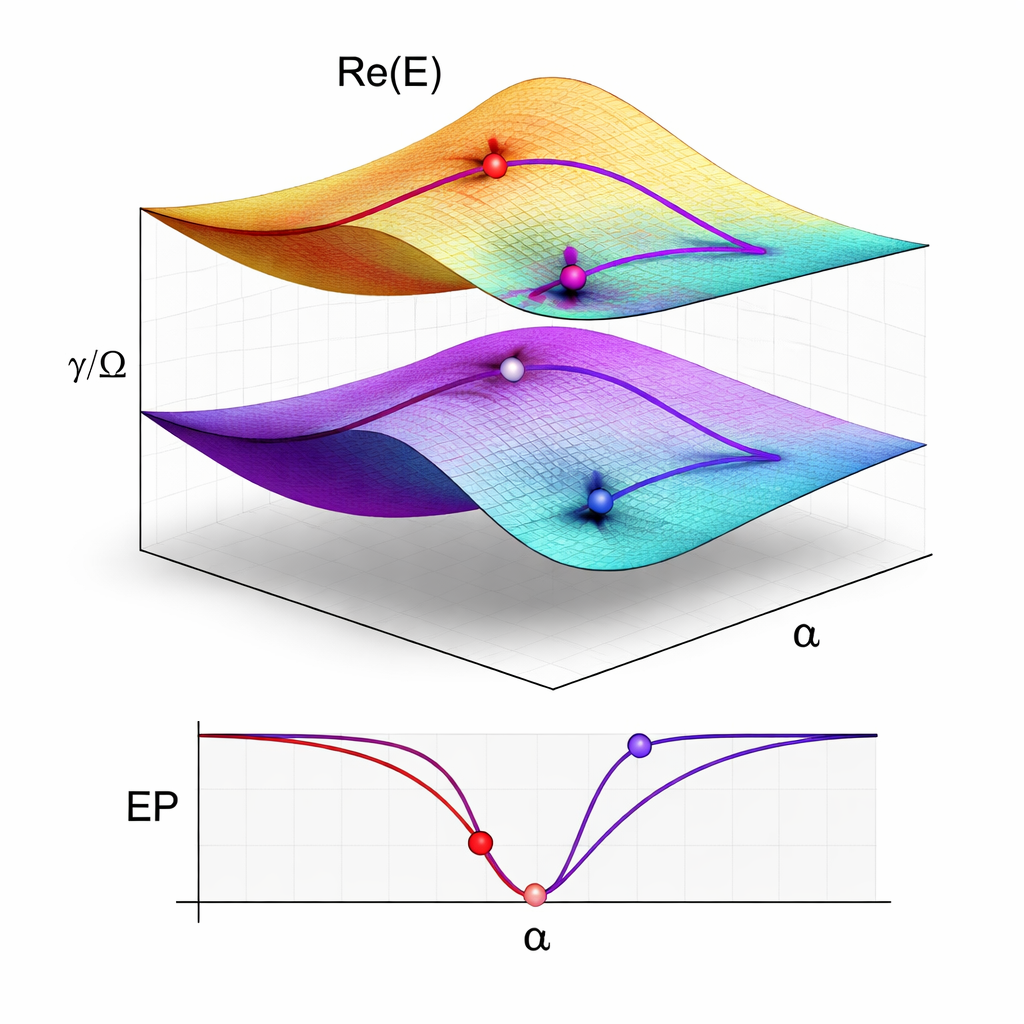
Watching exceptional points move under competing noise
With the system parameters tuned, the team reconstructs the ion’s steady-state density matrix through full quantum state tomography, extracting the effective eigenvalues of the Liouvillian. This allows them to map out where degeneracies occur. They identify second-order Liouvillian exceptional points—where two modes coalesce—and track how their locations shift as the balance between decay and dephasing is changed. A key insight is that the Liouvillian pieces describing decay and dephasing do not commute: they cannot be simultaneously diagonalized. Because of this, their competition pushes the exceptional points along a trajectory in parameter space, even making them disappear to infinity when decay and dephasing are perfectly balanced. By introducing a small detuning of the drive laser, they further reveal third-order Liouvillian exceptional points, where three modes merge. These higher-order points arise only when quantum jumps are fully included; they cannot appear in a simple two-level Hamiltonian model.
How randomness can boost precision and control
For a non-specialist, the takeaway is that the “messy” parts of quantum systems—loss, decoherence, and sudden jumps—are not just nuisances to be suppressed. When engineered correctly, they reshape the system’s dynamical landscape and create special points of extreme sensitivity and rich topology. Near the observed third-order Liouvillian exceptional points, the system’s response to small parameter changes becomes especially steep, suggesting new strategies for ultra-sensitive quantum sensing. The ability to move these points around by tuning decay and dephasing also opens routes to switch topological behavior on and off in a controlled way. In short, the work shows that quantum jumps can be harnessed as a resource, turning environmental noise into a powerful tool for precision measurement and robust quantum control.
Citation: Wu, ZZ., Li, PD., Cui, TH. et al. Experimental witness of quantum jump induced high-order Liouvillian exceptional points. Nat Commun 17, 1923 (2026). https://doi.org/10.1038/s41467-026-68705-9
Keywords: exceptional points, non-Hermitian quantum physics, trapped ions, quantum jumps, precision sensing