Clear Sky Science · en
Hierarchical maturation of structural brain connectomes from birth to childhood
How Baby Brains Build Their Wiring
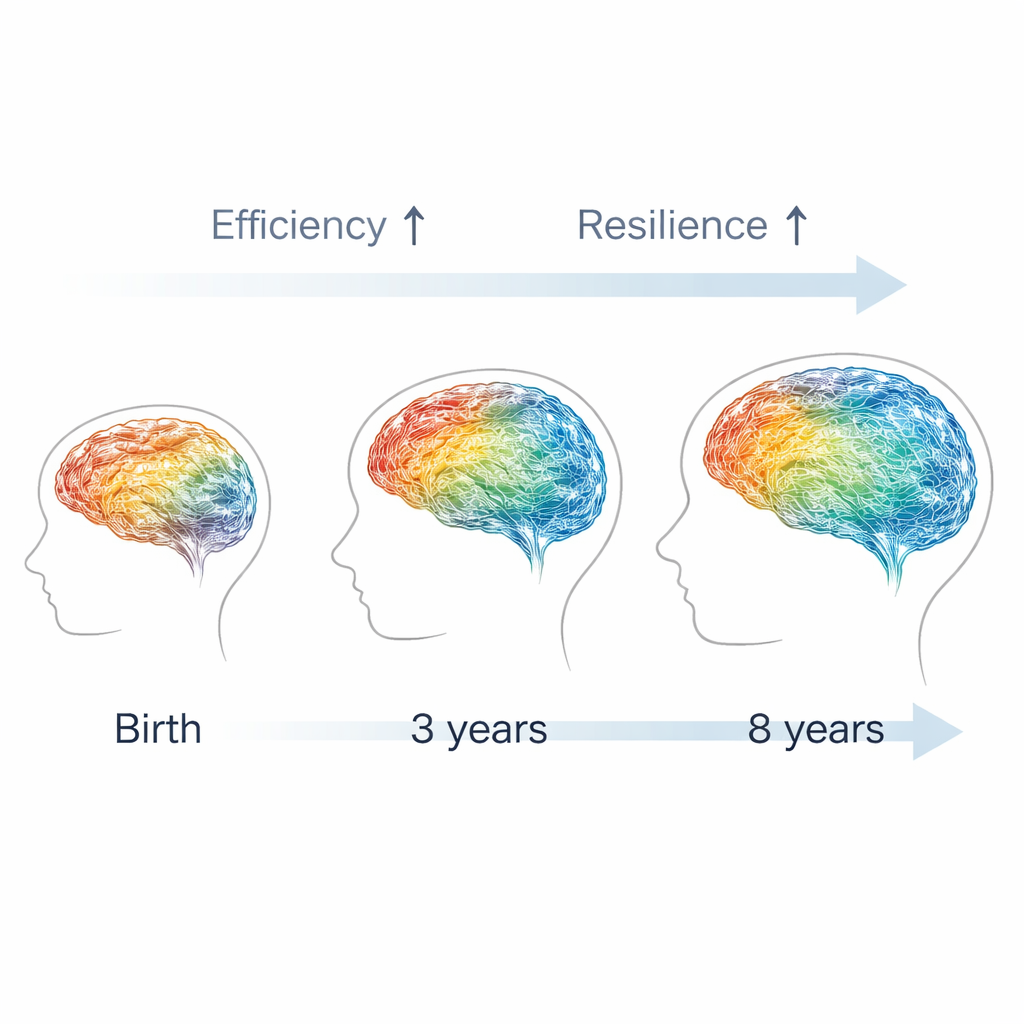
The first years of life are a time of astonishing brain change. Behind every new skill—from a baby’s first smile to a schoolchild’s problem‑solving—lies a fast‑evolving web of nerve fibers that connect different brain regions. This study tracks how that wiring network, called the structural connectome, grows and reorganizes from birth to eight years of age, revealing when and where the brain’s communication system becomes fast, efficient, and resilient.
A Growing Map of Brain Highways
The authors combined advanced MRI scans from more than 200 typically developing children between birth and eight years old. Instead of looking at single brain regions, they treated the brain like a city map, where areas of gray matter are “neighborhoods” and white matter fibers are “roads.” Using tools from network science, they measured how easily information can travel through this road system and how well it keeps working when key junctions are disrupted. They then compared many possible growth curves to see how the network changes over time.
Faster, Tougher Connections in Early Life
Across the whole brain, communication became both faster and more reliable with age. Measures of global and local efficiency—how quickly signals can move across long distances and within local clusters—rose sharply in infancy and then leveled off toward childhood. At the same time, the network became more robust: it was increasingly able to withstand the loss of important nodes, such as heavily connected “hub” regions, without falling apart. These trends suggest that the brain rapidly optimizes its wiring in the first few years, building a system that is both efficient and fault‑tolerant, rather than simply growing bigger.
Different Timetables for Basic Senses and Higher Thought
The study also uncovered striking differences between brain areas that handle basic senses and movement and those that support complex thinking and emotions. Regions in primary sensory and motor areas showed steady, more gradual improvements in communication capacity. In contrast, higher‑order association regions—especially in the prefrontal and insular cortices—showed rapid, nonlinear gains that peaked before age three and continued to refine into childhood. These higher‑order areas increasingly gathered as densely connected hubs and shifted their module memberships, meaning they changed which “sub‑networks” they coordinated. Early patterns of change in these association regions were strong predictors of how the network would look around age eight, whereas early changes in primary regions were less predictive.
Biology Behind the Brain’s Wiring Plan
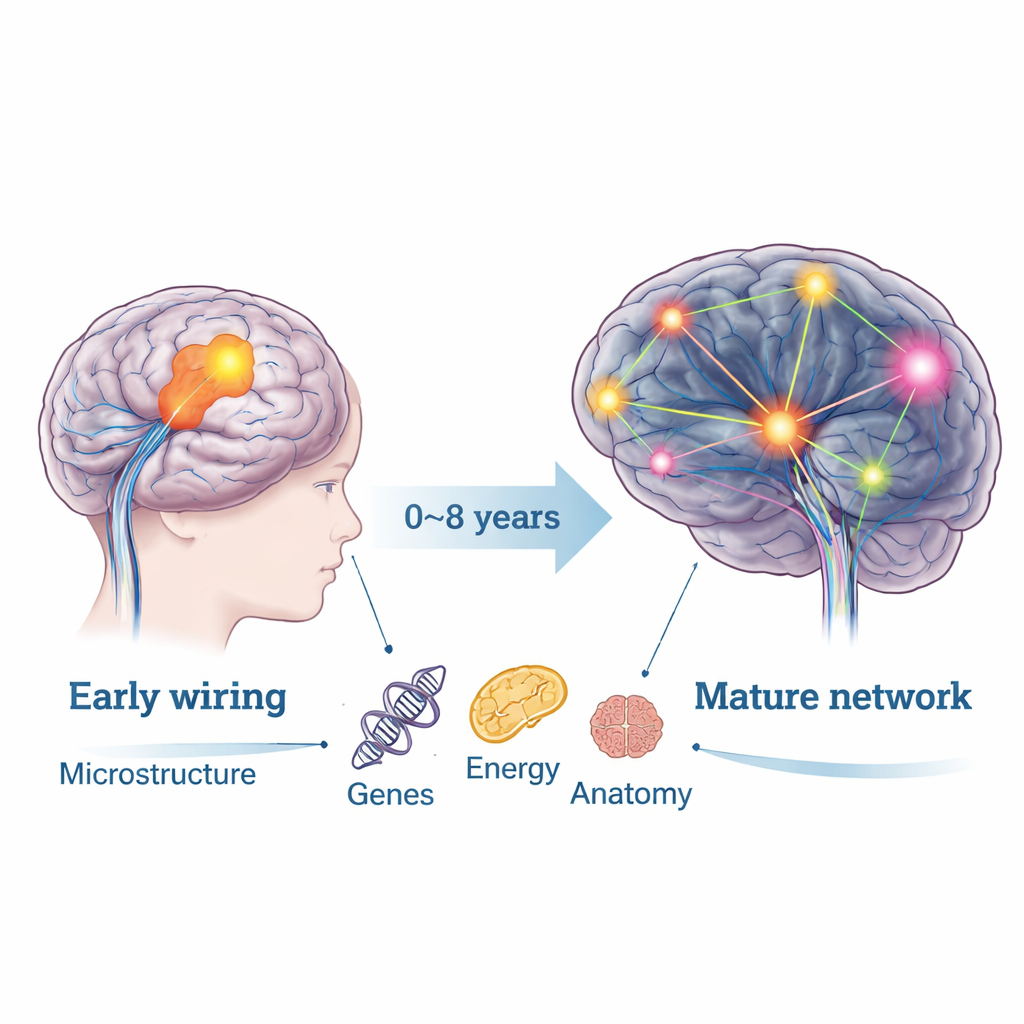
To understand why this hierarchy emerges, the researchers compared the network changes with many independent brain maps that reflect anatomy, evolution, energy use, and gene activity. Places where communication efficiency increased most aligned with regions that are less myelinated at birth, expanded most during human evolution, and sit high on known sensory‑to‑association gradients. Regions whose modular roles were most flexible lined up with areas of higher blood flow and energy use, suggesting that the costliest parts of the brain are also the most adaptable. The team further showed that improvements in local white matter microstructure—particularly measures linked to axon growth and myelination—helped explain how early changes in association‑area efficiency lead to the highly connected networks seen in later childhood.
Why These Early Years Matter
Together, these findings paint a picture of a brain that does not mature evenly, but according to a built‑in hierarchy. Basic sensory and motor systems provide stable input early on, while association regions undergo rapid, energy‑hungry remodeling that shapes the communication backbone for later thinking, emotion, and behavior. Because the most dramatic changes occur before about age three, this work underscores how sensitive the early years are—and why disruptions to white matter development during this window could have lasting effects on learning and mental health.
Citation: Zhao, T., Ouyang, M., Shou, XJ. et al. Hierarchical maturation of structural brain connectomes from birth to childhood. Nat Commun 17, 1945 (2026). https://doi.org/10.1038/s41467-026-68704-w
Keywords: brain development, white matter, connectome, childhood, neuroimaging