Clear Sky Science · en
Ultrafast dynamic stark shift of an exciton-polariton condensate
Shaping Quantum Light with Gentle Touch
Imagine being able to nudge a laser-like quantum fluid of light and matter without disturbing its delicate order, and to do it a thousand times faster than today’s fastest computer chips switch. This study shows how ultrafast flashes of light can briefly shift the energy of a special quantum state—an exciton‑polariton condensate—in solid‑state devices. That ability could become a key ingredient for future all‑optical logic and quantum technologies, where information is processed and routed entirely by light.
A Hybrid Fluid of Light and Matter
Inside a carefully engineered semiconductor “hall of mirrors,” light bounces between mirrors and strongly binds to electronic excitations in thin quantum wells. The result is a new kind of particle, an exciton‑polariton, which behaves like a lightweight boson carrying both light and matter traits. When enough of these particles gather, they can lock together into a single, coherent quantum state called a condensate, emitting laser‑like light with very low power and revealing collective behavior similar to superfluids in cold‑atom experiments, but in a compact chip‑like structure.
A Fast, Non‑Invasive Quantum Knob
In gases of ultracold atoms, researchers have long used the “dynamic Stark effect”—off‑resonant light that shifts energy levels without creating real particles—to sculpt and steer condensates into patterns like lattices, solitons, and vortices. In solid‑state polariton systems, however, most ways of shaping the condensate rely on injecting extra carriers, which tends to scramble the fragile quantum state and acts too slowly. The authors set out to show that the same gentle Stark trick used in cold‑atom physics can be applied to a polariton condensate, shifting its energy on femtosecond time scales (a millionth of a billionth of a second) without destroying its coherence.
Watching Ultrafast Shifts in Real Time
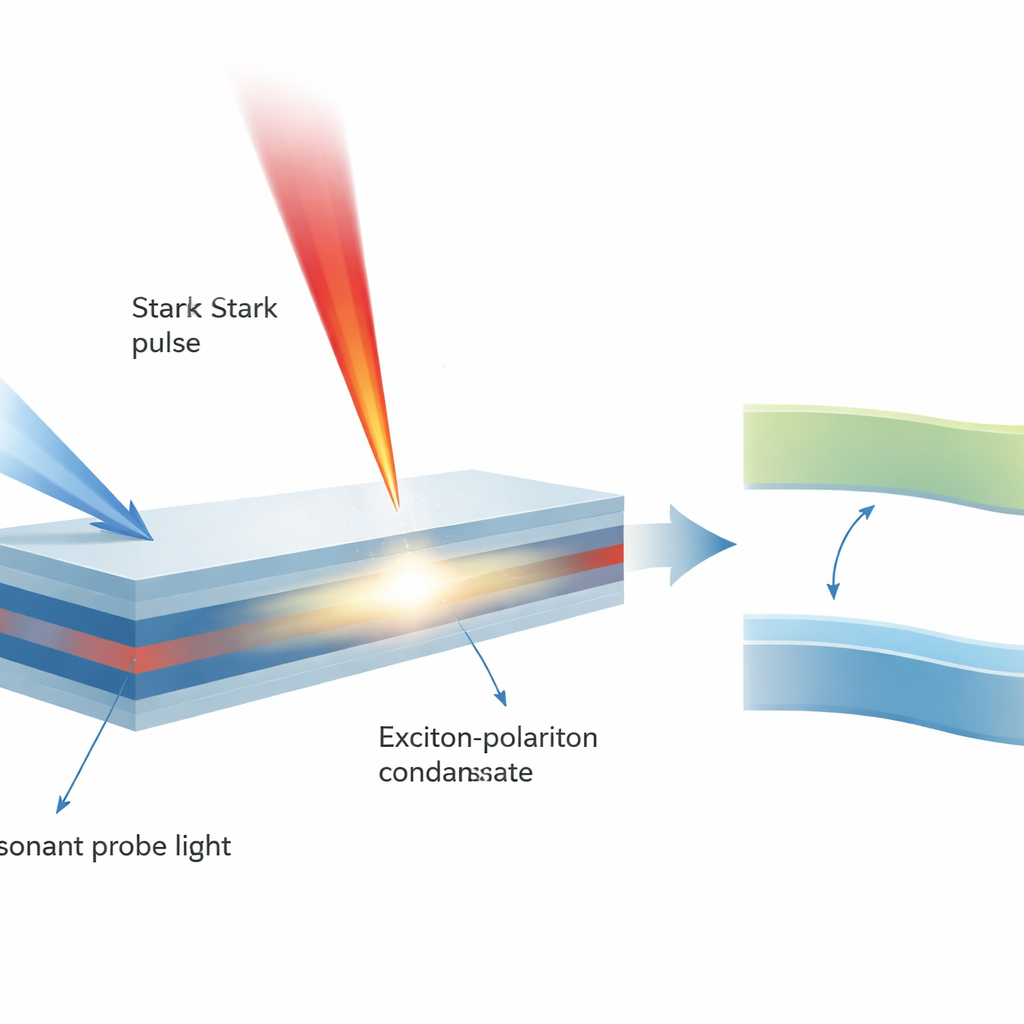
The team built a pump–probe setup that uses two ultrashort laser pulses. One pulse, the probe, is tuned near the polariton energies and both creates and interrogates the polaritons; by increasing its intensity, it drives the system from a sparse gas into a dense condensate. A second pulse, the Stark beam, is tuned below resonance so it cannot efficiently create new carriers, but it can temporarily shift the energy of the polariton levels. By measuring how the reflected probe light changes when the Stark beam arrives at different time delays, the researchers obtained “differential reflectivity” spectra that track how the polariton energies move and how long the induced polarization remains coherent.
Signatures of Condensation in Light Echoes
When the system is below the condensation threshold, the Stark pulse produces a short‑lived upward shift (blueshift) in the absorption dips associated with the lower and upper polariton branches. As the probe intensity increases and a condensate forms, two things change. First, repulsive interactions among densely packed polaritons push the lower branch to higher energy, a hallmark of condensation. Second, the Stark effect now acts on a bright, highly populated state: instead of shifting a dark absorption dip, it shifts a luminous emission peak from the condensate. The timing of the maximum shift also changes—reaching its peak only after polaritons have relaxed into the lowest‑energy states—directly tying the effect to the formed condensate rather than to uncondensed particles.
Coherence Survives the Ultrafast Jolt
Beyond static energy shifts, the measurements reveal subtle oscillating fringes in the spectra when the Stark pulse follows the probe. These oscillations arise from interference between early emission and emission modified by the Stark pulse, and their decay time reflects how long the induced polarization remains phase‑coherent. Below threshold, increasing polariton density actually shortens this coherence time, as interactions introduce disorder. At a critical density, the trend abruptly reverses: once a condensate forms, the oscillations persist far longer, indicating a sharp increase in temporal coherence and a narrowed spectral linewidth. Crucially, this prolongation survives even in the presence of the intense Stark pulse, showing that the ultrafast energy modulation does not destroy the condensate’s quantum order.
Toward Light‑Based Logic and Quantum Devices
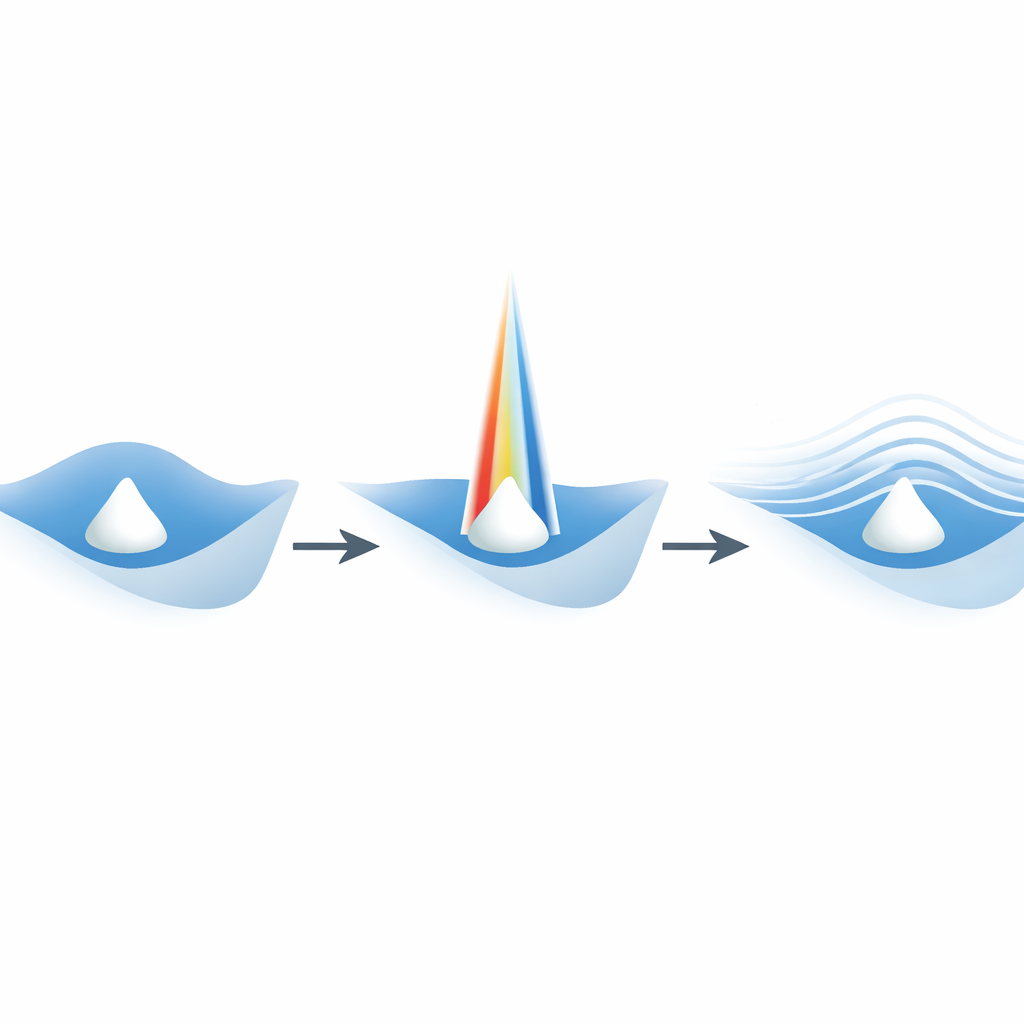
By demonstrating that a polariton condensate can be shifted in energy coherently and reversibly on femtosecond time scales, this work adds a powerful new “knob” for controlling quantum fluids of light in solid‑state platforms. The ability to rapidly and non‑invasively modulate condensate energies opens the door to exploring nonequilibrium quantum phases that mirror those in cold‑atom systems, but on a chip. It also suggests ways to build ultrafast, low‑power optical switches, logic gates, and potentially quantum information elements that use polariton condensates as active components, bringing the dream of light‑driven computing and communication a step closer to reality.
Citation: Feldman, S., Panna, D., Landau, N. et al. Ultrafast dynamic stark shift of an exciton-polariton condensate. Nat Commun 17, 2089 (2026). https://doi.org/10.1038/s41467-026-68703-x
Keywords: exciton-polariton condensate, dynamic Stark effect, ultrafast optics, quantum fluids of light, all-optical switching