Clear Sky Science · en
The biological role of local and global fMRI BOLD signal variability in multiscale human brain organization
Why small changes in brain activity matter
Our brains are never truly at rest. Even when we sit quietly, brain activity rises and falls from moment to moment. For years, many scientists treated these fluctuations as random “noise” that should be averaged away. This study asks a simple but powerful question: what if that apparent noise is actually a meaningful signal that tells us how the brain is organized and how it stays flexible across life? By digging into tiny ups and downs in brain scans, the authors show that this variability is a core feature of healthy brain function, not a defect.

Looking at the brain’s moment-to-moment flicker
The researchers focused on a common brain imaging method called fMRI, which tracks changes in blood oxygen as a stand-in for neural activity. Instead of averaging these signals over time, they measured how much the signal changed from one time point to the next in each brain region. They called this “local variability” and captured it with a simple mathematical measure of moment-to-moment change. They also studied “global variability” – how the communication patterns between regions, or functional connections, shift over time. To do this, they used a method that summarizes how whole-brain connection patterns drift and reorganize during a scan, giving each region a score for how flexible its connections are.
Testing whether variability is real or just scanner noise
To be sure they were not simply measuring random artefacts from the scanner, the team analyzed several large, publicly available datasets. These included young adults scanned with different fMRI settings, as well as people spanning the adult lifespan. They showed that global variability measures were highly reliable: individuals showed similar patterns across repeated scans, and key results held up across different scanning protocols. Both local and global variability changed with age in a way that matches earlier work: older adults tended to have a dampened dynamic range, meaning their brain activity and connections fluctuated less over time. These findings argue that variability captures stable, biology-driven features rather than measurement noise.
Linking brain flicker to cells, chemistry, and metabolism
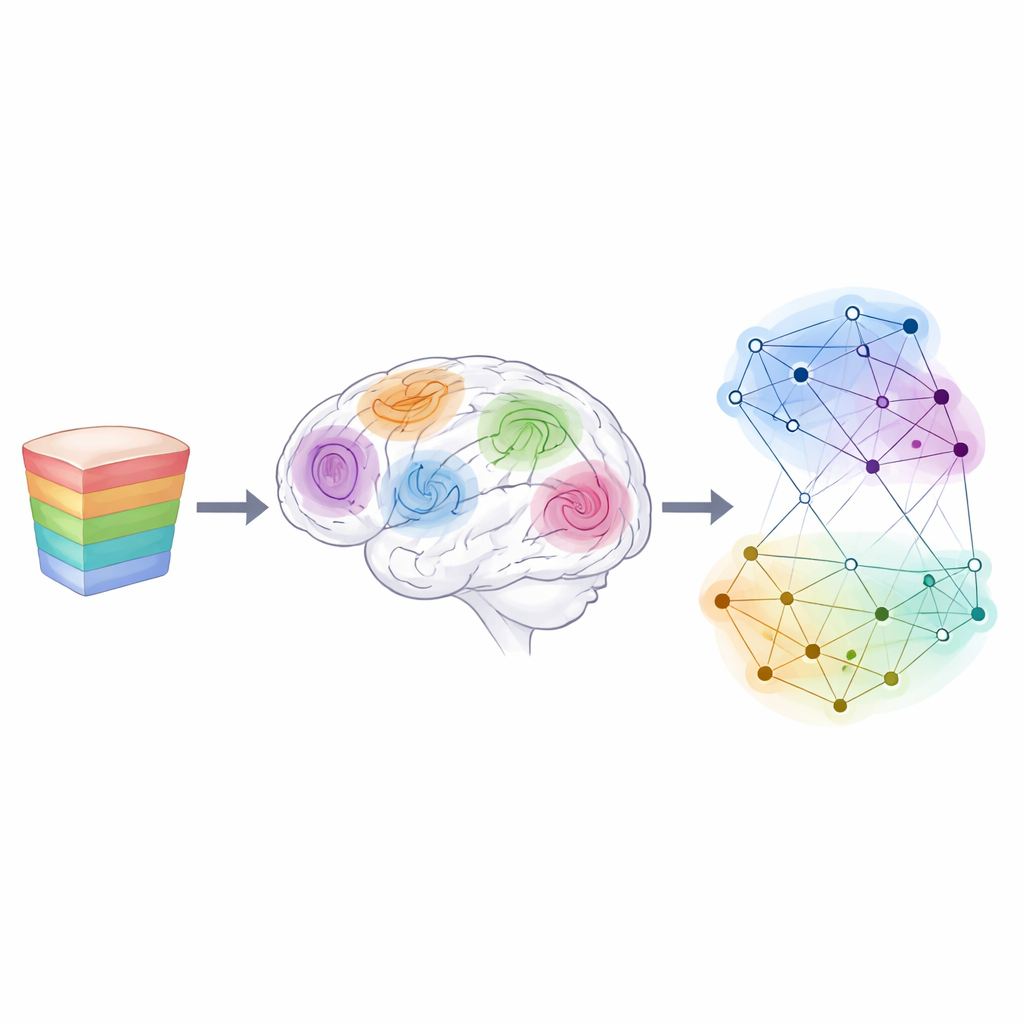
Next, the authors asked how these variability patterns line up with what is known about brain anatomy and chemistry. They mapped fMRI variability onto detailed atlases built from post-mortem tissue, high-resolution MRI of brain microstructure, gene expression, and PET scans of neurotransmitter receptors and metabolism. Local variability was highest in sensory regions that have a prominent input layer and dense, diverse cell populations. These regions also showed strong blood flow and high energy use, suggesting that rapid, rich processing of incoming information goes hand-in-hand with a wide range of possible responses. Global variability, in contrast, peaked in higher-order “association” areas that tie information together across the brain. There it was linked to slower, more diffuse signaling systems and to known gradients that run from basic sensory processing to abstract cognition.
Connecting fMRI variability to fast brain rhythms
Because fMRI is relatively slow, the team turned to magnetoencephalography (MEG), which records brain activity at millisecond resolution. They computed MEG-based measures similar to local variability and also looked at the shape of the brain’s power spectrum, which describes how strong different frequencies are. Flatter spectra – which resemble white noise and include more high-frequency activity – went along with greater local variability, both in real recordings and in simulated data. When they compared MEG and fMRI across the cortex, they found consistent relationships between the two, indicating that the slow fMRI fluctuations are rooted in underlying electrical processes rather than arbitrary drift.
What this means for understanding the brain
Taken together, the results show that variability in brain signals is not a trivial nuisance. It is spatially patterned, stable, and tightly linked to how cells are arranged, how chemicals carry messages, how blood delivers energy, and how fast neurons fire. Local variability reflects the rich, ever-changing responses of input-driven areas, while global variability reflects the flexible coordination of large-scale networks. As we age, these dynamic ranges shrink, which may help explain changes in thinking and behavior. For a lay reader, the key message is that a healthy brain is not a perfectly steady machine but a finely tuned, slightly unpredictable system whose small fluctuations are essential for adaptation and resilience.
Citation: Baracchini, G., Zhou, Y., da Silva Castanheira, J. et al. The biological role of local and global fMRI BOLD signal variability in multiscale human brain organization. Nat Commun 17, 2189 (2026). https://doi.org/10.1038/s41467-026-68700-0
Keywords: brain signal variability, functional MRI, brain networks, neuroimaging, neural dynamics