Clear Sky Science · en
The network architecture of general intelligence in the human connectome
Why this matters for everyday thinking
When we talk about “intelligence,” we usually imagine a smart spot in the brain that does the heavy lifting on tests and tough decisions. This study turns that picture on its head. Using advanced brain‑scanning and network analysis in hundreds of young adults, the authors show that general intelligence is not housed in one mental “CPU,” but instead grows out of the way the entire brain’s wiring is organized and works together.
A web of many brain communities
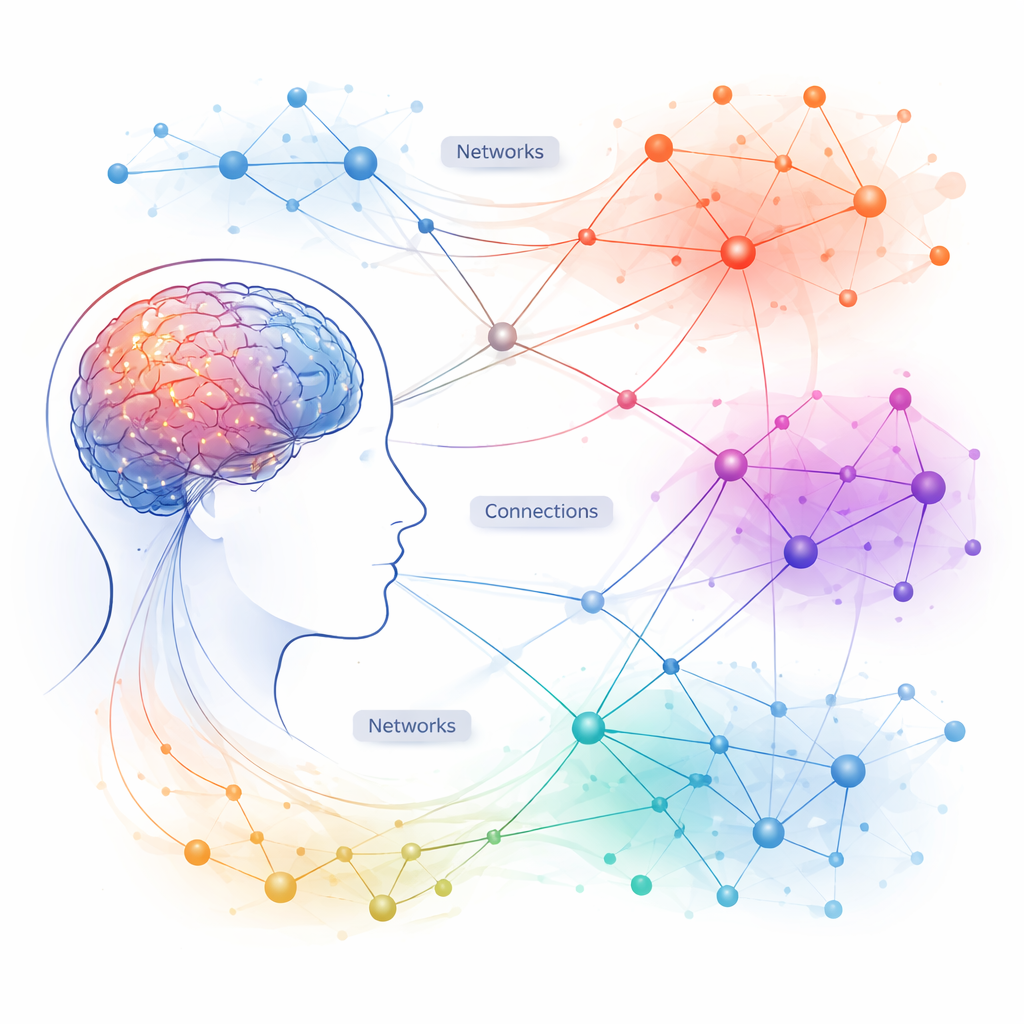
Scientists often measure general intelligence, or g, as the shared ability that explains why people who do well on one kind of mental task, such as reasoning, also tend to do well on others, like memory or processing speed. Here, the researchers first built a careful statistical model of g using a broad battery of tests covering vocabulary, reasoning, memory, attention, and speed. They then asked how well patterns of connections across the whole brain could predict a person’s g score. Rather than focusing on single “intelligence centers,” they treated the brain as a web of 12 large-scale networks, including systems for vision, hearing, movement, attention, language, and high‑level control.
Intelligence as teamwork, not a single hero
When the team trained predictive models on brain connectivity data, they found that using the complete, brain‑wide network gave the best forecast of people’s intelligence scores. Individual networks — even those long thought to be key, such as the fronto‑parietal control network — could not match the whole‑brain model. In fact, removing any one network hardly hurt prediction at all. What mattered most were the connections running between networks, linking sensory systems, attention hubs, and control regions into a coordinated whole. This suggests that intelligence depends less on the strength of any single brain module and more on how well many communities talk to one another.
The quiet power of long-distance links
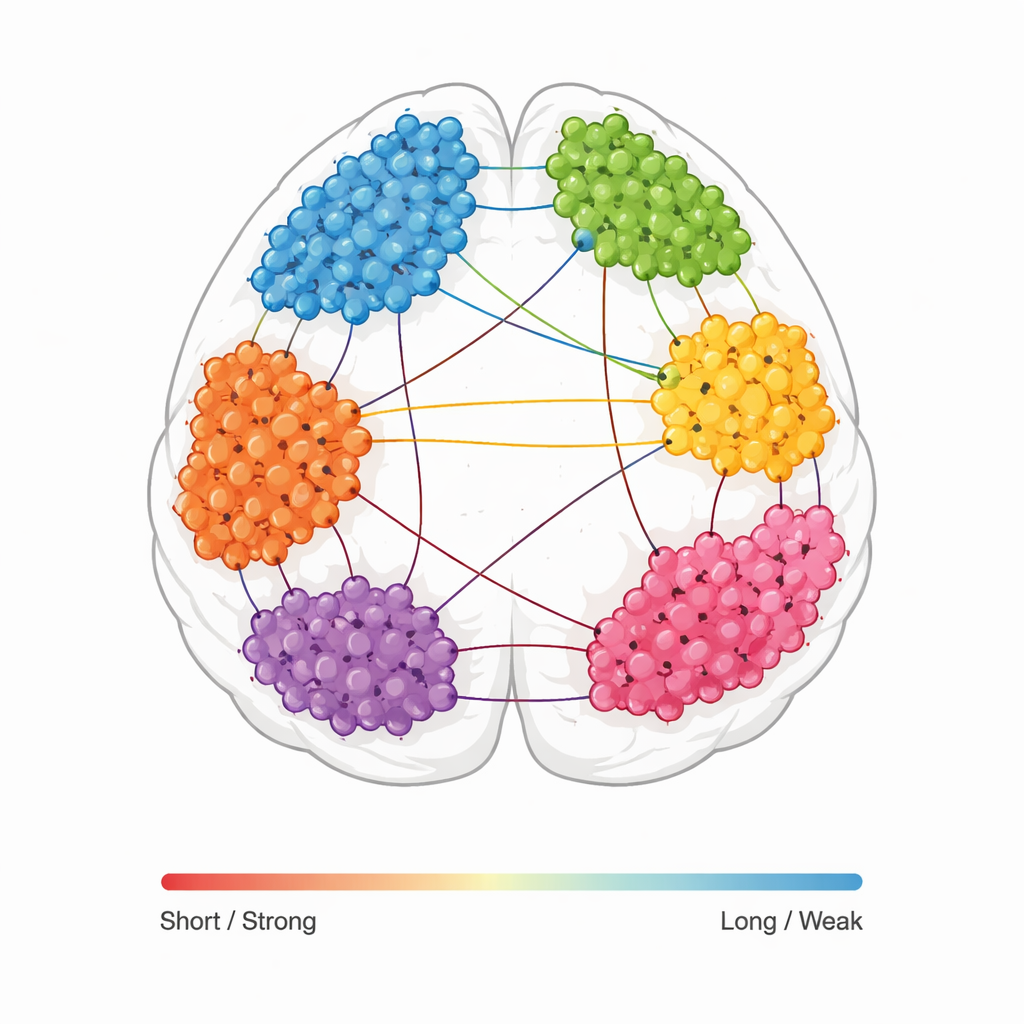
A central idea in this work is the importance of “weak ties”: relatively subtle, long‑range links that bridge distant regions of the brain. By combining structural scans (which show physical wiring) with functional scans (which show regions that activate together at rest), the authors could detect these delicate pathways more reliably than earlier methods. They found that people with higher g tended to have longer connections that were weaker in raw strength but more informative for predicting intelligence. At the same time, their shorter, local connections tended to be stronger. In other words, smart brains appear to pair tight local clusters with a set of lighter, long‑distance bridges that allow information to travel efficiently across the whole system.
Brain “traffic controllers” and small-world design
The study also looked at special regions that act like traffic controllers, able to push the brain into different activity patterns needed for complex, goal‑directed thought. Using tools from control theory, the researchers showed that a person’s profile of these controller regions — spread across attention, control, and even visual areas — was linked to their g score. Finally, they examined the brain’s overall layout and found that higher intelligence was associated with a “small‑world” design: dense local neighborhoods connected by a limited number of shortcuts that keep the average communication distance low. This architecture balances specialization with integration, allowing the brain to switch flexibly between focused processing and broad coordination.
Rethinking what makes a brain smart
For a layperson, the key message is that intelligence is less about having a single powerful brain region and more about owning an efficient, well‑organized mental city. In this city, neighborhoods handle their own specialties, weak but well‑placed roads connect distant districts, and a handful of hubs can redirect traffic when new problems arise. The findings push researchers to move beyond hunting for an “intelligence center” and instead study how global wiring, long‑distance connections, and control hubs together give rise to the flexible thinking that helps us solve the many different challenges of everyday life.
Citation: Wilcox, R.R., Hemmatian, B., Varshney, L.R. et al. The network architecture of general intelligence in the human connectome. Nat Commun 17, 2027 (2026). https://doi.org/10.1038/s41467-026-68698-5
Keywords: general intelligence, brain networks, human connectome, small-world topology, network neuroscience