Clear Sky Science · en
Quantum Hall effect at 0.002 T in graphene
Why this strange quantum effect matters
Electronics are built from trillions of electrons flowing through materials, yet we rarely control them with true atomic-scale precision. In this work, researchers show that graphene—an atom-thin sheet of carbon—can host exquisitely clean electron motion, so clean that a famous quantum effect usually seen in powerful magnets appears in fields weaker than those from a fridge magnet. This kind of control brings us closer to quantum electronics that work in practical conditions, not just in extreme labs.
Building a quieter playground for electrons
Graphene is celebrated because its electrons behave like massless particles, zipping through the material at high speed with very little resistance. In real devices, however, dust, charges in the substrate, and rough edges create an uneven landscape that scatters electrons and hides graphene’s best properties. The team tackled this by stacking two separate graphene layers with an ultra-thin insulating sheet of hexagonal boron nitride (hBN) between them, all encapsulated in thicker, clean hBN and controlled by graphite gates. In this carefully engineered sandwich, electrons in one graphene layer help screen out random electric fields that would otherwise disturb electrons in the other layer. The result is a far more uniform environment where electrons can travel almost unhindered. 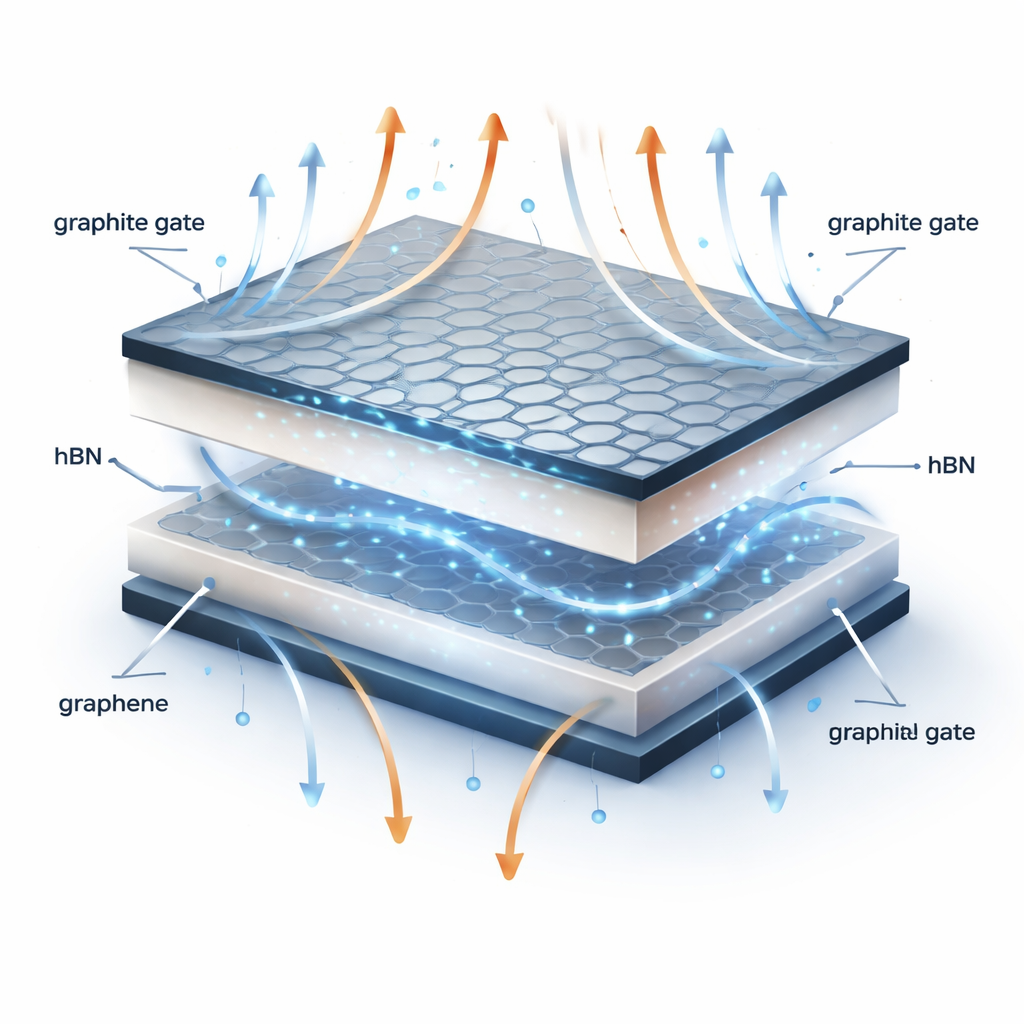
How double layers tame disorder
To understand why the double-layer design works so well, the researchers examined how the two sheets of graphene interact electrically. The thin hBN separator blocks actual current from tunneling between the layers, so each behaves like an independent channel. But charges in one layer still respond to electric fields produced by impurities, effectively shielding the other layer. Theory shows that as the spacing between layers shrinks, this mutual screening grows stronger, lengthening the time electrons travel before being scattered and boosting their mobility by a factor of three to four compared with a single layer. Experiments across several devices with different contact designs and channel widths confirmed that thinner spacers and wider channels yield cleaner, more ballistic electron transport.
Seeing quantum steps in ultra-weak magnets
Such cleanliness allows the team to access the quantum Hall effect, a hallmark of two-dimensional electron systems. Normally, to see this effect—where electrical resistance locks onto precise plateaus as a magnetic field is applied—researchers rely on strong magnets. In the best of these double-layer devices, the first clear quantum Hall plateaus appear at magnetic fields of only about 0.002 tesla, orders of magnitude below typical values and even below many earlier record graphene samples. Measurements of tiny ripples in resistance, known as Shubnikov–de Haas oscillations, suggest a quantum mobility above 107 cm2 V−1 s−1, meaning electrons can travel extraordinarily far between quantum-scattering events. Wider graphene channels and carefully engineered graphite contacts further reduce edge and contact disorder, helping the quantum behavior appear at these vanishingly small fields. 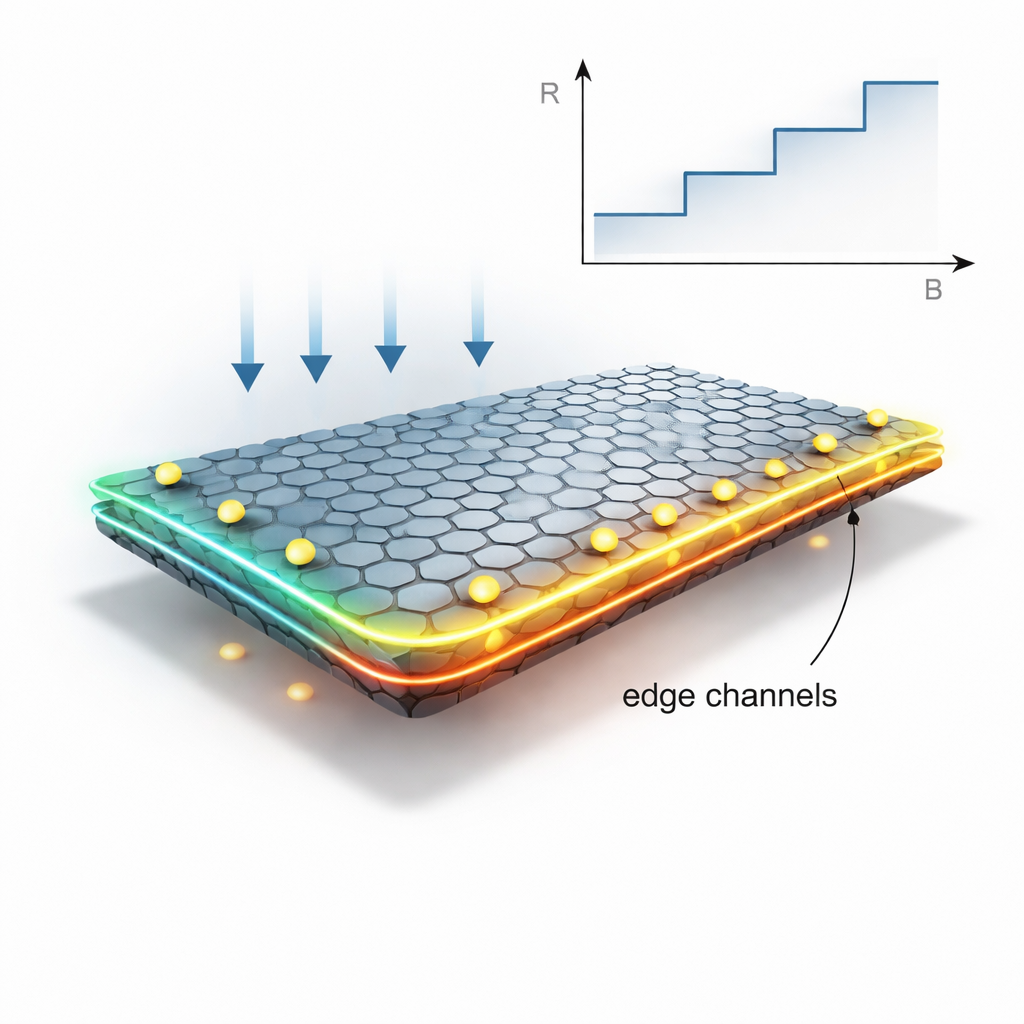
Fractional electrons and delicate correlations
The researchers pushed further by raising the magnetic field into the tesla range to look for the fractional quantum Hall effect, where strong interactions cause electrons to form new collective states that act as if they carry fractions of an electron’s charge. Remarkably, they observed a robust fractional plateau at a total filling factor of −10/3 at a field of only 2 tesla, along with additional fractional states at slightly higher fields. By tracking how the resistance changes with temperature, they estimated the energy required to disrupt these states and found gaps that, when scaled, rival or exceed those in other state-of-the-art graphene devices. Importantly, the way screening works in this double-layer arrangement appears to preserve these fragile correlated phases better than earlier methods that relied on nearby metallic gates.
What this means for future devices
In plain terms, the study shows how to build graphene devices where electrons move so smoothly that quantum effects usually reserved for powerful magnets become visible in extremely weak fields, and delicate fractional states still survive. By inserting just a few atomic layers of hBN between two graphene sheets, the team suppresses disorder in the bulk of the material so effectively that the main remaining limitation comes from the sample’s edges and overall width. This approach offers a promising platform for exploring exotic quantum phases and could eventually underpin ultra-sensitive sensors or components for quantum technologies that operate under far more accessible conditions than before.
Citation: Mayorov, A.S., Wang, P., Yue, X. et al. Quantum Hall effect at 0.002 T in graphene. Nat Commun 17, 2003 (2026). https://doi.org/10.1038/s41467-026-68695-8
Keywords: graphene, quantum Hall effect, two-dimensional materials, electron mobility, fractional quantum Hall