Clear Sky Science · en
Chainmail-inspired conformable and switchable microwave metamaterial absorber
Armor for Invisible Electronics
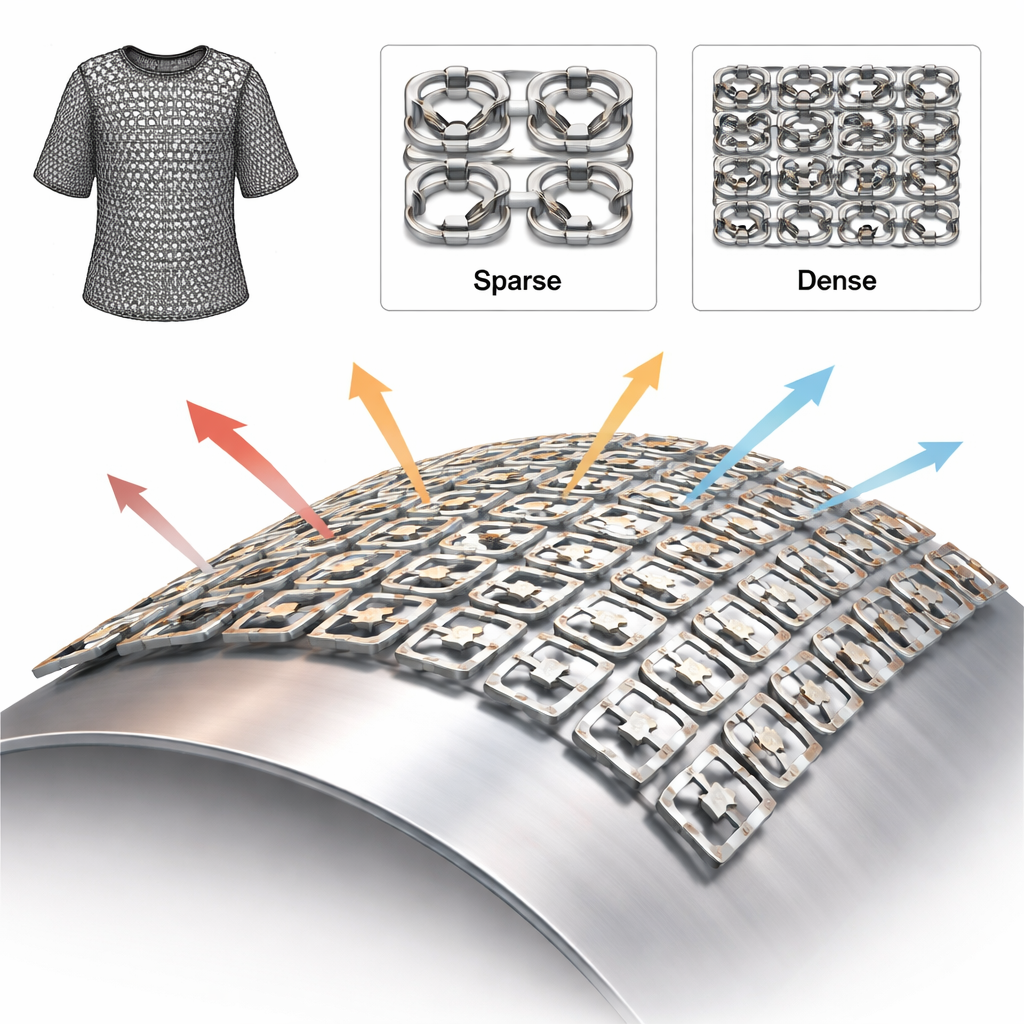
From self-driving cars to 5G base stations, our world is filling up with antennas and radar systems that constantly send and receive microwaves. These signals can interfere with each other or betray the presence of sensitive equipment to radar. This study introduces a new kind of "microwave armor"—a thin, flexible, and tunable material inspired by medieval chainmail—that can cling to almost any shape and soak up a huge range of unwanted microwaves.
Why Traditional Shields Fall Short
Conventional microwave absorbers are usually rigid panels or coatings. They work reasonably well on flat or gently curved surfaces, but modern devices rarely have such simple shapes. Cars, aircraft, tightly packed circuit boxes, and radar domes present complex curves and moving parts. When existing absorbers are bent or stretched to fit, their internal structure distorts, degrading performance and sometimes building up mechanical stress that shortens their lifespan. Flexible foams and rubber sheets help somewhat, but they often sacrifice either strength, bandwidth, or efficiency, and they typically struggle on surfaces that curve in more than one direction at once, like a saddle or a dome.
Borrowing a Page from Medieval Armor
The authors borrow their key idea from chainmail, the ancient armor made of interlocking metal rings. Chainmail is both robust and drapable: hard elements linked loosely so they can slide and rotate. Translating this concept into electromagnetics, the team designed tiny rigid units that link together like a fabric. Each unit consists of a square frame made from ordinary plastic and a cross-shaped inner structure made from a plastic loaded with conductive carbon nanotubes, which efficiently convert microwave energy into heat. Dozens of these cubic rings interlock to form a thin sheet that can be printed in one go with a standard dual-nozzle 3D printer.
A Fabric that Soaks Up a Wide Band of Waves
Careful design of the unit geometry does two jobs at once. Electromagnetically, the cross-shaped inner pieces act a bit like tiny antennas and magnetic loops, setting up resonances that broaden the range of frequencies the sheet can absorb. The final design, only 5.5 millimeters thick, swallows more than 90% of incoming microwaves across most of the 6.2 to 17.6 gigahertz range—covering important bands used in automotive radar and many communication systems—and it works for different polarizations and slanted angles of incoming waves. Mechanically, the added beams and pillars make each unit about ten times stronger than earlier versions, so the material behaves as a tough, wearable mesh rather than a fragile lattice.
Clinging to Curves Without Losing Its Bite
The chainmail layout allows the rigid units to tilt and rotate relative to one another instead of bending or stretching. The researchers show, both by geometric analysis and experiments, that the mesh can tilt significantly in multiple directions and even fully overhang, letting it drape over fingers, wrists, cylinders, saddles, and mixed spherical surfaces. When the sheet is attached to curved metal objects and tested in anechoic chambers, it dramatically reduces the radar cross-section—the apparent size that radar "sees"—while keeping its average absorption nearly unchanged. In fact, its performance degrades far less than that of standard absorbers of the same thickness, especially at higher frequencies, and it can handle shapes that traditional layered materials simply cannot conform to.
Switching Bands Like a Radio Dial
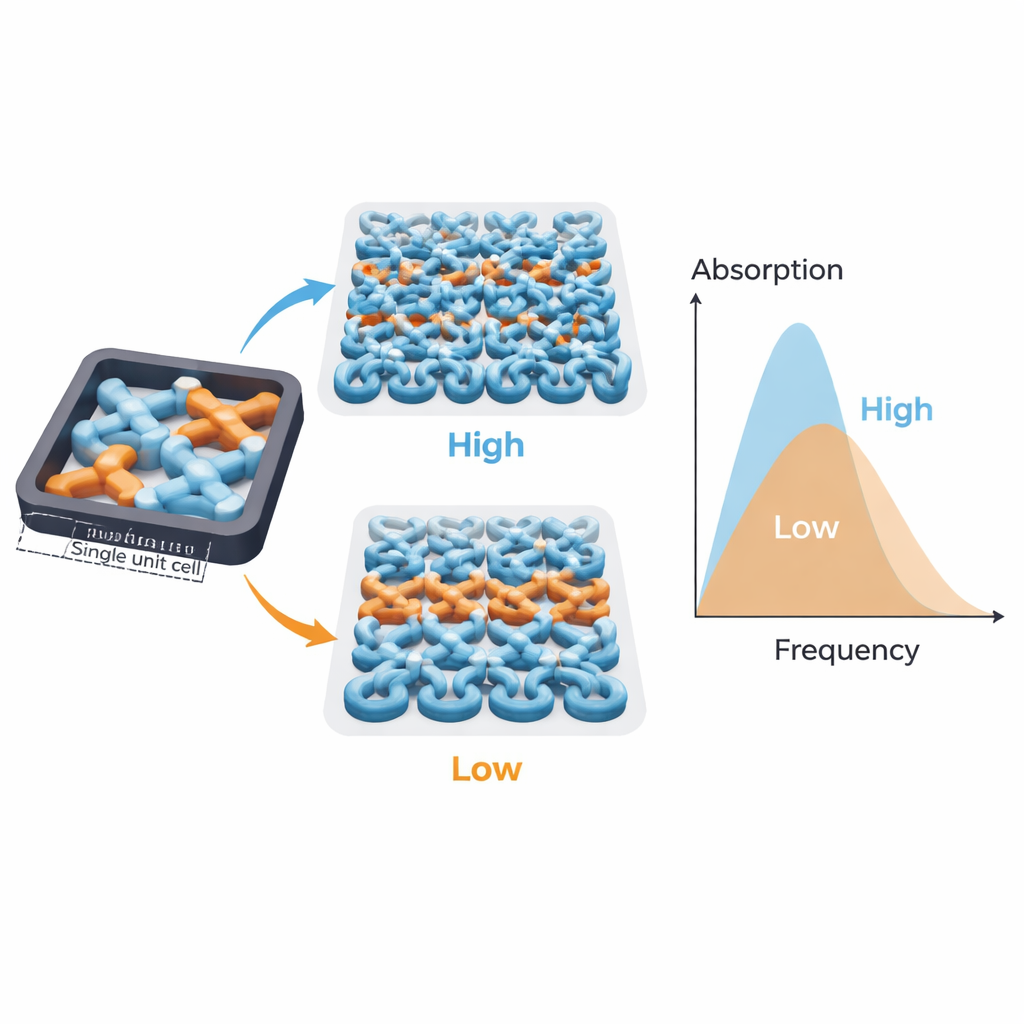
Because the units themselves do not deform, the authors use another trick to make the absorber tunable: they change how tightly the units pack together. By threading elastic bands through the outer rows and pulling the edges inward with a small motor, they can smoothly shrink the sheet from 30 to 24 centimeters across, or let it expand back. This motion densifies or loosens the mesh, shifting its main absorption band between lower and higher microwave frequencies. Measurements show that, by switching between sizes, the same thin sheet effectively covers from about 4.6 to 18 gigahertz in total—wider than a fixed design of the same thickness is theoretically allowed to achieve. The system holds its state without continuous power, survives at least 100 switching cycles, and can bear substantial loads, making it attractive for real devices.
What This Means for Everyday Technology
For non-specialists, the takeaway is that the researchers have built a kind of smart, 3D-printed chainmail that makes devices less visible to radar and less prone to microwave interference, even when those devices have complicated, curved shapes. Unlike stiff panels or stretchy but fragile coatings, this material combines strength, flexibility, and tunability in a single thin layer. It could help future cars, drones, communication hardware, and test facilities dynamically adjust how they interact with surrounding radio waves, much like armor that can change its protection level depending on the threat.
Citation: Tan, R., Zhou, J. & Chen, P. Chainmail-inspired conformable and switchable microwave metamaterial absorber. Nat Commun 17, 1904 (2026). https://doi.org/10.1038/s41467-026-68694-9
Keywords: microwave absorber, metamaterial, electromagnetic stealth, flexible electronics, chainmail structure