Clear Sky Science · en
Domain-specific schema reuse supports flexible learning to learn in the primate brain
Why past experience makes new learning easier
Why does learning a new skill in a familiar family of skills often feel easier—like picking up badminton after years of tennis, or adapting to a new smartphone after owning several? This paper explores how the primate brain pulls off that trick. By studying monkeys learning a series of visual-to-movement tasks, the authors uncover how the brain stores reusable "templates" for decisions while still staying flexible enough to handle new situations, offering clues for both neuroscience and artificial intelligence.
Patterns in the brain that capture general rules
The researchers focus on a concept psychologists call a schema—a mental framework that captures the common structure across related experiences. At the neural level, they refer to the brain’s version of this as neural correlates of schema (NCS): stable activity patterns that recur when similar rules are applied in different contexts. The big question is how the brain can preserve these stable patterns, which speed up future learning, without becoming rigid and unable to adapt when circumstances change. This trade-off is known as the stability–plasticity dilemma and is also a major challenge in designing artificial neural networks that must learn continually without "forgetting" what they already know.
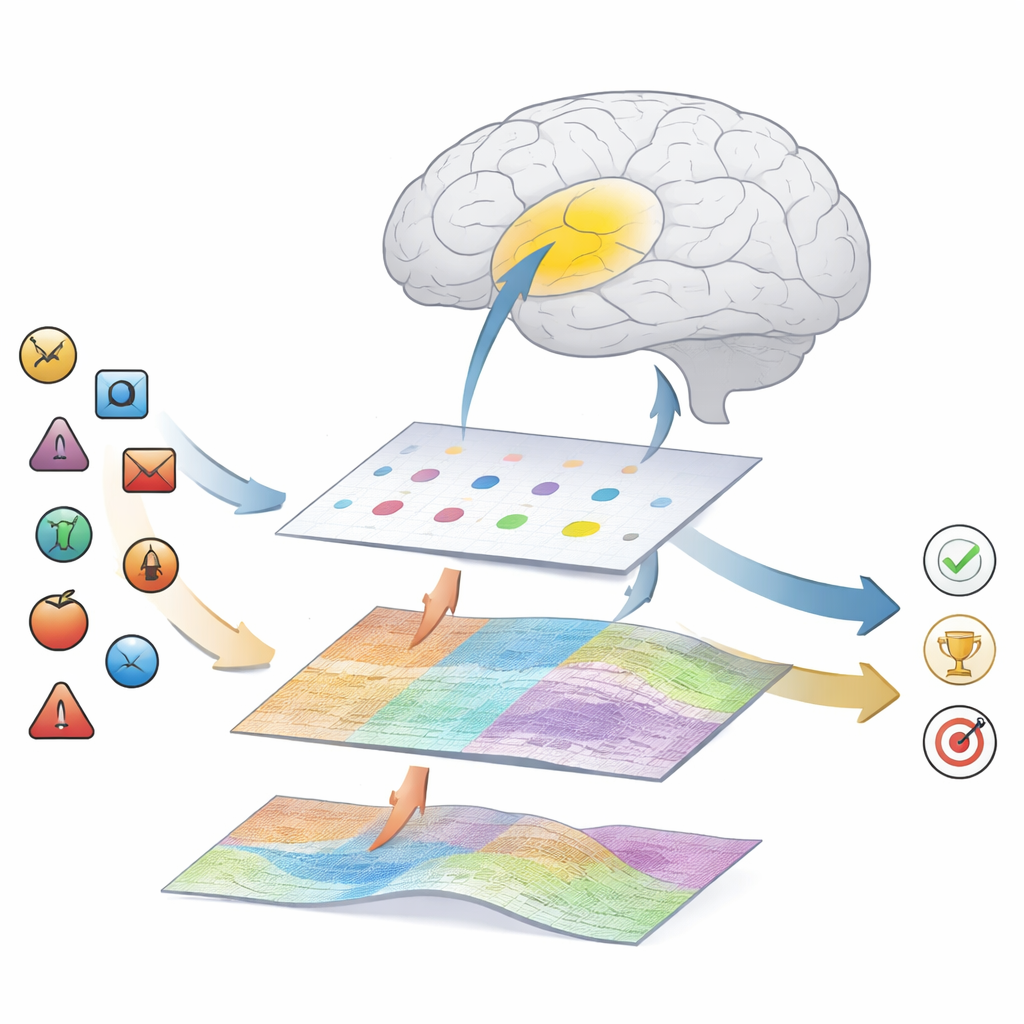
Teaching monkeys new rules and revisiting old ones
To probe this, three macaque monkeys were trained on visuomotor mapping tasks. On each trial, a picture appeared on a touch screen, and after a short delay the monkey had to press one of two buttons, for example, up or down, to receive a reward. In each training session, the animals first learned one new mapping between images and actions (task A), then one or two other new mappings (tasks B and sometimes C), then revisited the original mapping (Revisit-A), and in some cases finally learned the reverse of the original rule (Reverse-A), where the same pictures now required the opposite button. While the monkeys worked, researchers recorded the activity of hundreds of neurons in the dorsolateral premotor cortex, a region involved in planning movements and decisions.
When similar tasks get easier—but opposite rules get harder
Behaviorally, the monkeys showed a classic "learning to learn" effect. New but similar tasks (B and C) were learned faster than the first task A, and when they returned to the original mapping (Revisit-A), they relearned it even more quickly. In stark contrast, the reversed mapping (Reverse-A), which directly contradicted what they had previously learned, took longer to master. This pattern suggests that prior knowledge helps when new tasks share the same underlying rule, but can actually slow things down when the new rule conflicts with the old one. The neuronal recordings offered a window into why: they revealed which aspects of the tasks were encoded in stable, reusable patterns and which were allowed to change.
Separating stable choices from changing sights
Using advanced analysis methods, the authors decomposed the population activity in premotor cortex into two main "subspaces"—collections of neural activity patterns that carried different types of information. One subspace captured the monkeys’ decisions (for example, choosing the upper versus lower button). The other subspace captured details of the visual images. In the decision-related subspace, the same choices formed stable, low-dimensional trajectories that were reused across tasks A, B, C, and Revisit-A, even when the pictures changed. The more similar the trajectories were between a new task and the original task, the fewer trials the monkey needed to learn it. By contrast, in the reverse task, these decision patterns were not reused: the neural trajectories shifted, and learning was slower. Meanwhile, the visual subspace changed more freely from task to task and did not show the same stable reuse.
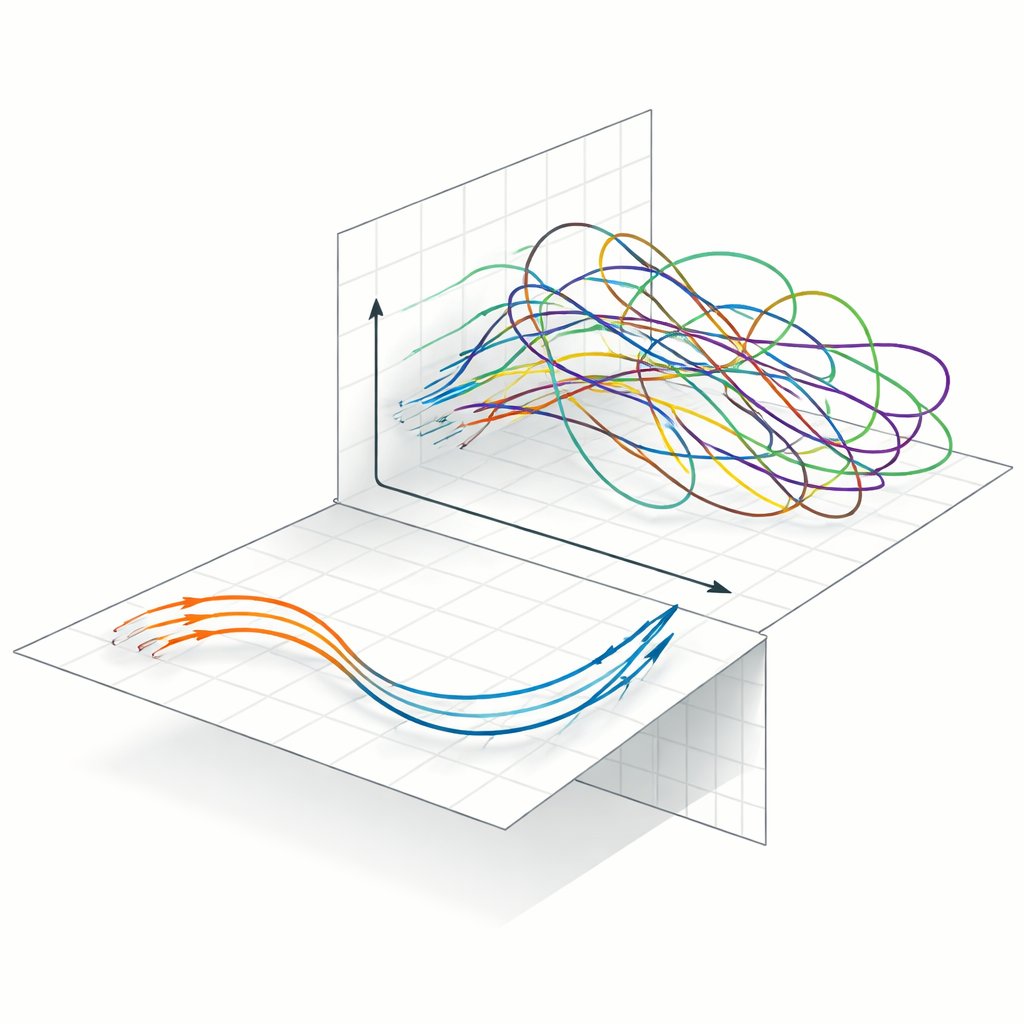
Keeping information streams almost at right angles
A striking finding was the geometric relationship between these two subspaces. Mathematically, they were nearly orthogonal—arranged in neural activity space at angles close to 90 degrees. This near-right-angle arrangement means that changes in how visual information is represented have minimal impact on the decision patterns, and vice versa. In other words, the brain appears to house stable, reusable decision schemas in one domain, while allowing another domain to remain flexible for new sensory details, with the two kept separate enough to avoid interference. This architecture may be a general principle seen across brain regions that deal with complex behavior.
What this means for brains and machines
For a general reader, the takeaway is that the brain seems to solve the stability–plasticity dilemma by carefully organizing its internal activity. It stores the "essence" of a rule—whether to act one way or another—in a protected, stable subspace, while leaving room in other subspaces to accommodate new sights and situations. Similar tasks can then be learned quickly by reusing the existing decision template, whereas directly opposing rules require the brain to build a new pattern from scratch. Beyond explaining how animals learn efficiently from experience, this work hints at strategies for building artificial intelligence systems that can, like brains, both remember what matters and flexibly adapt to whatever comes next.
Citation: Tian, K., Zhao, Z., Chen, Y. et al. Domain-specific schema reuse supports flexible learning to learn in the primate brain. Nat Commun 17, 2150 (2026). https://doi.org/10.1038/s41467-026-68692-x
Keywords: schema learning, neural representations, cognitive flexibility, visuomotor learning, stability plasticity