Clear Sky Science · en
Observation of mechanical kink control and generation via acoustic waves
Shaping Matter with Gentle Vibrations
Kinks might sound like small imperfections, but in many materials they act like powerful switches that control how a structure deforms, moves, or carries signals. They appear in everything from metals to DNA, yet reliably steering them has been notoriously difficult. This study shows, for the first time in experiment, that carefully tuned sound-like vibrations can both move and create such kinks in a specially designed mechanical chain. By doing so without the usual energy barriers that pin kinks in place, the work hints at future materials that can change stiffness, shape, or function at a distance with only tiny inputs of energy.
What These Tiny Twists Really Are
In simple terms, a mechanical kink is a narrow zone where a material switches from one orderly pattern to another—like a line of tilted dominoes suddenly flipping their tilt direction at one spot. Because this narrow transition is tied to the overall layout of the system, it is topologically protected: it cannot be easily erased by small disturbances. In ordinary crystals and polymers, similar defects strongly affect strength, flexibility, and how waves travel through the material. However, in such natural settings, the “lattice” of atoms is discrete, which creates an energy landscape known as the Peierls–Nabarro barrier that tends to trap kinks and cause them to lose energy when they move. Past attempts to nudge kinks with vibrations therefore led mostly to random, thermally driven motion or slow pushing rather than precise control.
A Custom Chain That Lets Kinks Glide
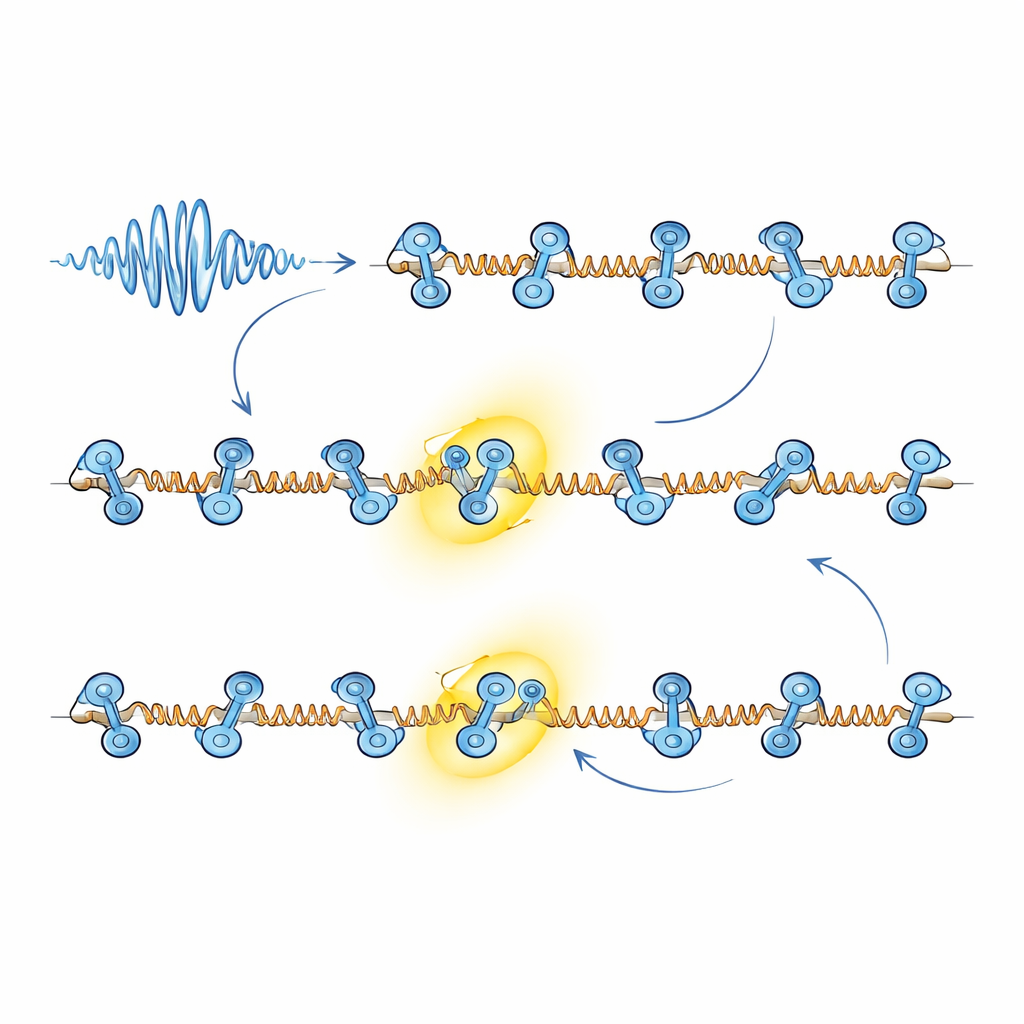
The authors overcome this limitation by building a topological mechanical metamaterial called a Kane–Lubensky (KL) chain. Instead of atoms, the chain uses macroscopic rotors linked by elastic beams acting as springs. By carefully choosing the geometry—rotor length, spacing, and spring rest length—the chain supports two mirror-image uniform states and a special kink that connects them. Remarkably, this kink costs essentially zero energy to shift along the chain, meaning the usual pinning barrier is eliminated. Through detailed numerical calculations, the researchers catalog how this kink behaves across many geometries, identifying a rich set of localized vibration patterns, or internal modes, clustered around the kink. Because these modes can store and release energy, they turn out to be crucial players in how incoming acoustic waves interact with the kink.
Watching Waves Push and Pull a Defect
With this design in hand, the team both simulated and built physical KL chains. In simulations, they launched small wave packets—well-defined bursts of motion—along the chain and tracked how they scattered from the kink. Depending on the chain’s geometry, the kink could be attracted toward the incoming wave or repelled away from it. In most practical cases, the interaction was attractive: the kink moved in the opposite direction to the wave’s travel, yet kept gliding long after the wave passed, without the gradual slowdown seen in conventional models with an energy barrier. The type of response could be tuned by changing the wave’s amplitude, frequency within the allowed band, and the kink’s starting position. Stronger waves drove the kink faster and farther, while also exciting its internal modes and radiating small amounts of energy back into the chain.
From Lab-Built Chains to Moving Defects on Demand
Experiments brought these ideas to life using a tabletop KL chain made of 18 rotors connected by bent polycarbonate beams. High-speed cameras recorded the motion as the researchers drove one end with a controlled, tone-like input. When a kink was initially placed near the center of the chain, a passing acoustic wave packet reliably shifted it several sites before frictional damping halted the motion—now the dominant limiting factor in the absence of a pinning barrier. By varying the drive amplitude, they showed that kink speed and travel distance could be dialed in. Even more striking, when the chain started in a uniform state, a longer acoustic drive from the rigid end spontaneously created a kink at the opposite, softer edge and sent it traveling through the structure. Simulations that included damping faithfully reproduced the observed trajectories and revealed how repeated reflections and internal modes shape the kink’s non-uniform motion over time.
Why This Matters for Future Smart Materials
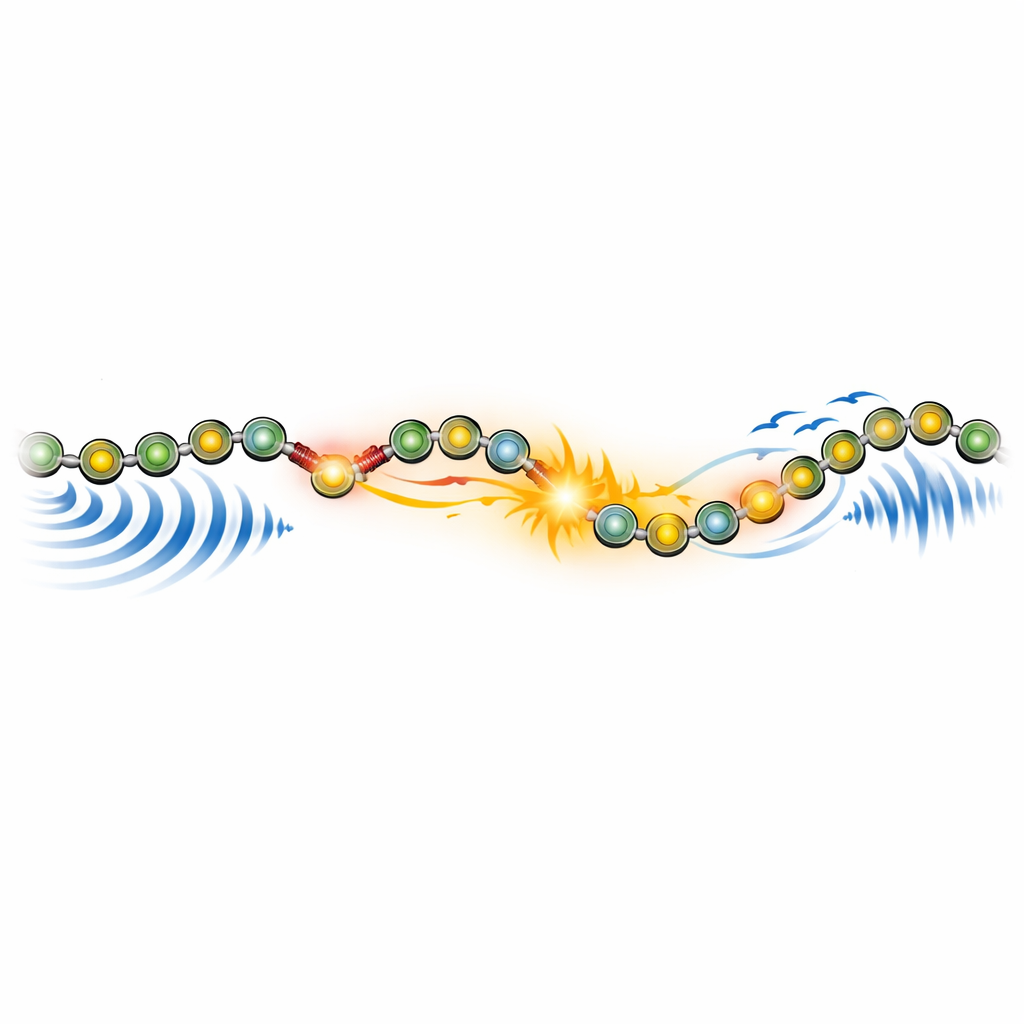
For a layperson, the key message is that the authors have built a mechanical “track” where a robust internal switch—the kink—can be moved and even written into existence by gentle, well-aimed vibrations. Because the kink marks a boundary between regions of very different stiffness, steering it amounts to remotely tuning how rigid or soft different parts of a material are, potentially allowing shape-shifting structures, crawling metamaterials, or protected signal channels that are hard to disrupt. The fact that this control works in a highly discrete, barrier-free setting suggests possible analogues down to microscopic or even molecular scales, where true phonons—quantized sound waves—might manipulate similar defects in nanoscale devices or biological systems.
Citation: Qian, K., Cheng, N., Serafin, F. et al. Observation of mechanical kink control and generation via acoustic waves. Nat Commun 17, 2428 (2026). https://doi.org/10.1038/s41467-026-68688-7
Keywords: topological metamaterials, mechanical kinks, acoustic wave control, solitons, programmable materials