Clear Sky Science · en
Broadband and high-resolution snapshot spectroscopy with high-index transition metal dichalcogenides
Why tiny spectrometers matter
Spectrometers – instruments that split light into its colors to reveal what things are made of – sit at the heart of technologies from medical diagnostics to environmental monitoring and food safety. Yet most high-performance spectrometers are bulky and complex, which makes it hard to put them into phones, drones, or wearables. This paper reports a new way to shrink powerful spectrometers down to a tiny chip by exploiting unusual optical properties of a family of materials called transition metal dichalcogenides (TMDCs). The result is a miniature device that can analyze a broad range of wavelengths, including light invisible to the human eye, with exceptional precision and efficiency.
Turning a thin crystal into a light fingerprint machine
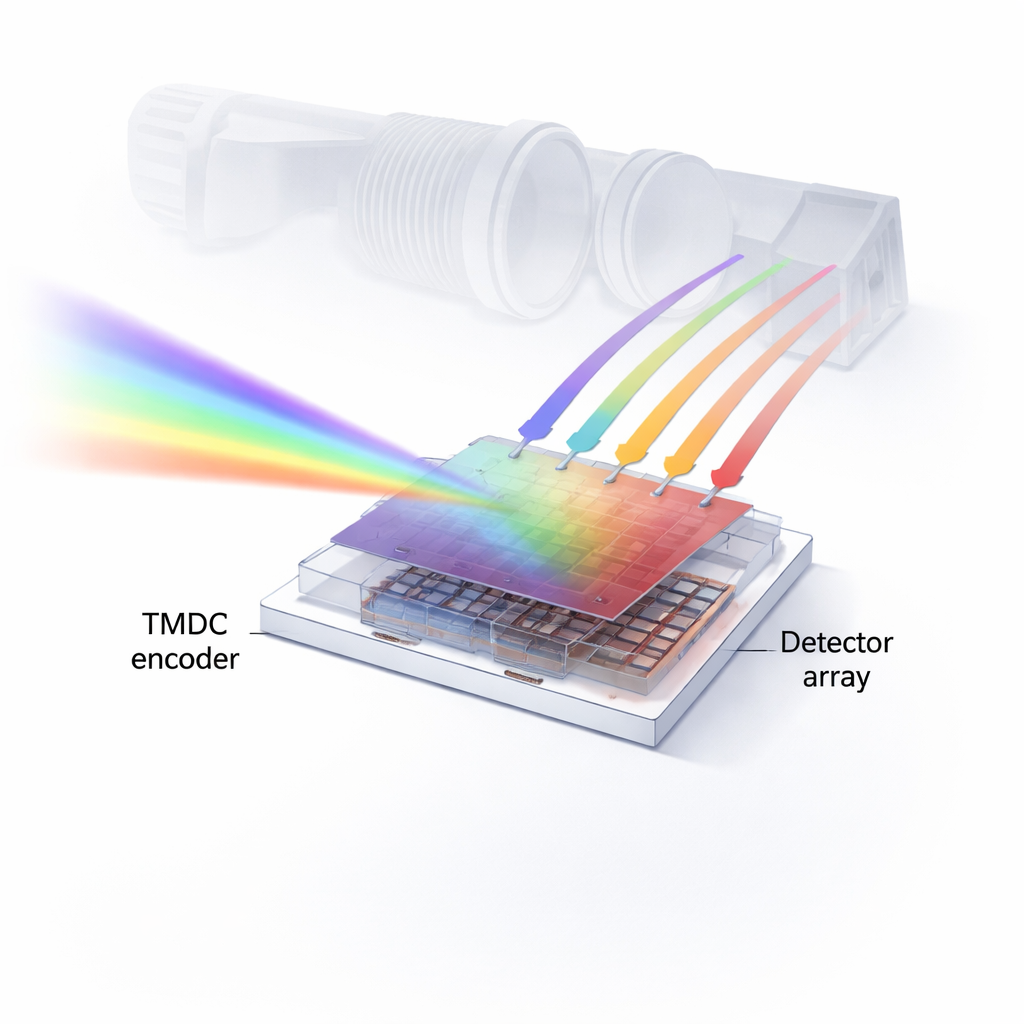
At the core of the work is the idea of a "computational spectrometer." Instead of using moving parts or large prisms to separate colors, a thin optical element reshapes incoming light in a complex but predictable way before it reaches an array of tiny photodetectors. A computer then reconstructs the original spectrum from the detector signals. The challenge has been finding materials that can both interact strongly with light and transmit a wide range of wavelengths without absorbing too much. Most common materials force a trade-off: if they bend light strongly, they usually absorb it in the same range, limiting how much can pass through. TMDCs break this rule by combining a very high refractive index (they bend light strongly) with a relatively large electronic bandgap (they stay transparent over a wide window from visible to short-wave infrared). This unusual mix allows a single, flat TMDC layer to act as an efficient “light fingerprint” encoder.
How high-index TMDCs sculpt light
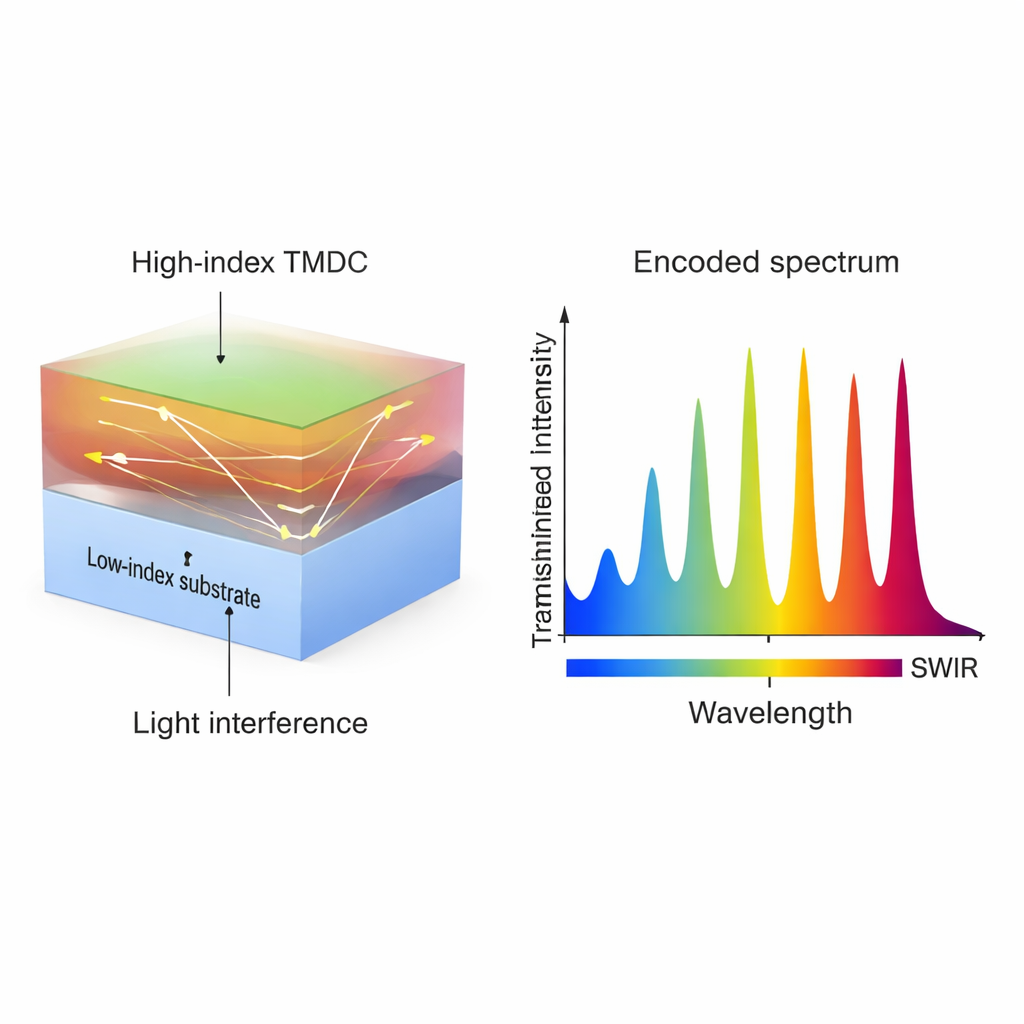
The authors show that when light passes through a TMDC flake on a transparent substrate, the strong difference in optical density at the interfaces causes light to bounce back and forth inside the crystal. Because the material has very low loss in its transparent range, these multiple internal reflections interfere with each other, producing a pattern of bright and dark transmission bands across a huge span of wavelengths – roughly 1000 nanometers. By carefully choosing the thickness of the flake, the team can tune the spacing and depth of these interference fringes. For thicker flakes, the interference becomes dense and strong, yielding almost full transmission at some wavelengths and substantial dips at others, without needing mirrors or complicated nanostructures. In thinner flakes, additional features from excitons – bound electron–hole pairs – imprint sharp signatures, especially at visible wavelengths, further enriching the pattern.
From patterned light to a chip-scale spectrometer
To transform this optical behavior into a practical device, the researchers bonded TMDC layers onto custom-made arrays of indium gallium arsenide (InGaAs) photodetectors, which are sensitive to short-wave infrared light where many molecules have telltale absorption lines. A thin polymer spacer between the TMDC and the detector electrically isolates them while also adding another reflecting interface that increases the complexity of the spectral patterns reaching each pixel. Different pixels see different TMDC thicknesses, so each one responds with its own unique wavelength-dependent curve. By illuminating the array with a precisely tunable laser, the team first calibrates these response curves in fine wavelength steps. Later, when unknown light arrives, a computer uses these pre-measured curves and a robust mathematical method to reconstruct the incident spectrum from the set of photocurrents, all captured in a single snapshot.
Performance that rivals benchtop instruments
The resulting snapshot spectrometer delivers performance that is striking for such a simple structure. It achieves a wavelength accuracy of about 0.02 nanometers and can distinguish spectral features separated by just 1 nanometer, numbers comparable to or better than many table-top systems. Because the TMDC encoder transmits more than 65% of the incoming light, the device can detect signals down to below a billionth of a watt, aided by low-noise, fast InGaAs detectors. The authors demonstrate its usefulness by identifying nearly transparent liquids such as water, alcohol, and acetone from their subtle infrared absorption signatures, and by reconstructing detailed spectra of integrated optical components like microring resonators. Using a real airborne hyperspectral dataset, they also show how such a system could support remote sensing of crops and land cover, linking each pixel in a scene to a full local spectrum.
What this means for everyday technology
In plain terms, this work shows that a single, ultrathin crystal of a special semiconductor can replace bulky optics in a spectrometer without sacrificing precision or sensitivity. By harnessing the strong light-bending and broad transparency of TMDCs, the authors create a compact sensor that can see beyond human vision into the short-wave infrared, where many chemical fingerprints lie. As photodetectors improve and are extended to even longer wavelengths, the same concept could cover the full range from visible to long-wave infrared. This opens the door to spectrometers small enough to be integrated into phones, wearable devices, drones, and industrial sensors, enabling real-time, on-site analysis of materials, health indicators, and environmental conditions.
Citation: Wu, J., Shao, B., Ye, Y. et al. Broadband and high-resolution snapshot spectroscopy with high-index transition metal dichalcogenides. Nat Commun 17, 1955 (2026). https://doi.org/10.1038/s41467-026-68685-w
Keywords: computational spectroscopy, transition metal dichalcogenides, snapshot spectrometer, short-wave infrared sensing, hyperspectral imaging