Clear Sky Science · en
Ultra-fast self-gelling self-expanding self-propelling high-adhesion procoagulant hemostatic powder for non-compressible hemorrhage hemostasis in pigs
Stopping Hidden Bleeding in Seconds
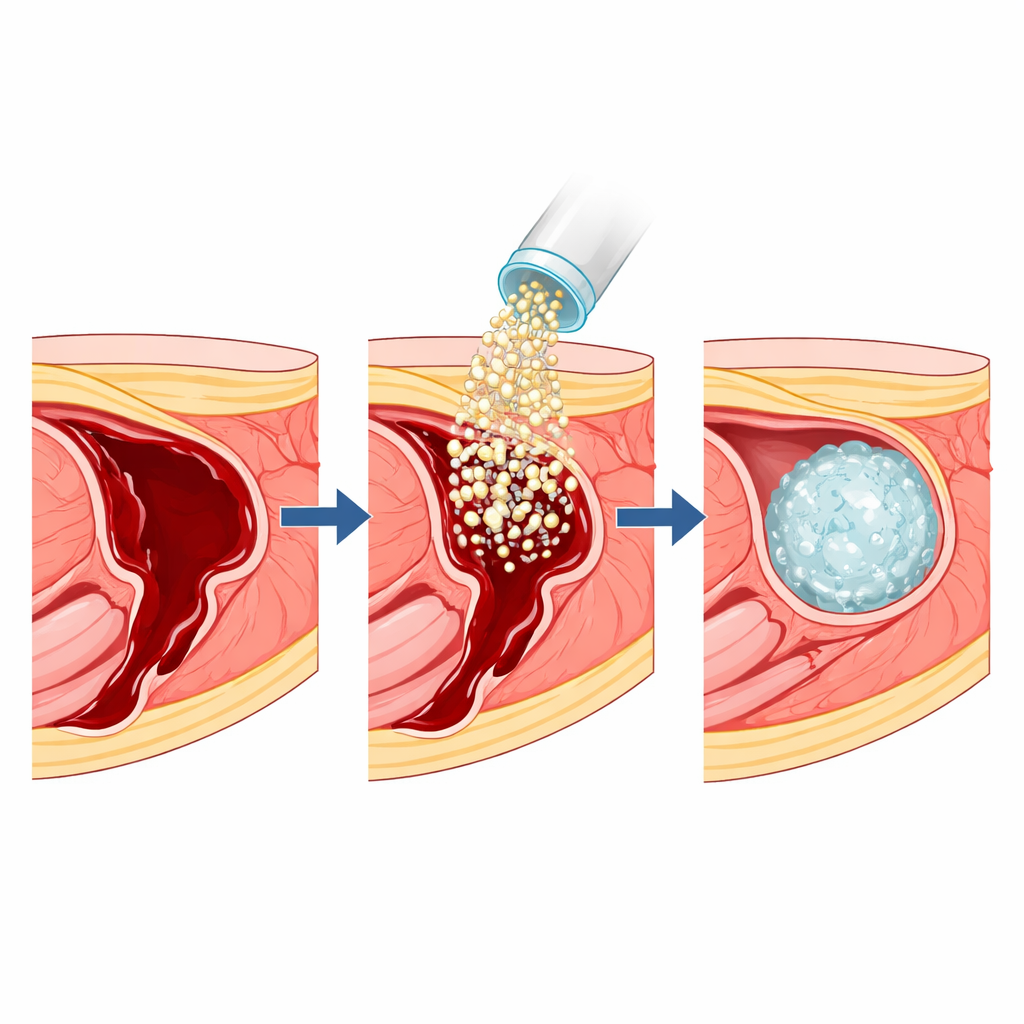
Severe internal bleeding after accidents or explosions can kill within minutes, and in many cases medics cannot simply press on the wound to stop the blood loss. This paper describes a new powder that can be poured or injected into deep, hard‑to‑reach injuries, where it instantly turns into a soft, expanding gel that plugs the wound and jump‑starts the body’s own clotting. Tested in multiple animal models, including pigs with otherwise lethal injuries, this material stopped bleeding faster and with less blood loss than current products, hinting at a future where soldiers, first responders, or even bystanders could control deadly hemorrhage with a few seconds of action.
Why Deep Bleeding Is So Hard to Control
Many battlefield and civilian trauma deaths are caused by “non‑compressible” hemorrhage—bleeding inside the chest, abdomen, or at junctions like the groin and shoulder, where you cannot clamp down with a tourniquet or simple pressure. Traditional tools such as gauze, sponges, or surgical glues mainly work by soaking up blood and relying on someone to press hard and hold them in place. They struggle to reach narrow or irregular wound channels, and some expandable sponges can push too hard, risking additional tissue damage. Fluid foams can fill space more gently, but they are often difficult to store, sterilize, and handle in emergencies. The challenge has been to create something that is solid enough to carry, safe to store, yet behaves like a smart, shape‑filling fluid when it contacts blood.
A Smart Powder That Becomes a Protective Gel
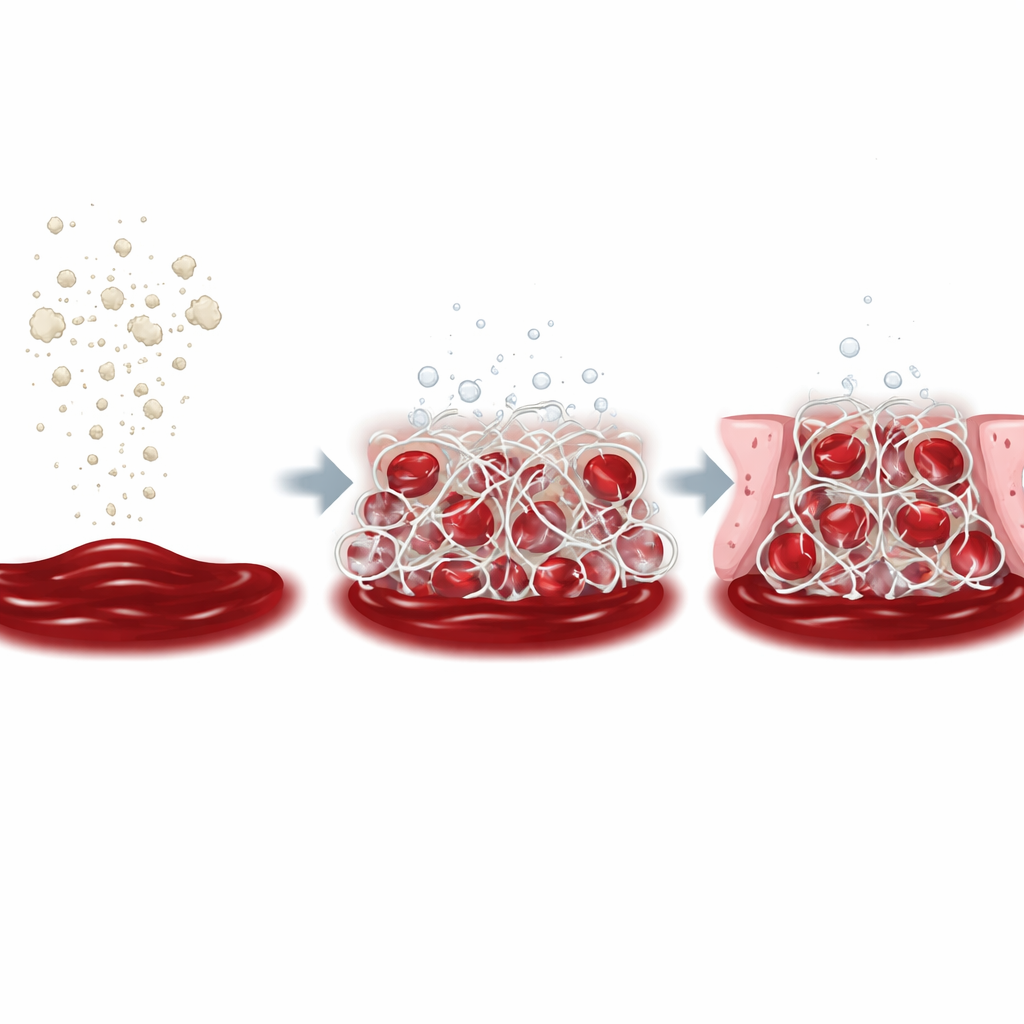
The researchers designed a portable powder made from two common polymers and a tiny clay modified with a mussel‑inspired coating, plus a solid form of the antifibrinolytic drug tranexamic acid and a simple salt. When the grains of powder meet blood or other fluid, they rapidly absorb it and physically crosslink into a continuous gel within a few seconds. At the same time, a gentle gas‑forming reaction produces bubbles that make the gel expand and push itself deeper into cracks and cavities. The clay and mussel‑like surface chemistry give the gel strong wet stickiness to tissues, while the tranexamic acid helps stabilize natural clots. Lab tests showed that the gel absorbs several times its own weight in blood, swells without falling apart, adheres firmly to wet organ surfaces, withstands pressures higher than normal blood pressure, and kills common bacteria—important for dirty battlefield or roadside wounds.
From Bench Tests to Life‑Threatening Injuries
To see how this powder behaves in real injuries, the team tested it in rats, rabbits, and pigs. In rats with liver defects or severed femoral arteries, the powder cut blood loss by up to almost 90 percent and reduced the time to stop bleeding to about one minute, far better than a widely used chitosan‑based commercial powder. In a rabbit model where both the subclavian artery and vein were completely cut—a situation that is usually rapidly fatal—the new powder again greatly reduced blood loss and slashed the time to hemostasis compared with the commercial product, while markedly improving survival. Most strikingly, in pigs with a standardized lethal shoulder vessel injury, the powder reduced blood loss by about 98 percent and shortened time to hemostasis from over half an hour with gauze packing and manual pressure to just over a minute, without the need for sustained compression.
Beyond Bleeding Control: Helping Wounds Heal
Because the gel sticks strongly to skin and underlying tissue, the researchers also explored whether it could replace stitches or traditional skin glues. In rats with clean, full‑thickness back incisions, applying the powder to the cut edges created an immediate seal within seconds. Over two weeks, these wounds closed faster and produced stronger healed skin than those treated with sutures or medical glue. Microscopic examination showed better re‑growth of the outer skin layer, more organized collagen fibers, more new blood vessels, and fewer signs of prolonged inflammation in the powder‑treated group, suggesting that the material not only stops bleeding but also creates a friendlier environment for tissue repair.
A Portable Tool for the Most Dangerous Minutes
Overall, this study introduces a compact, shelf‑stable powder that turns into a self‑expanding, self‑propelling, tissue‑gripping gel as soon as it meets blood. By combining physical plugging, strong adhesion, and biochemical support for clotting, it can rapidly control internal and junctional bleeding in situations where existing dressings struggle, all without complicated preparation or prolonged manual pressure. If future work confirms safety in humans and enables large‑scale production, such a powder could become a critical tool for soldiers, paramedics, and emergency rooms, buying precious minutes to get patients from the point of injury to definitive surgical care.
Citation: Huang, S., Li, M., Xu, H. et al. Ultra-fast self-gelling self-expanding self-propelling high-adhesion procoagulant hemostatic powder for non-compressible hemorrhage hemostasis in pigs. Nat Commun 17, 2146 (2026). https://doi.org/10.1038/s41467-026-68683-y
Keywords: hemostatic powder, internal bleeding, trauma care, self-gelling hydrogel, battlefield medicine