For many women, damage to the womb’s inner lining can silently steal away fertility. Intrauterine adhesions—bands of scar tissue that form inside the uterus—can lead to painful periods, recurrent pregnancy loss, and difficulty conceiving. Standard care mostly involves surgically cutting away the scars, but the tissue often scars over again. This study introduces a bioengineered “smart” gel that aims not just to remove damage but to teach the womb to heal itself more like it does in early pregnancy—regenerating healthy lining instead of laying down more scar.
When repair goes wrong
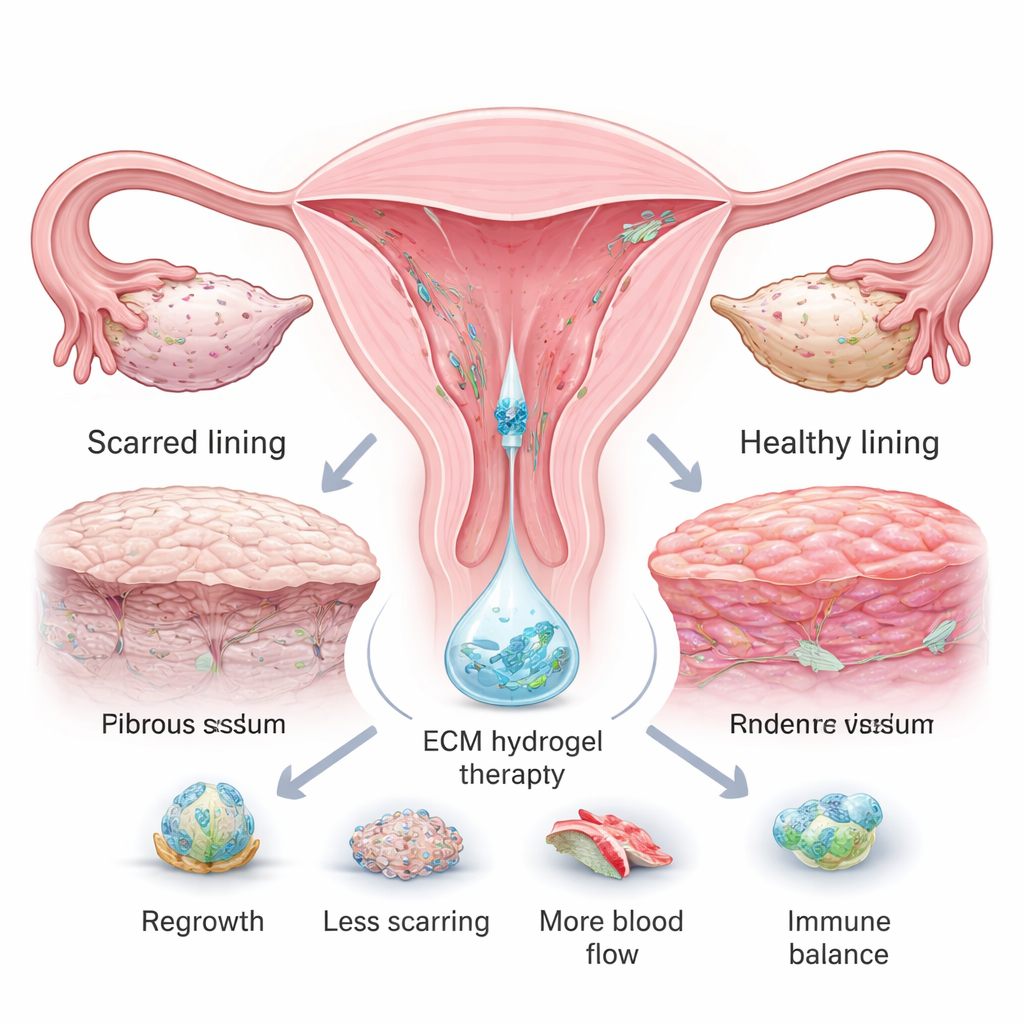
Intrauterine adhesions arise when the endometrium, the tissue that lines the uterus, responds to injury by forming dense, fibrous scars instead of rebuilding a soft, blood‑rich surface. After damage, an intense burst of inflammation normally helps clear debris. In this disease, that response becomes stuck in overdrive: immune cells release harsh inflammatory signals, specialized cell‑death pathways are triggered, and a key scarring system called TGF‑β/Smad3 stays switched on. Collagen and other matrix proteins pile up, stiffening the tissue, choking off new blood vessels, and blocking the activity of resident stem and progenitor cells. The result is a hostile environment where embryos cannot properly implant or grow.
Borrowing a healing program from early pregnancy Figure 1.
The authors asked whether the uterus’s own “best version” of healing—seen during early pregnancy—could be copied and reused as a therapy. In that natural process, called decidualization, the lining thickens, becomes richly vascular, and shifts its immune balance toward calm repair rather than attack. The team induced a decidual‑like state in mice, then stripped the cells away to leave only the underlying scaffold of proteins, known as the extracellular matrix. This decidualized matrix (DEndo‑UdECM) retained the three‑dimensional structure of the original tissue and was enriched in proteins linked to wound healing, blood‑vessel growth, stem‑cell support, and natural brakes on scarring signals. Unlike a simple gel, this matrix behaves like a preserved blueprint of a pro‑regenerative womb.
A two‑part gel: accelerator and brake
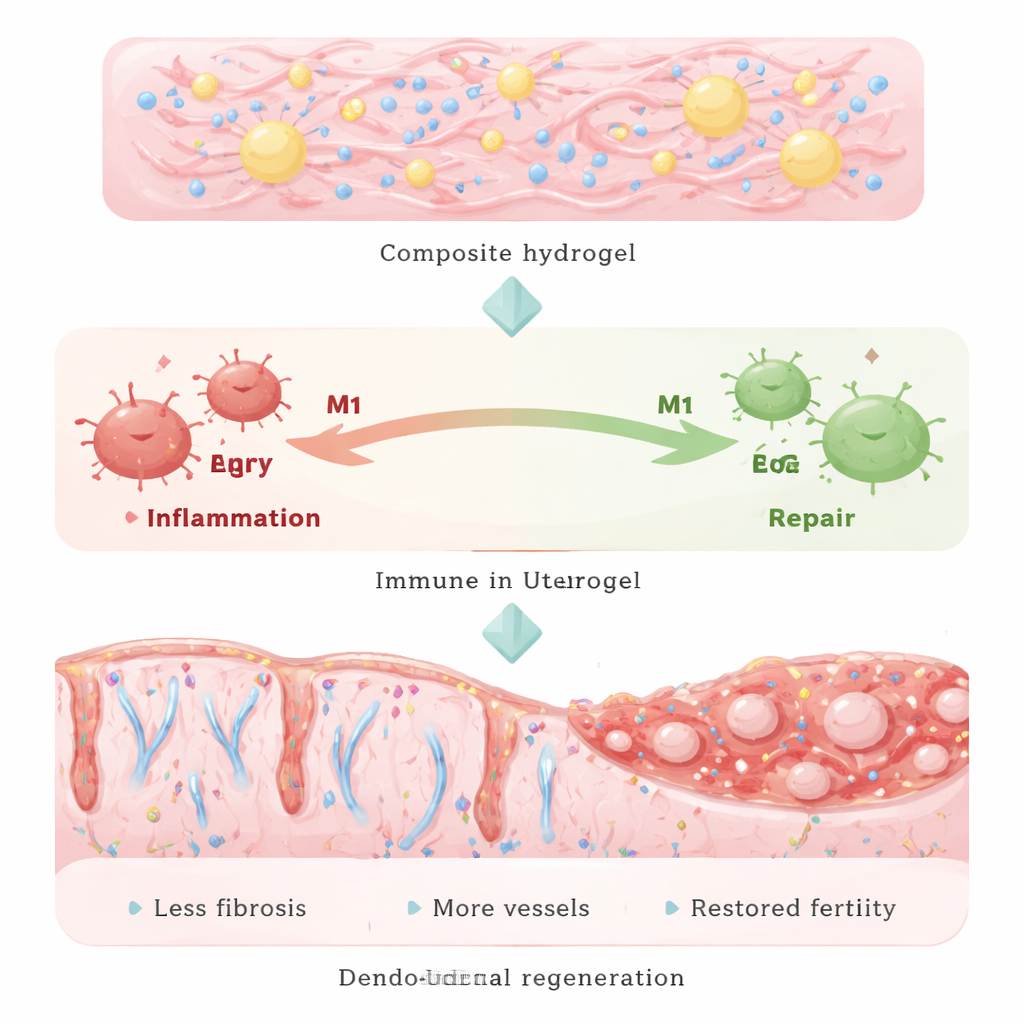
On its own, even a smart scaffold must contend with strong scarring forces in severe disease. To counter this, the researchers added a second component: microspheres made of a biodegradable polymer (PLGA) loaded with thymosin β4, a small peptide known to encourage vessel growth and to dampen fibrosis. Mixed into the liquefied decidual matrix, these microspheres form a composite hydrogel that can be injected through a fine needle and rapidly solidifies at body temperature. Tests in the lab showed that the decidual matrix powerfully boosted growth and migration of endometrial cells and promoted the formation of capillary‑like networks, while thymosin β4 specifically shut down fibrosis‑related proteins. Together, the scaffold acts as an accelerator for regeneration, and the slow‑release drug serves as a long‑acting brake on scarring.
From scarred wombs to healthy pregnancies Figure 2.
The team then moved to a stringent mouse model in which the uterine lining was badly damaged with ethanol, mimicking severe intrauterine adhesions. A single injection of the composite hydrogel into the injured uterus led to striking changes over two weeks. Compared with untreated or partially treated animals, mice receiving the full gel had a much thicker, better‑organized endometrium with many restored glands and far less collagen‑rich scar tissue. Markers of harmful inflammation and the TGF‑β/Smad3 scarring pathway were sharply reduced. At the same time, immune cells called macrophages shifted from a destructive “M1” state to a healing “M2” state, and signals of stem‑cell activity, new vessel growth, and orderly cell division all rebounded. Crucially, when these mice were mated, their implantation rates and litter sizes returned to nearly normal, and the offspring grew and developed like those from healthy mothers.
A blueprint for smarter tissue repair
To a lay reader, the main message is that the researchers have built a gel that helps the womb remember how to heal properly. By copying the matrix from early pregnancy and combining it with a slow‑release anti‑scar factor, they created a microenvironment that calms runaway inflammation, blocks fibrotic pathways, and encourages genuine tissue regrowth rather than patchy repair. In mice with severe uterine scarring, this approach did not just improve the appearance of the tissue—it restored the ability to carry healthy litters. While more work is needed before use in humans, the study illustrates a broader idea: carefully mimicking the body’s own best healing programs may offer a way to reverse stubborn scarring diseases and recover organ function.
Citation: Liang, Y., Yu, Z., Du, S. et al. Decidualization-empowered ECM hydrogel integrating sustained Tβ4 release drives endometrial regeneration in intrauterine adhesions.
Nat Commun17, 1910 (2026). https://doi.org/10.1038/s41467-026-68677-w