Clear Sky Science · en
A tidal disruption event from an intermediate-mass black hole revealed by comprehensive multi-wavelength observations
When Stars Wander Too Close
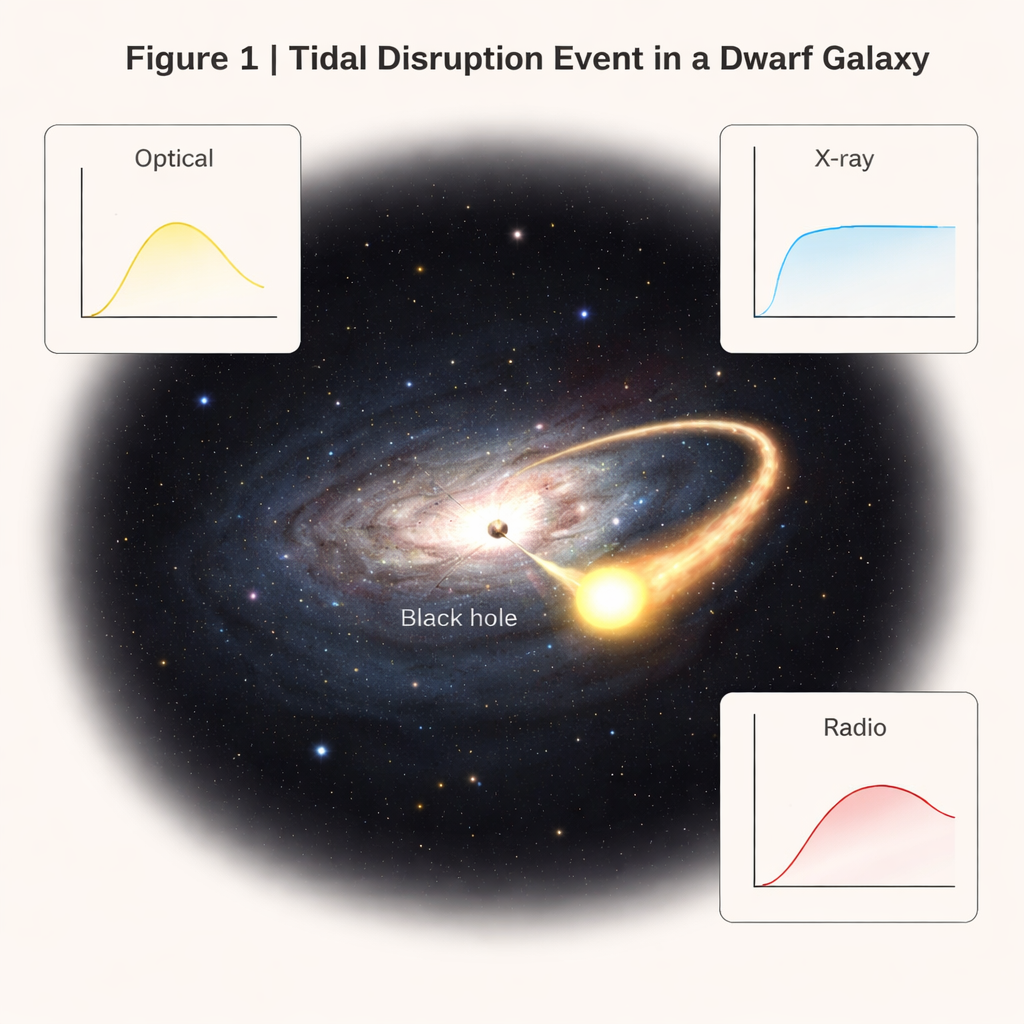
Imagine a quiet, faint galaxy with a hidden black hole at its center, so small and inactive that our telescopes can barely notice it. Now picture a star drifting too close, getting torn apart, and suddenly lighting up the sky in optical light, X‑rays, and radio waves. This study tells the story of exactly such an event, called AT 2018cqh, and shows how it reveals a long‑sought missing link in the black‑hole family: an intermediate‑mass black hole, sitting between the tiny ones formed from dead stars and the giants that power bright quasars.
A Star Torn Apart
AT 2018cqh began as a mysterious flare spotted in 2018 at the center of a small, relatively nearby dwarf galaxy. Astronomers soon realized this was likely a tidal disruption event: a star that wandered too close to a central black hole, was ripped apart by gravity, and formed a hot, glowing disk of debris spiraling inward. The team gathered data across the spectrum—visible light, X‑rays, and radio waves—to follow the entire evolution of the event. The optical light rose and faded in a way typical for such stellar disruptions, staying unusually blue in color, while later observations in X‑rays and radio exposed an even more intriguing and long‑lived outburst.
A Surprisingly Long X‑Ray Plateau
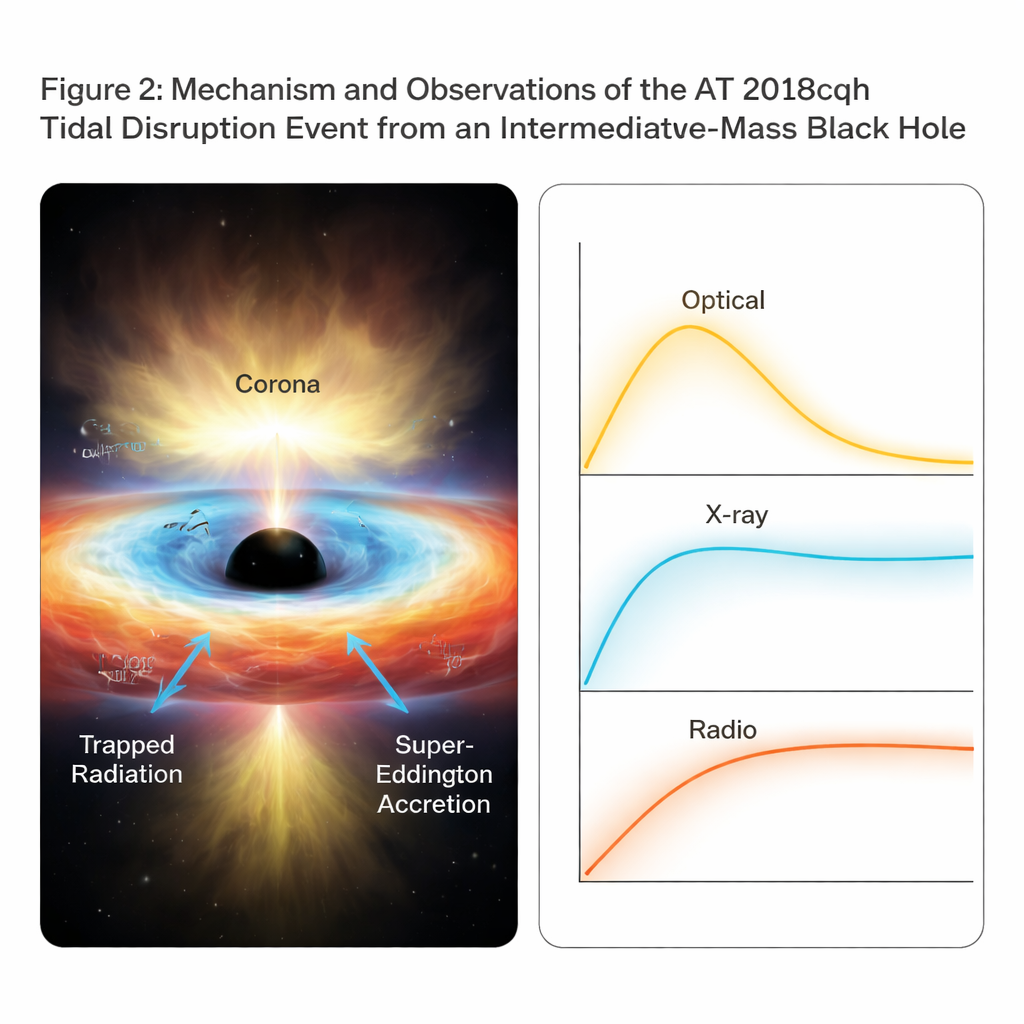
The most striking feature of AT 2018cqh is what happened in X‑rays. After slowly brightening for at least 550 days—one of the longest rises ever seen in this kind of event—the X‑ray emission stopped fading and settled onto a nearly steady “high plateau” that has lasted for more than 500 days so far. At the galaxy’s distance, this steady X‑ray glow corresponds to a power output of roughly 2.4 × 1042 ergs per second in soft X‑rays, with a peak around twice as bright. Rather than flickering or declining as many tidal disruption events do, AT 2018cqh appears to have reached a stable, long‑lasting state in which matter is flowing smoothly onto the black hole and radiating at nearly the same level for years.
A Modest Black Hole with a Big Appetite
By carefully analyzing the X‑ray spectrum—the distribution of X‑ray energies—the researchers could estimate how hot the inner regions of the disk are and how the radiation is produced. The emission looks like it comes from a very hot, dense disk of gas with a temperature of only a few hundred thousand degrees, cooler than disks around much heavier black holes. The team modeled the spectrum using simple thermal components plus a weaker, harder X‑ray tail, likely caused by some of the disk’s light being scattered to higher energies by a hot “corona” of energetic particles above the disk. When they compared the measured brightness and temperature to theoretical expectations, they consistently found a black hole mass of about 100,000 to 600,000 times the mass of the Sun—squarely in the “intermediate” range.
Clues from the Host Galaxy
The galaxy hosting AT 2018cqh is itself unusual. It is a low‑mass dwarf galaxy with a stellar mass of only a few billion Suns and shows signs of a strong burst of star formation in the relatively recent past, but little ongoing activity today. Its colors and spectral features place it in a rare “post‑starburst” class of galaxies, which previous studies have found to be disproportionately common homes for tidal disruption events. Using established relations between the properties of galaxies and the masses of their central black holes, the authors find that this galaxy should harbor a black hole of a few hundred thousand solar masses—matching the mass inferred from the X‑ray data. The event also produced a transient, highly ionized emission line in the optical spectrum and a bright, delayed flare in radio waves, both consistent with powerful radiation and outflows from the central region slamming into surrounding gas.
Why This Event Matters
Intermediate‑mass black holes are notoriously hard to find, because they are dimmer than their supermassive cousins and too far away to weigh directly. AT 2018cqh provides one of the clearest cases yet that such black holes really do lurk in the centers of small galaxies. By catching this event from its optical flare through its unusually long X‑ray rise and stable high plateau—while also tracking the evolving radio signal—the researchers have mapped almost the entire life cycle of a star being destroyed by an intermediate‑mass black hole. Their results show that when such a modest black hole overeats, it can shine steadily for years at close to its maximum allowed power, giving astronomers a powerful new way to track down this elusive population.
Citation: Wang, J., Huang, M., Xue, Y. et al. A tidal disruption event from an intermediate-mass black hole revealed by comprehensive multi-wavelength observations. Nat Commun 17, 2007 (2026). https://doi.org/10.1038/s41467-026-68670-3
Keywords: tidal disruption event, intermediate-mass black hole, dwarf galaxy, X-ray astronomy, multi-wavelength observations