Clear Sky Science · en
European forest carbon and biodiversity policies have a limited win-win potential
Why Forest Carbon and Wildlife Matter to Everyone
European forests are being asked to do two big jobs at once: help slow climate change by locking away carbon, and protect the rich web of life that depends on trees. Policymakers often assume that planting more trees and packing more wood into each hectare will automatically benefit both goals. This study challenges that assumption by showing that where and how carbon is stored in forests—especially in dead wood—can matter more for wildlife than simply having lots of living trees.
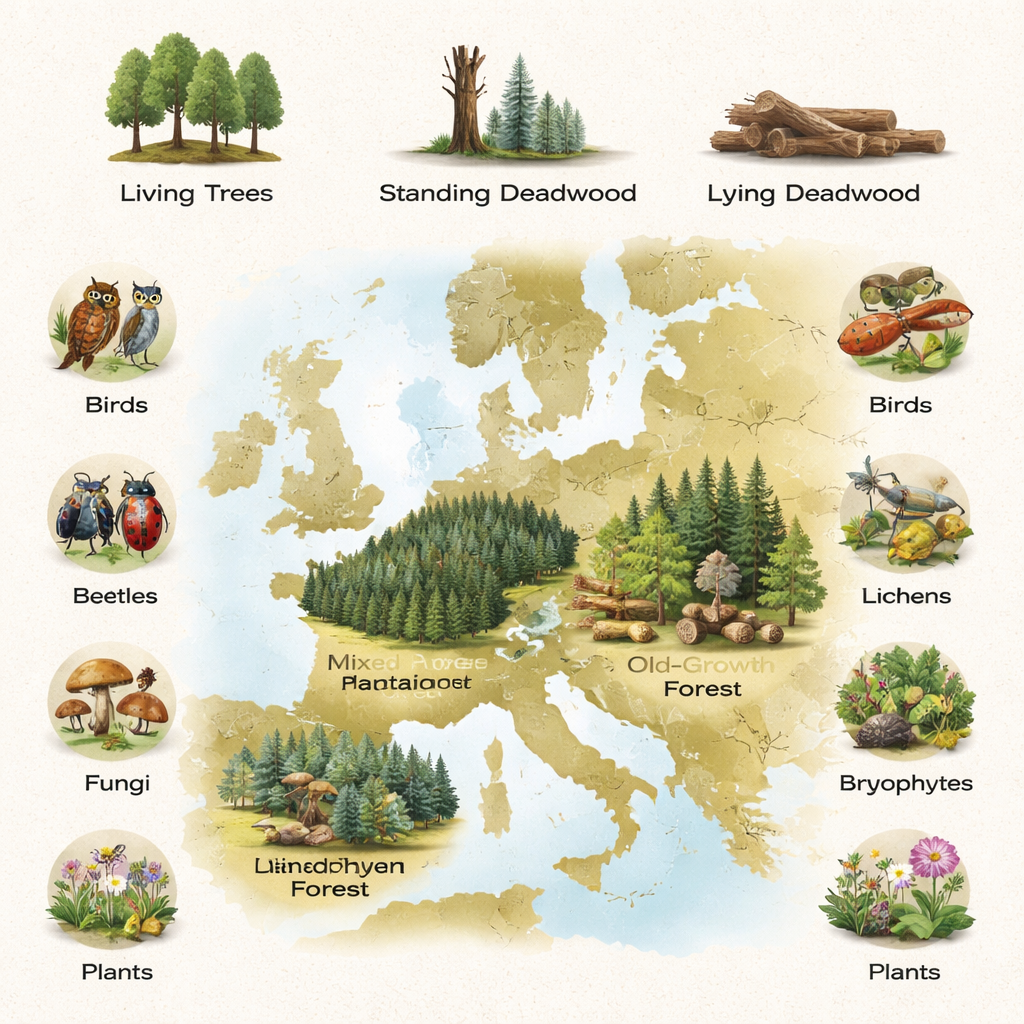
More Than Just Green Wooded Land
Forests store carbon in several ways. Carbon is held in living trunks and branches, but also in standing dead trees and fallen logs that slowly decay on the forest floor. At the same time, forests host many kinds of organisms: plants in the understory, mosses and lichens on bark and logs, fungi inside wood, beetles that depend on dead trees, and birds using trees for food and nesting. The researchers pulled together a large database from 12 European countries, covering nearly 8,000 forest plots and more than 3,500 species across six major groups: vascular plants, bryophytes and lichens, fungi, saproxylic (wood-dependent) beetles, and birds. This allowed them to look at how different “carbon pools” relate to the richness of life in each group.
Dead Wood, Living Diversity
The team found that dead wood—especially logs lying on the ground—was often the best predictor of how many species a forest could support. Higher amounts of lying deadwood were strongly linked to more fungi and more lichens, both of which use decaying wood as habitat or food. Standing dead trees were particularly important for beetles that depend on wood, and also had a positive, though smaller, effect on fungi. These results confirm that deadwood is not waste: it is a structural backbone for food webs that recycle nutrients and sustain many specialized organisms. In contrast, the amount of carbon in living trees usually had weaker or mixed links to species richness.
When More Trees Can Mean Less Variety
For some groups, especially understory plants, very high amounts of living tree carbon were actually associated with fewer species. Dense stands of tall, fast-growing trees cast deep shade and leave little light for herbs and small shrubs, favoring only a limited set of shade-tolerant plants. Many other organisms also thrive on structural variety—gaps, mixed ages, and a patchwork of living and dead trees—rather than on uniform, tightly packed plantations. Because modern forestry can create stands with high tree biomass but low structural complexity, forests rich in living carbon do not necessarily have rich, multi-layered biodiversity.
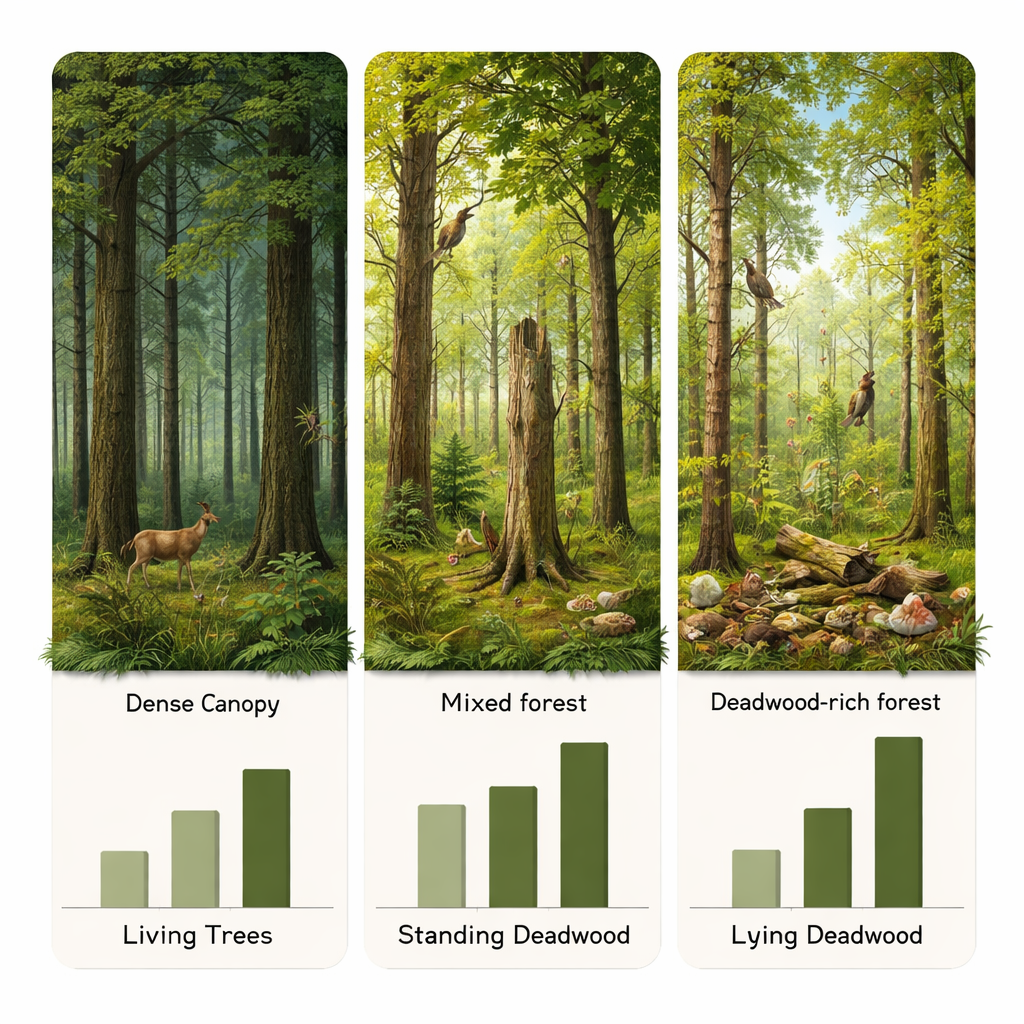
Limits of the "Win-Win" Story
The study suggests that expecting a simple win–win between maximizing aboveground tree carbon and maximizing biodiversity is unrealistic. Policies that focus mainly on increasing carbon in living trees—such as widespread planting of fast-growing, even-aged stands—may conflict with the needs of many species, even if they look “green” from a distance. By contrast, forests with more deadwood can contribute to climate goals through long-term carbon storage while also supporting fungi, insects, mosses, lichens, and birds. The authors argue that forest management and restoration plans must distinguish between carbon in living trees and carbon in deadwood, and must consider local conditions, forest history, and management practices.
What This Means for Forest Futures
For a general reader, the takeaway is straightforward: a “tidy” forest that removes most dead trees is not necessarily healthy, either for wildlife or for the climate. Leaving more deadwood—both standing and fallen—can be one of the most effective ways to support many forms of life while still storing carbon. The study concludes that aboveground living biomass alone is a poor stand‑in for true forest health. To meet both climate and biodiversity goals, European policies need to value and track deadwood alongside live trees, and to promote diverse, structurally complex forests instead of uniform, fast-growing plantations.
Citation: Balducci, L., Haeler, E., Paillet, Y. et al. European forest carbon and biodiversity policies have a limited win-win potential. Nat Commun 17, 1976 (2026). https://doi.org/10.1038/s41467-026-68668-x
Keywords: forest biodiversity, carbon storage, deadwood, climate policy, European forests