Clear Sky Science · en
Probing the molecular structure at graphite–water interfaces by correlating 3D-AFM and SHINERS
Why the Water Next to Surfaces Matters
Water behaves very differently in the thin film right next to a solid surface than it does in a glass or a lake. That ultrathin “skin” of water controls how batteries work, how pollutants stick to pipes, and even how cells talk to their surroundings. Yet, for decades, scientists have disagreed about what this boundary layer really looks like, especially on carbon-based materials used in energy technologies. This study tackles that puzzle head-on at graphite–water interfaces, revealing that there is not just one interfacial structure but three distinct states that can switch with time and electric voltage.
Looking at Water in 3D
To see what is happening at the graphite–water boundary, the researchers combined two powerful but very different tools. Three-dimensional atomic force microscopy feels the liquid near the surface with a tiny vibrating probe, building a map of how densely molecules are packed in layers only a few billionths of a meter thick. A specialized form of Raman spectroscopy, boosted by tiny coated gold particles, listens to how the molecules vibrate, which reveals what kinds of chemical bonds and environments are present. Crucially, both techniques are sensitive to the same 1–2 nanometer slice of liquid right at the interface, allowing the team to directly connect structure with molecular identity.
Two Faces of the “Resting” Interface
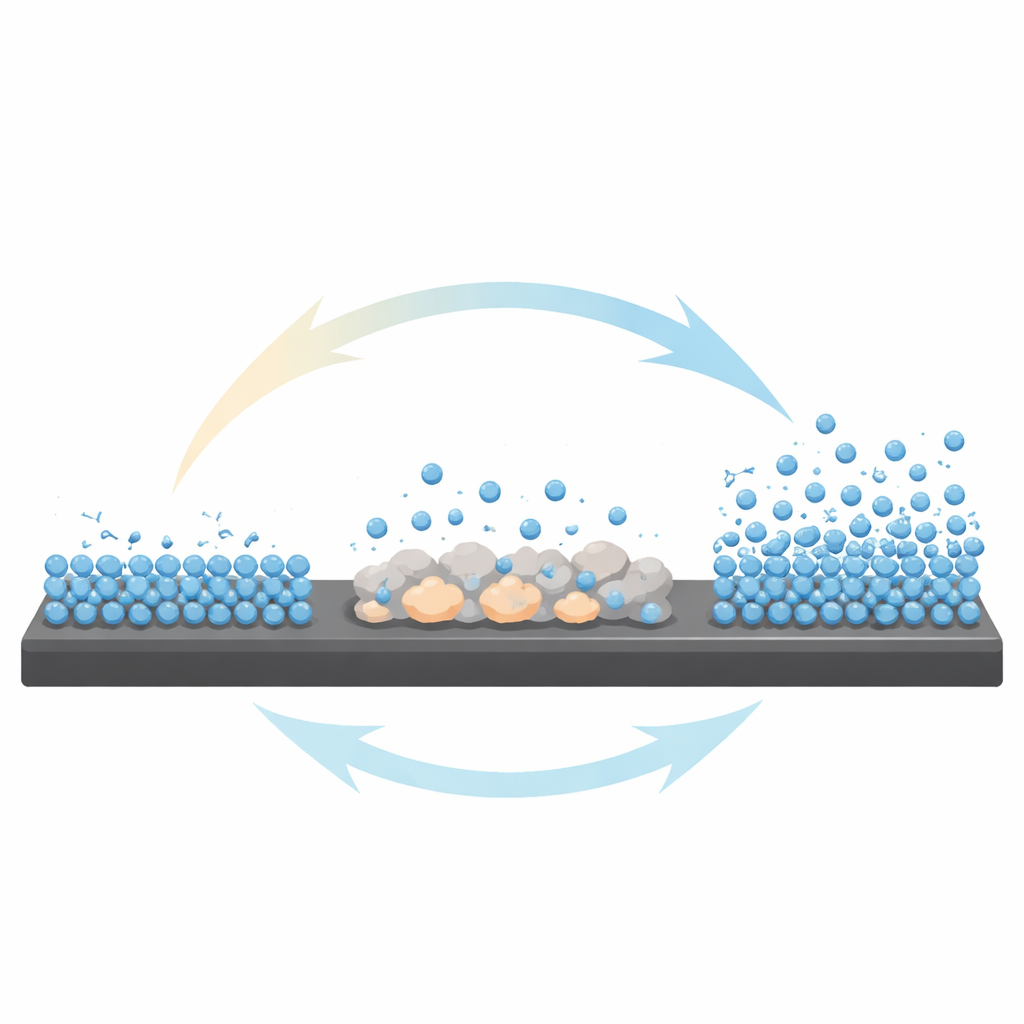
When the graphite electrode sits at its natural, unforced voltage, the interface does not settle into a single, fixed arrangement. Instead, it can exist in two very different forms. Immediately after careful cleaning, layers of almost pure water stack up in sheets about three ångströms apart, close to the spacing of molecules in ordinary liquid water. Spectroscopic signatures show that, in this pristine state, many of water’s usual hydrogen bonds are broken or distorted, producing a rich mix of bonding patterns. Over the course of about an hour in contact with air-exposed solution, however, this structure gradually changes. Airborne hydrocarbon molecules creep in, forming two to three layers between graphite and the bulk liquid. The spacing between layers swells to four to five ångströms, water density near the surface drops sharply, and the remaining nearby water adopts a more orderly, strongly bonded arrangement.
How Voltage Wipes the Slate Clean
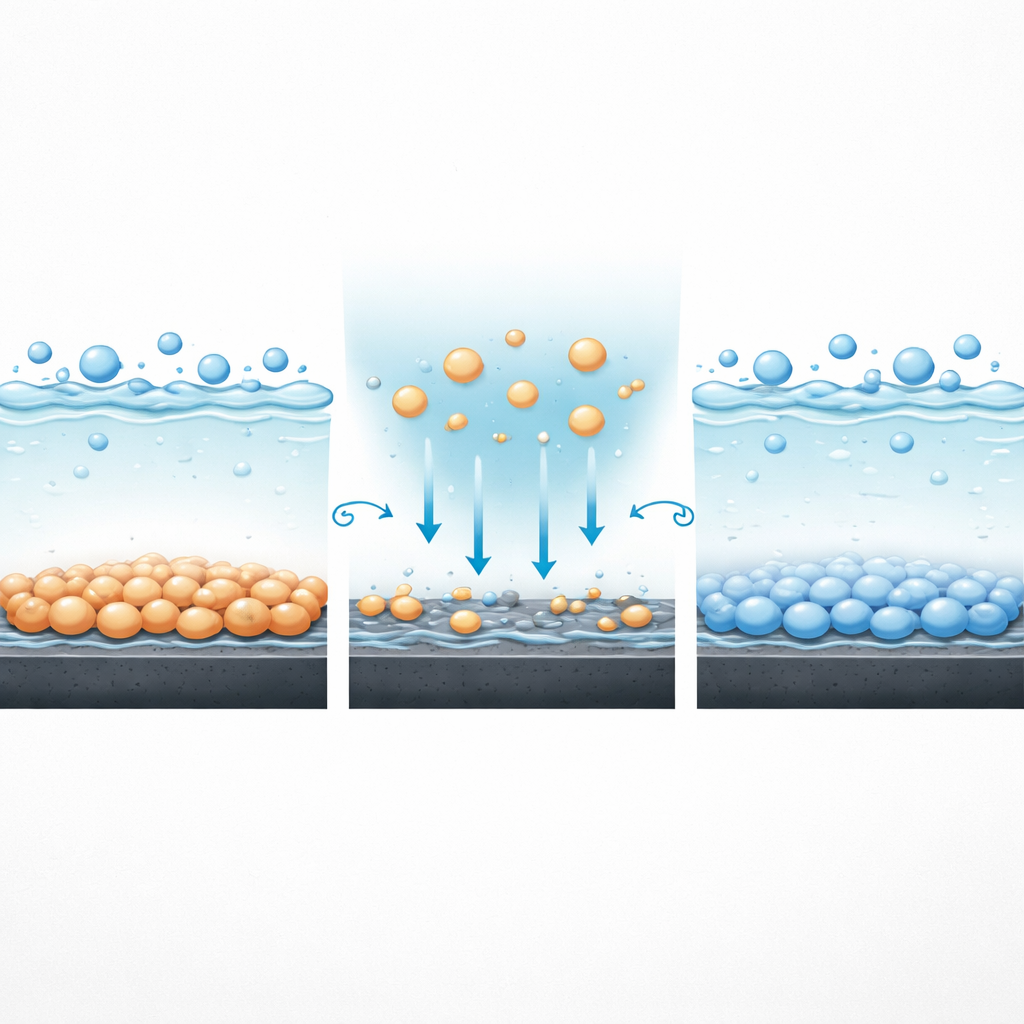
Applying a sufficiently negative voltage to the graphite causes a dramatic reorganization. If the interface starts in the hydrocarbon-covered state, the layer spacing measured by force microscopy suddenly shrinks from four–five ångströms back to about three ångströms as the bias becomes more negative than roughly −1 to −1.5 volts. At the same time, the spectroscopic fingerprints of hydrocarbons fade and nearly disappear, while those of water grow stronger. This shows that water molecules displace the adsorbed contaminants and once again directly contact the graphite. Interestingly, even when the interface begins in the pristine water state, moving the voltage across a wide negative range does not noticeably change the average distances between layers or the overall amount of interfacial water. Instead, the electric field primarily reshapes how water molecules orient and share hydrogen bonds, broadening the distribution of bonding motifs without thinning the liquid.
A Hidden Third State of Interfacial Water
By comparing many experiments taken over years in two laboratories, the authors identify a third, previously overlooked state that appears only under strong negative polarization. In this regime, the interface is again dominated by water with closely spaced layers, but now the vibrational spectrum reveals an unusually wide variety of hydrogen-bonding environments. These include both ice-like, fourfold-bonded structures and weakly bound species with very few or no hydrogen bonds, some of which sit extremely close to the graphite surface. One particular vibrational feature does not shift with changing electric field, implying a special orientation where the effective dipole change lies parallel to the surface. This is consistent with “non-donor” water molecules that press both hydrogen atoms toward the surface while their oxygen points outward—an arrangement that had been theorized but not clearly separated in experiments at such interfaces.
What This Means for Real-World Systems
Together, these observations lead to a simple but powerful three-state picture. At open-circuit conditions, graphite–water interfaces can be either freshly cleaned and water-rich, with strongly disturbed hydrogen bonding, or aged and hydrocarbon-coated, with water held at arm’s length and bonds closer to those in the bulk. Under sufficiently negative voltage, both pathways converge to a stable, clean water state with a broad mix of hydrogen-bonding patterns, including rare, weakly bound configurations. This framework reconciles many conflicting reports in the literature by showing that previous studies likely probed different starting states without realizing it. More broadly, it suggests that other mildly water-repelling materials—such as many metals and semiconductors used in batteries, sensors, and desalination—may also toggle between multiple interfacial structures as they age or are driven by electric fields, with major consequences for how efficiently they operate.
Citation: Bonagiri, L.K.S., Arvelo, D.M., Zhao, F. et al. Probing the molecular structure at graphite–water interfaces by correlating 3D-AFM and SHINERS. Nat Commun 17, 2230 (2026). https://doi.org/10.1038/s41467-026-68667-y
Keywords: interfacial water, graphite electrode, hydrogen bonding, electrochemical interface, hydrocarbon contamination