Clear Sky Science · en
Sensight enables quantitative multivariate engineering of high-performance chemical imaging tools
Seeing the Earliest Signs of Cellular Trouble
Many diseases begin with tiny chemical changes inside our cells long before symptoms appear. To catch these early warning signs, scientists use special dye-like molecules that light up under a microscope when they encounter specific chemicals. But building dyes sensitive enough to detect faint, fleeting signals in living cells has largely been a matter of trial and error. This study introduces Sensight, a data-driven design strategy that helps researchers systematically engineer brighter, smarter imaging tools to watch biology unfold in real time.
Why Ordinary Glowing Dyes Fall Short
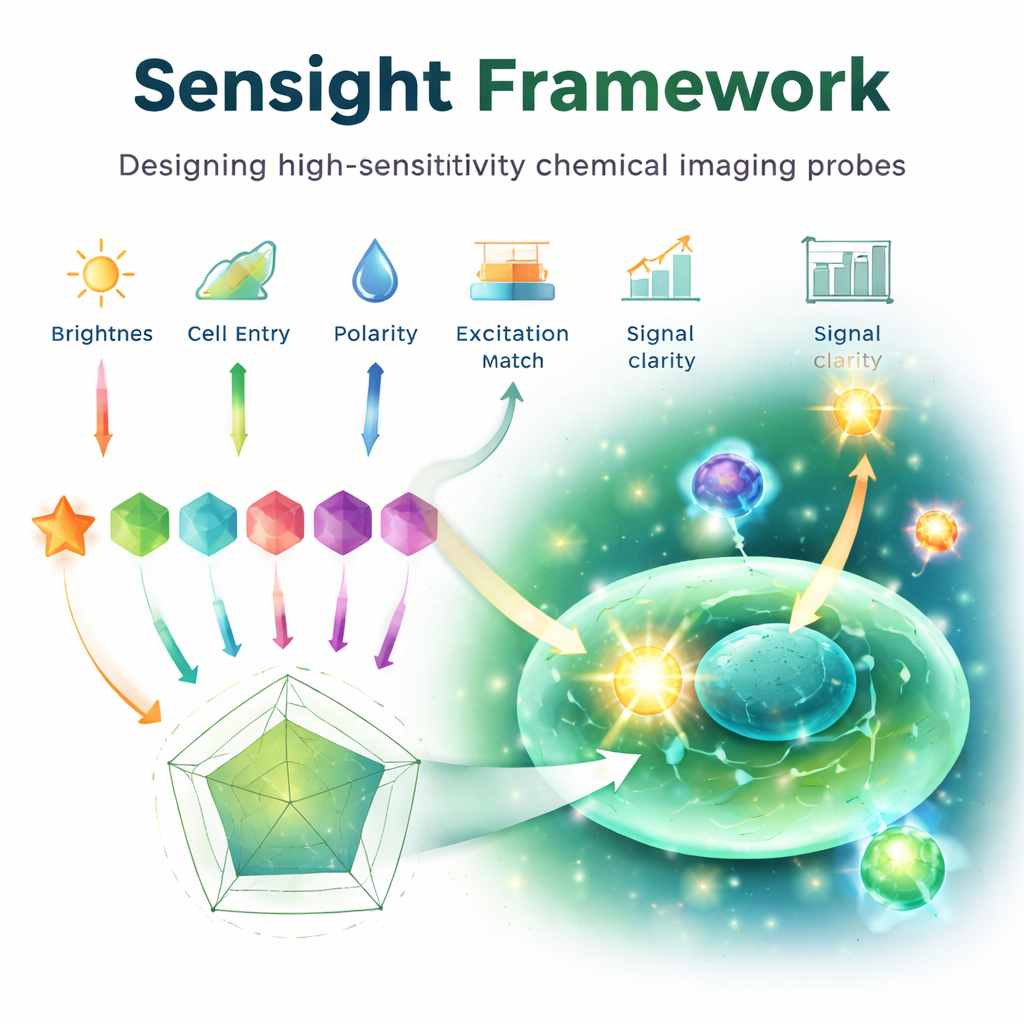
Traditional fluorescent probes are often judged by how strongly they light up in a test tube. Chemists tweak their structures to maximize “turn-on” brightness when the probe reacts with its target. Yet, when these same probes are placed in real cells, many perform poorly: they may not cross the cell membrane efficiently, may not match the microscope’s light source, or their signals may be hard to distinguish from background glow. The authors first showed that a probe’s apparent power in solution does not reliably predict how well it actually works in a living cell. Clearly, sensitivity inside cells depends on several intertwined factors, not just raw brightness.
Five Design Knobs That Matter Most
To uncover which features truly control performance, the team built a broad library of chemical probes that all detect the same target—superoxide, a short-lived reactive oxygen species—using the same core reaction chemistry. They then measured fifteen physical and optical properties for each probe and compared these to how strongly the probes lit up stressed cells. Using statistical tools, they discovered five dominant “design knobs”: how much brighter the probe becomes upon activation, how oily or water-loving it is, how polar its surface is (which influences membrane crossing), how well its optimal excitation matches the microscope’s laser, and how cleanly its emitted color stands apart from its excitation color. Together, these features explained probe behavior far better than any single property alone.
A Radar Map for Choosing Better Probes
To turn this multivariate analysis into a practical design tool, the authors created Sensight. Sensight translates the five key properties of a probe into a weighted radar map—a five-spoked chart whose filled-in area summarizes expected sensitivity in cells. Probes with large, well-balanced radar areas tend to show strong, reliable signals in live imaging experiments. The team confirmed this by synthesizing new probes that differed mainly in just one property at a time: improving cell entry, better matching the excitation light, or boosting turn-on brightness each increased performance in exactly the way Sensight predicted. In other words, the radar map was not just descriptive; it was genuinely predictive.
Designing a Super-Sensitive Early Warning Probe
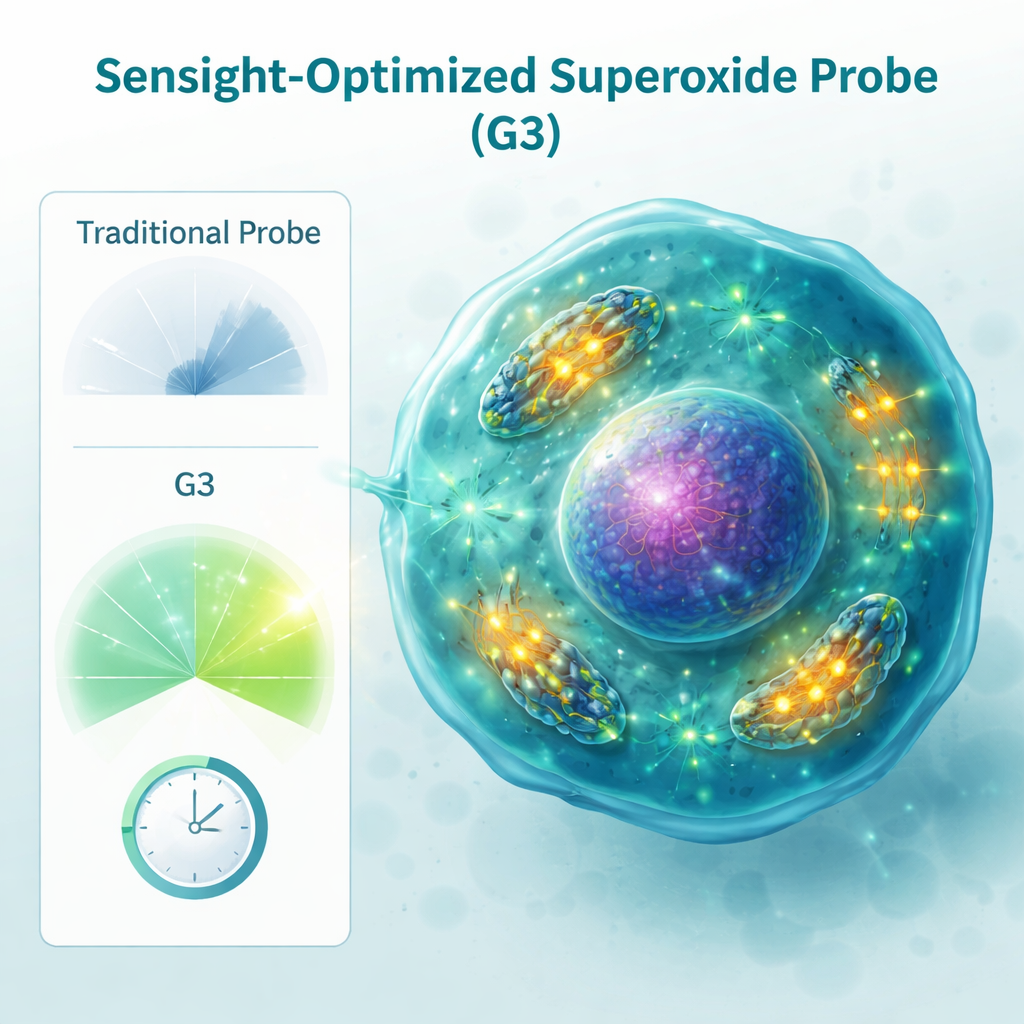
Armed with Sensight, the researchers moved from explaining past results to designing new tools. They sketched thirteen candidate probes on the computer, all built around the same superoxide-sensing core but with different attachments to tune the five key properties. Sensight ranked these candidates by their predicted radar areas, and six were synthesized and tested in liver cancer cells. The top-ranked design, called G3, outperformed not only its sister designs but also common commercial probes. G3 could detect subtle bursts of superoxide triggered by growth signals or by low doses of a toxic herbicide, revealing early oxidative stress that standard probes missed. It even tracked fast superoxide surges over time, despite lacking any special targeting sequence.
Beyond One Molecule, Towards Smarter Imaging Chemistry
To test how general their framework is, the authors applied Sensight to very different chemistries: fast “click” reactions used to tag biomolecules and a family of probes that sense formaldehyde, a reactive small molecule tied to metabolism and disease. In both cases, Sensight’s predictions closely matched experimental results, correctly identifying which designs would be most sensitive inside cells. For non-specialists, the core message is straightforward: instead of guessing, chemists can now use a simple, visual, multi-parameter map to build better molecular flashlights. This shift from intuition-driven tweaking to quantitative design could accelerate the creation of sensitive imaging tools that reveal the earliest molecular changes in health and disease.
Citation: Wen, C., Jiang, Y., Shen, T. et al. Sensight enables quantitative multivariate engineering of high-performance chemical imaging tools. Nat Commun 17, 2061 (2026). https://doi.org/10.1038/s41467-026-68663-2
Keywords: fluorescent probes, live-cell imaging, superoxide sensing, bioorthogonal chemistry, formaldehyde imaging