Clear Sky Science · en
Flexoelectric domain walls enable charge separation and transport in cubic perovskites
Why this matters for future solar power
Solar cells made from lead-halide perovskites have sprinted to record efficiencies, rivaling silicon while being cheaper and easier to process. Yet their inner workings remain puzzling: light-excited charges live for a very long time and travel far, even though the crystals are full of imperfections. This paper reveals that the secret lies in invisible internal boundaries that act like tiny built-in power lines, quietly steering and protecting charges inside the material.
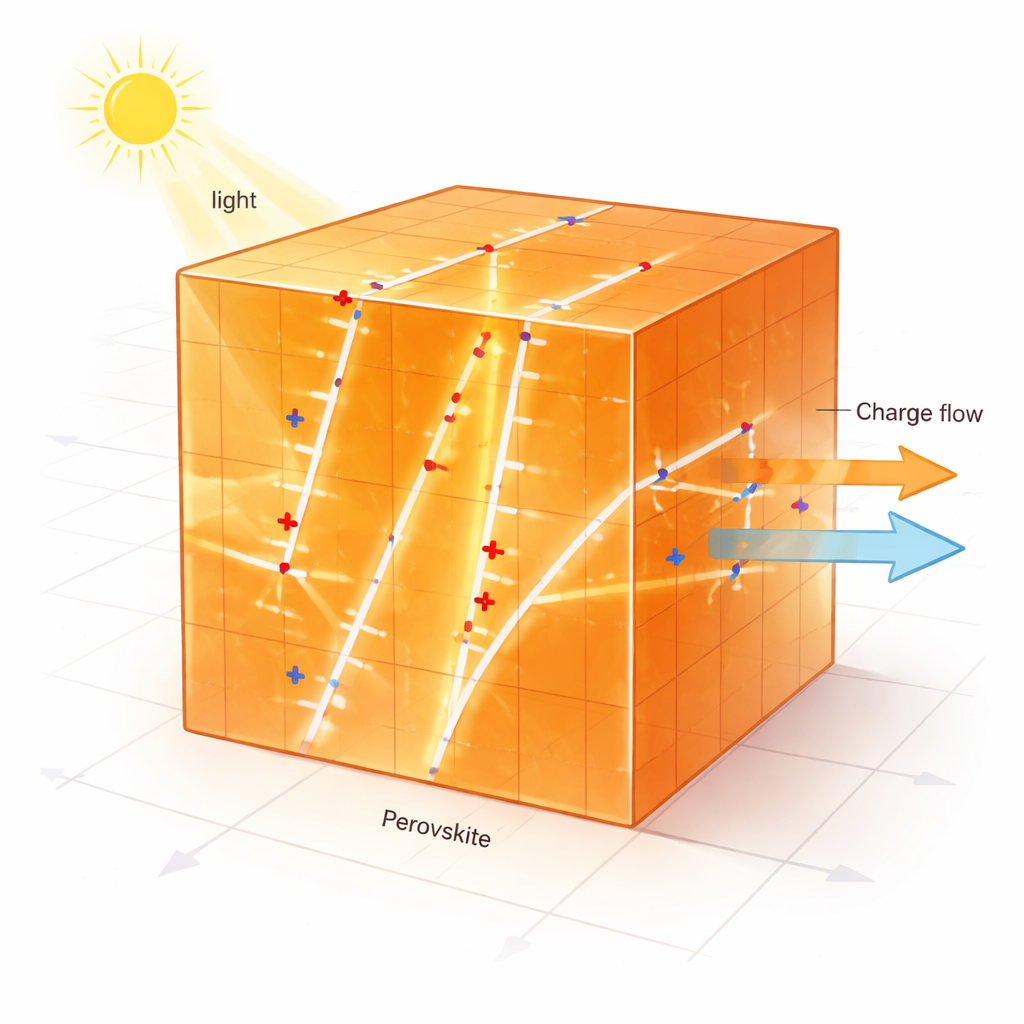
Hidden structure inside “simple” crystals
On paper, the perovskite studied here, methylammonium lead bromide (MAPbBr3), should be structurally simple and highly symmetric at room temperature. In such a perfectly cubic crystal, light would pass uniformly in all directions. The authors, however, found that real crystals bend and split light differently depending on direction, a property known as birefringence. This immediately signals that the crystal is not as symmetric as textbooks suggest, hinting at built-in strain and internal structure that standard measurements can easily overlook.
Revealing a patchwork of tiny strained regions
To see what causes this hidden anisotropy, the team used an inventive electrochemical staining method. They drove silver ions into the crystal; these ions naturally settled and turned into tiny metallic deposits where the lattice is strained. Under a microscope, the silver traced out intricate, tree-like patterns aligned along specific angles relative to the crystal axes. These patterns revealed a dense network of “ferroelastic domains” – small regions of slightly different internal strain – separated by narrow boundaries called domain walls. Rather than being smoothly distorted everywhere, the crystal is mostly uniform within each domain, with the strain abruptly changing only at these walls.
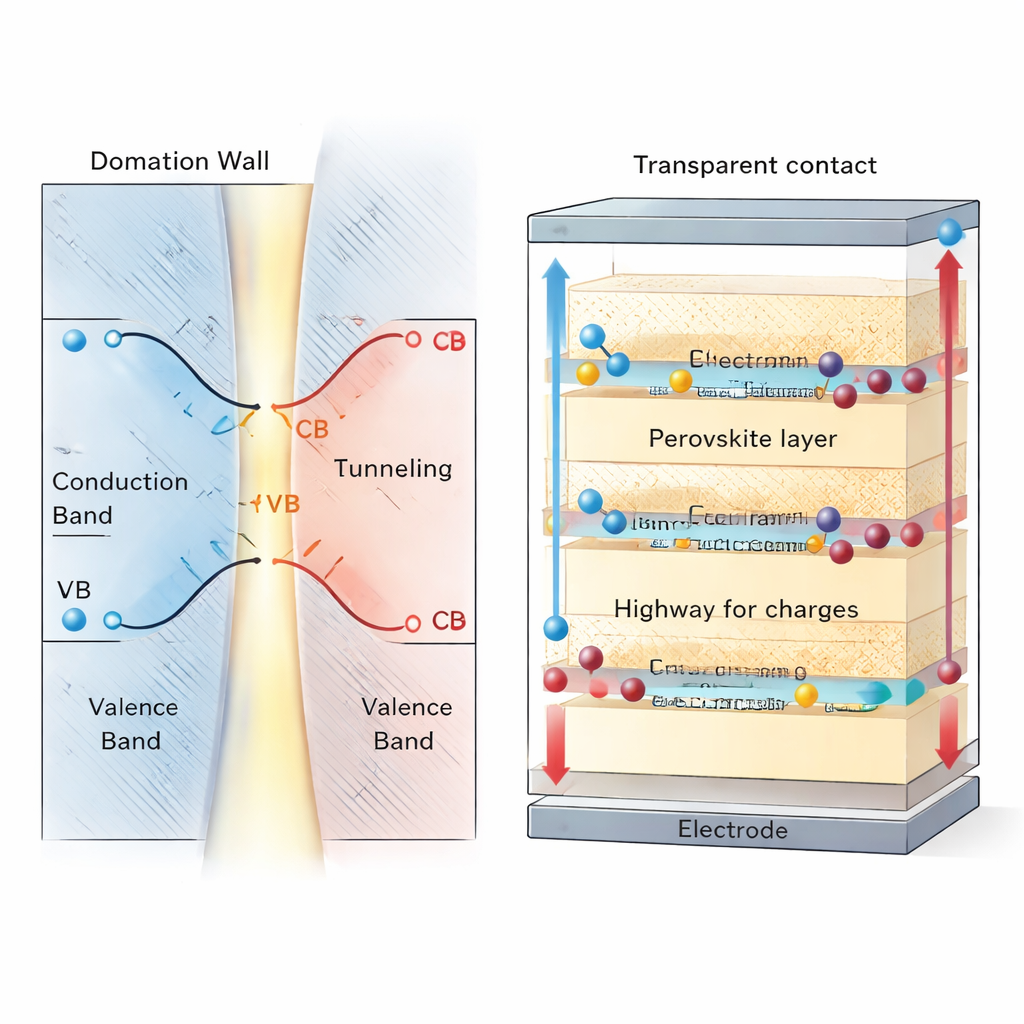
Domain walls that behave like built-in batteries
Where strain changes sharply at a domain wall, basic physics predicts that electric polarization can appear, a phenomenon known as flexoelectricity. The authors tested whether these walls carry internal electric fields by shining short, intense infrared laser pulses into the bulk of the crystal to create electrons and holes deep inside, far from any metal contact. Even with no applied voltage, they detected a measurable photocurrent whose direction depended on where inside the crystal the light was focused. This behavior is consistent with internal fields arising at domain walls: the walls separate positive and negative charges to opposite sides, creating local voltage steps that can drive displacement currents without moving net charge across the sample overall.
How charges live long and travel far
By reconstructing the time profile of the photocurrent, the researchers uncovered a two-stage process. Immediately after excitation, charges race toward the domain walls and are pulled to opposite sides by the internal fields, quickly building up polarization. Then, instead of recombining promptly, many of these separated charges linger for hundreds of microseconds or longer—vastly exceeding the lifetimes of tightly bound excitons measured by other techniques. The current decays unusually slowly and follows a pattern that matches tunneling across an energy barrier that gradually changes as charge accumulates at the wall. In essence, the walls act like energy barriers that keep electrons and holes apart, forcing them to tunnel through before they can meet and annihilate. While trapped in this separated state, they can still move along the walls, turning the boundaries into quasi-one-dimensional highways for charge transport.
Designing better solar cells with internal highways
This work resolves the long-standing paradox of how perovskites can show both very fast local recombination and exceptionally long-range charge transport. The key is not some exotic uniform property of the entire crystal, but the presence of flexoelectric domain walls that break inversion symmetry only in narrow regions. These walls provide spatial separation that suppresses recombination, yet allow charges to travel along them, supporting large diffusion lengths crucial for efficient solar energy harvesting. The authors argue that controlling the density, orientation, and character of such domain walls could become a powerful design lever for next-generation perovskite devices—shifting the focus from changing the material’s chemistry to engineering its internal mesoscopic structure.
Citation: Rak, D., Lorenc, D., Balazs, D.M. et al. Flexoelectric domain walls enable charge separation and transport in cubic perovskites. Nat Commun 17, 946 (2026). https://doi.org/10.1038/s41467-026-68660-5
Keywords: perovskite solar cells, flexoelectricity, domain walls, charge transport, photocurrent