Clear Sky Science · en
Substantially lower estimates in China’s offshore wind potential using farm-scale spatial modeling and wake effects
Why this matters for clean energy
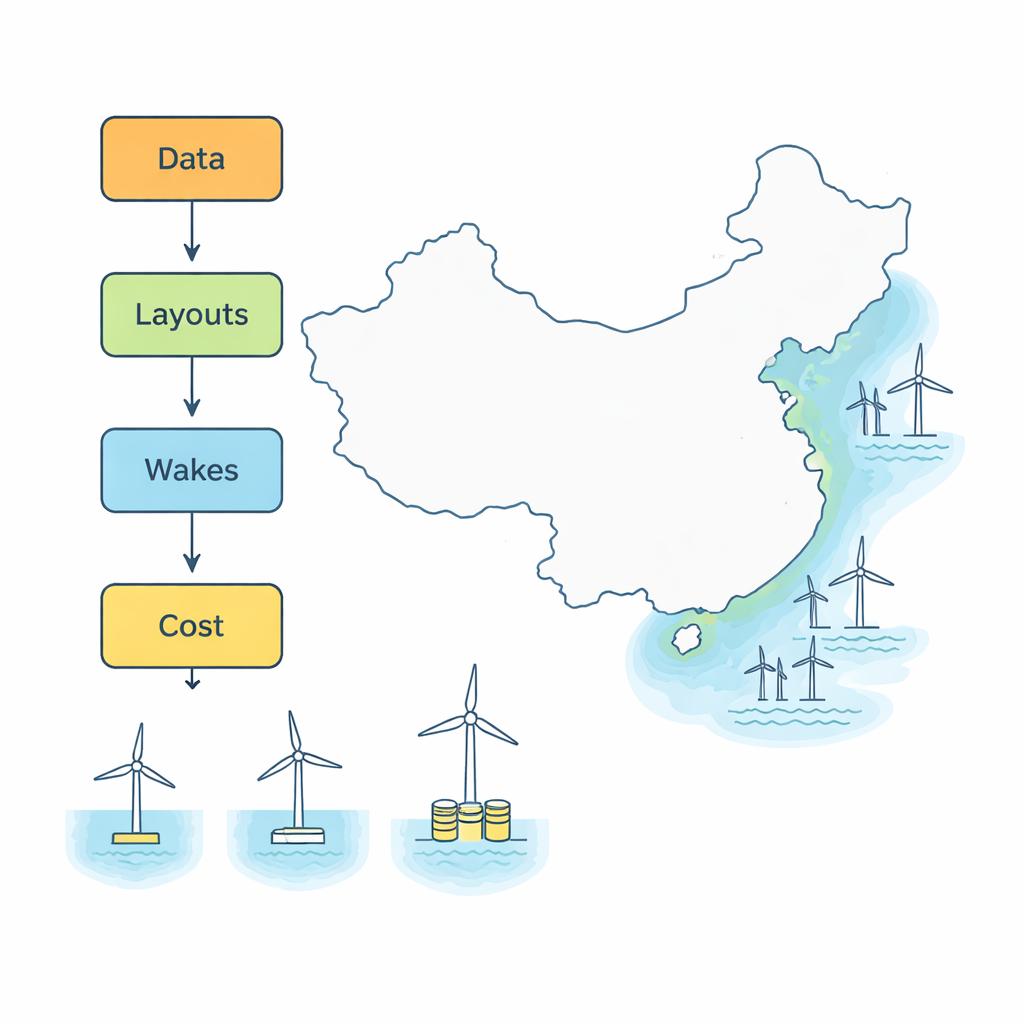
China has some of the world’s best locations for offshore wind turbines, and many energy plans assume these windy seas can deliver a huge share of the country’s future electricity. This study asks a simple but crucial question: how much power can really be produced once we move from idealized maps to the messy reality of actual wind farms? By looking carefully at how turbines are arranged, how their wakes interfere with one another, and how much these projects cost, the authors find that earlier expectations for China’s offshore wind potential were likely too optimistic.
Looking beyond simple maps
Most earlier studies estimated offshore wind potential by sprinkling individual turbines evenly across large areas of sea, enforcing only basic rules about water depth, protected zones, and very rough spacing between machines. They then applied a single, crude discount—often around 10 percent—to represent energy lost when turbines sit in one another’s wind shadows, or “wakes.” In reality, however, developers do not build isolated turbines; they build whole farms, each with its own carefully designed layout. China’s new offshore wind projects have also been moving farther from shore and into deeper water, which changes both the technical design and the cost. All of these details matter for how much electricity can actually be delivered to the grid at an affordable price.
Measuring real-world wind farms from space
The researchers began by mapping almost all existing offshore wind farms in China using satellite radar images and public project databases. They measured how far apart turbines really are, both along and across the prevailing wind direction, and counted how many rows are typically used. They found that most Chinese offshore wind farms use three or four rows of turbines, with machines spaced about 8–12 rotor diameters apart along the wind and 3–6 rotor diameters across it. Using these observed patterns, they designed six representative farm layouts of different sizes, instead of assuming a single idealized turbine grid. They then placed these realistic farms throughout China’s exclusive economic zone wherever water depth, distance from shore, waves, and protected areas allowed construction.
Revising how much wind power is available
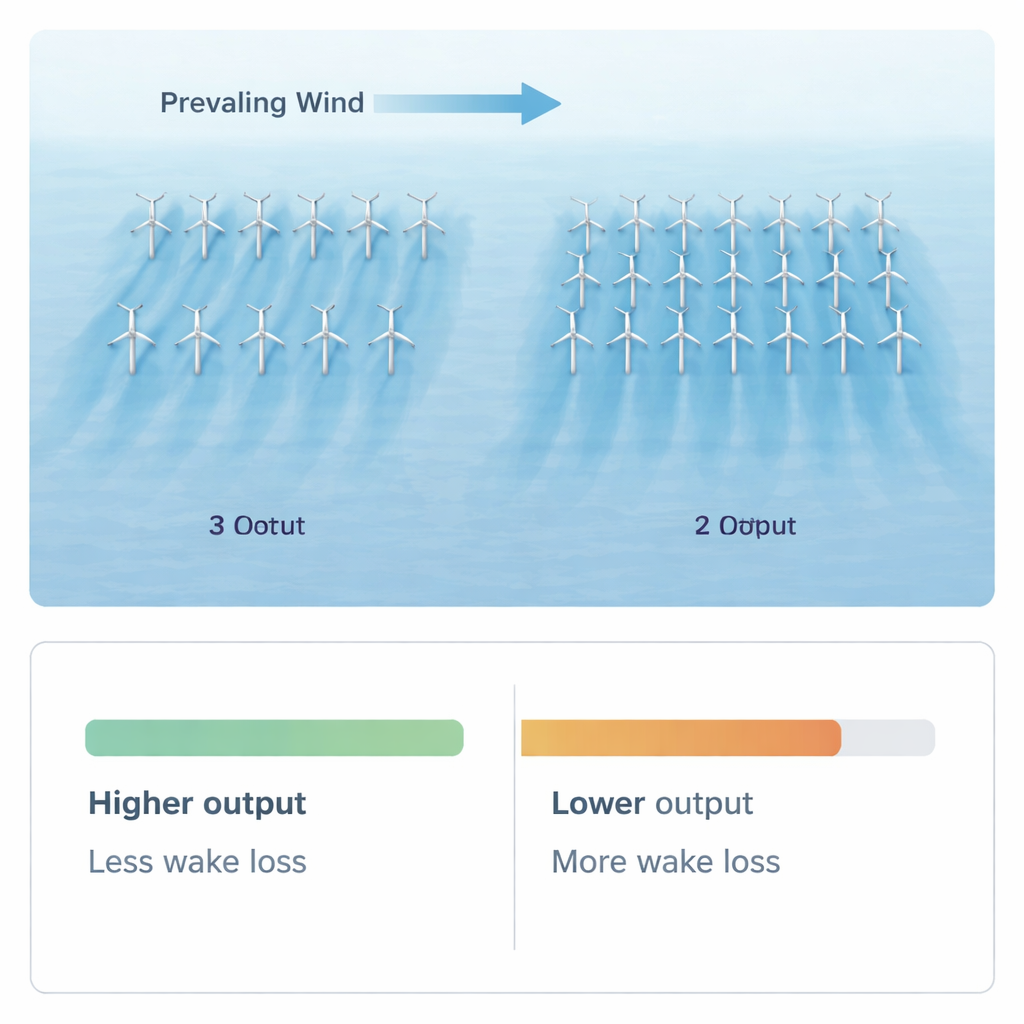
To estimate how much electricity these farms could produce, the team combined several ingredients: detailed weather data for the past few decades, climate-model projections for mid-century, realistic power curves for modern 4, 8, and 11 megawatt turbines, and sophisticated models of how wakes spread through a farm. They compared three wake models, from simpler to more advanced. Across dozens of scenarios, they found that farm-level wake losses are typically much higher than the traditional 10 percent assumption, often in the range of 14–20 percent and even more under the most conservative model. As a result, the total technical potential for China’s offshore wind power falls to about 2.5–4.2 petawatt-hours per year—well under many previous estimates, which often exceeded 5.6 petawatt-hours and sometimes approached 10.
Costs, deep‑water farms, and regional limits
The study also calculates the levelized cost of electricity for each modeled wind farm, taking into account water depth, distance from shore, installation and maintenance costs, and differences between fixed-bottom and floating foundations. Shallow, nearshore projects generally cost less per unit of electricity, but most of the best shallow sites have already been taken. Moving into deeper water unlocks more resource and allows denser floating wind farms, yet it raises costs sharply. In many scenarios, only a fraction of the modeled farms would currently be profitable without extra support. The authors also find that most coastal provinces cannot meet all their power needs from offshore wind alone; many could cover only 60–80 percent of their own demand, and some, such as Shanghai and Hebei, far less.
What this means for clean power plans
For non-specialists, the key message is that China’s offshore wind resource is still very large, but not as boundless or as cheap as once hoped when real engineering and spacing constraints are included. Careful farm design, smarter handling of wake effects, and cost reductions—especially for floating turbines in deep water—will be essential if offshore wind is to play the starring role many climate plans envision. This farm-scale, layout-aware approach provides a more sober and realistic foundation for setting national energy targets, choosing where to build first, and balancing offshore wind with other low-carbon options in China’s path toward net-zero emissions.
Citation: Xu, S., Yin, G., Hu, P. et al. Substantially lower estimates in China’s offshore wind potential using farm-scale spatial modeling and wake effects. Nat Commun 17, 2043 (2026). https://doi.org/10.1038/s41467-026-68655-2
Keywords: offshore wind, China energy, renewable power potential, wind farm design, floating wind turbines