Clear Sky Science · en
Latent transition analysis for longitudinal studies of post-acute infection syndromes
Why Long-Term Infection Matters
Many people recover from an infection only to find that months later they are still not well. This paper tackles that puzzle for post-COVID condition, often called Long COVID, and for similar illnesses that linger after infections. By following thousands of patients over two years and using a powerful pattern-finding method, the researchers show how different long-term health paths emerge, who is most at risk of lasting problems, and how doctors might one day forecast an individual’s recovery path.

Following Patients Over Time
The study focuses on Post-Acute Infection Syndromes, where symptoms persist long after the initial illness has passed. A key example is Long COVID, which may affect more than 65 million people worldwide. To understand these conditions, the team used data from the ORCHESTRA project, a large European study that followed over 5000 people with confirmed COVID-19 for up to 24 months. At the time of infection and again at 6, 12, 18, and 24 months, participants reported nine common symptoms such as fatigue, breathing trouble, loss of smell or taste, and memory problems. They also completed quality-of-life questionnaires that captured how well they could carry out daily activities and how they felt mentally and physically.
Finding Hidden Health Patterns
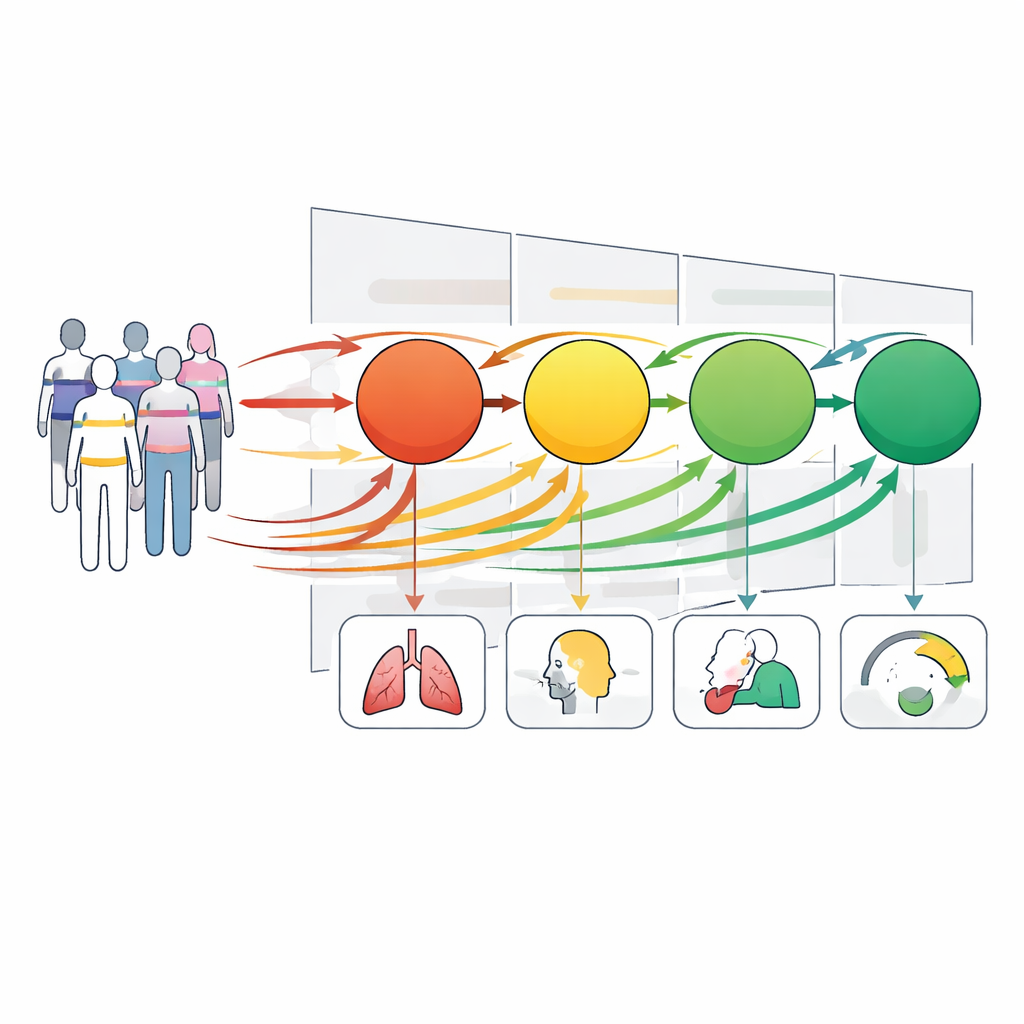
Instead of sorting patients into pre-defined groups, the authors used a technique called Latent Transition Analysis, a form of hidden-state modeling. This approach assumes that each person is in an unseen "health state" at each visit, and that state shapes which symptoms they report and how good or bad their life feels. The model looks across all patients and timepoints to discover which states best explain the data and how people move between them over time. Importantly, it can handle mixed types of measurements (yes/no symptoms plus numerical scores), missing visits, and many patient characteristics such as age, sex, and treatment, without building in strong assumptions about how Long COVID should look.
Seven Distinct Long-Term Paths
The model that best fit the data contained seven health states. Two appeared only during the initial infection and reflected different levels of acute illness. Five others described longer-term outcomes. At one end was a Healthy state, marked by very low chances of any symptom and above-average quality of life. At the other end was a Severe Symptom state, where most symptoms were frequent and daily life was clearly impaired. In between lay three main Long COVID patterns: a Respiratory state with more breathing problems and reduced stamina; a Fatigue state where tiredness was very common and other symptoms often accompanied it; and a Sensorial state marked by persistent loss of smell and taste but relatively preserved mood and mental well-being. Over time, more people moved into the Healthy state, but a substantial minority remained in one of the Long COVID states even after two years.
Who Recovers and Who Remains Unwell
By feeding age, sex, and other features into the model in a compact way, the researchers could see how these factors nudged people toward recovery or prolonged illness. Being female, middle-aged or older, or having chronic breathing disease or corticosteroid treatment during the acute phase was linked to a greater chance of staying in fatigue or respiratory Long COVID states and a lower chance of returning to full health. In contrast, infections from later pandemic waves were associated with better long-term outcomes. The study also showed that once a person entered a Long COVID state—especially the respiratory or fatigue types—they tended to stay there across visits, with relatively few jumps between different lingering-symptom states.
Personalized Forecasts from Ongoing Data
The same framework can be used not just to describe a population, but to make predictions for individuals. Starting from a patient’s characteristics and their earliest symptoms, the model forecasts their most likely future state and symptom pattern. As new information arrives at later visits, it updates those forecasts without needing to be rebuilt from scratch. In tests, these predictions captured both common symptoms and quality-of-life scores reasonably well and improved as more follow-up data were added. This suggests that similar tools could one day help clinicians monitor at-risk patients, estimate how long recovery might take, and identify those who might benefit most from targeted support or new treatments.
What This Means for Patients and Future Outbreaks
In everyday terms, the study shows that long-term problems after COVID-19 are not a single uniform condition, but a set of recurring patterns that can be detected, tracked, and partly predicted. Most people eventually recover, but some—especially older women and those with prior lung disease—face a higher risk of lingering fatigue or breathing issues that can last for years. By uncovering these invisible health states and the typical paths between them, the new method offers a way to turn complex, messy patient records into clear, actionable insight. Because the approach does not rely on advance knowledge about a disease, it can be reused for future outbreaks and for other infections that leave a long shadow, helping health systems prepare, monitor, and care for those who do not bounce back quickly.
Citation: Gusinow, R., Górska, A., Canziani, L.M. et al. Latent transition analysis for longitudinal studies of post-acute infection syndromes. Nat Commun 17, 2557 (2026). https://doi.org/10.1038/s41467-026-68650-7
Keywords: long COVID, post-acute infection syndromes, patient trajectories, disease phenotypes, longitudinal cohort