Clear Sky Science · en
Long-period microseismicity reveals cryptic earthquake-triggered fluid activity can facilitate caldera eruptions
Why distant earthquakes matter for volcanoes
Volcanoes are not as isolated as they seem. Around the world, moderate to large earthquakes have been observed to precede volcanic eruptions, sometimes by only a few hours. Yet scientists have struggled to see exactly what happens inside a volcano in the short window between a big quake and an eruption. This study uses a rare, well‑instrumented eruption at Sierra Negra volcano in the Galápagos Islands to reveal a hidden chain of events: tiny, low‑rumbling quakes that betray pressurized fluids weakening the volcano from within before magma finally breaks free.
A restless island volcano
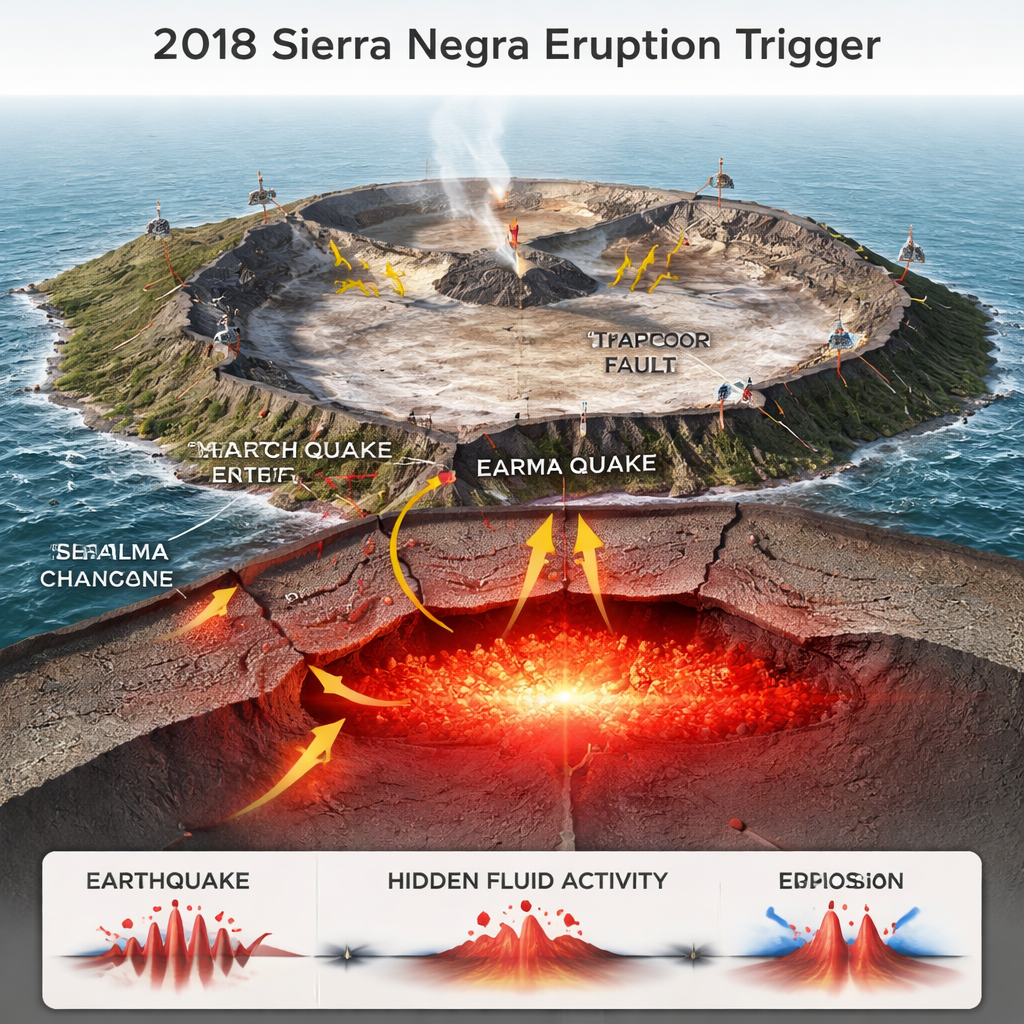
Sierra Negra is a broad, bowl‑shaped volcano, known as a caldera, that has slowly been swelling for decades as magma accumulates in a shallow, sill‑like reservoir about 2 kilometers below the surface. Cutting across the caldera floor is a major internal fault system called the Trapdoor Fault. Past eruptions in 1979 and 2005 began less than three hours after moderate earthquakes on this fault, suggesting that fault slip can instantly “unclamp” the rocks above the magma and open a pathway for lava to escape. But in June 2018, after 13 years of steady uplift totaling more than 6.5 meters, a magnitude 5.4 earthquake struck along the southern part of the Trapdoor Fault—and the volcano took a puzzling eight hours to respond.
Listening in on the smallest shakes
Unlike earlier events, the 2018 episode was captured by a dense network of seismometers and GPS receivers. The authors combined machine‑learning tools, automated phase pickers, and template‑matching techniques to build a much more complete earthquake catalog for the day of the eruption. This allowed them to detect thousands of tiny earthquakes, many too small to be found by traditional methods. They also used satellite‑style GPS measurements to track ground motion to within a few millimeters. Together, these data revealed four stages: steady inflation before the main quake; a quiet period of aftershocks with no detectable change in surface deformation; sudden failure of the northern and northwestern caldera rim linked to magma intrusion; and finally the eruption, which began about ten hours after the initial earthquake.
The hidden life of long‑period quakes
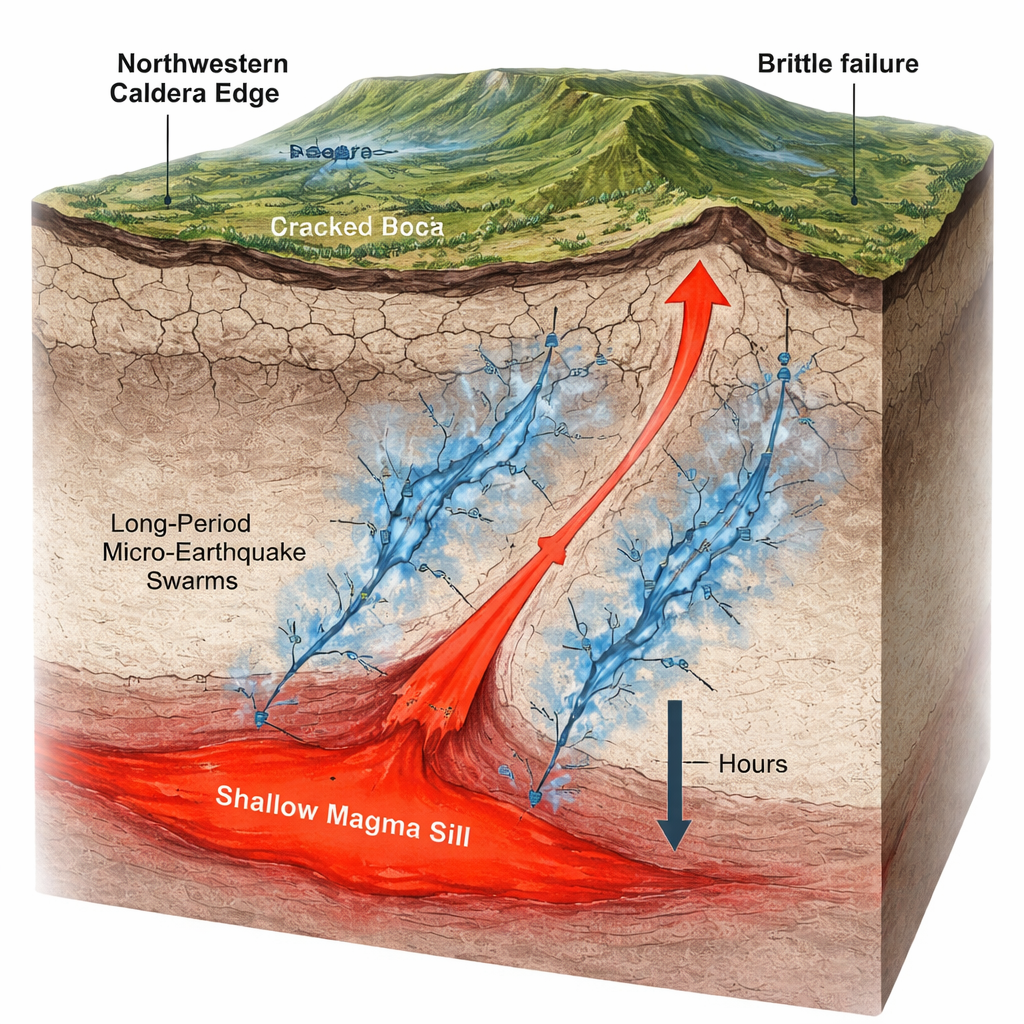
The key discovery lies in what happened during the “quiet” eight hours between the main earthquake and magma movement. About two hours after the magnitude 5.4 event, a new type of seismic signal appeared in the northwestern caldera, near a known hydrothermal area called Minas del Azufre. These were long‑period micro‑earthquakes—small events with most of their energy at low frequencies, more like a muffled thump than a sharp crack. They occurred in repeating families, with nearly identical waveforms, clustered in space and time. Careful analysis showed that these signals lacked the patterns expected from simple brittle fault slip. Some pairs were even “anti‑repeaters” with reversed waveform polarity, implying rapid flips in local stress direction. Together with their location along reservoir‑bounding faults, these features strongly point to pressurized fluids or gases moving through cracks rather than ordinary rock breakage.
From cryptic fluids to full eruption
These long‑period swarms persisted for roughly six hours and then stopped abruptly as more energetic, higher‑frequency quakes took over and the edifice began to fail. At around 17:00 UTC, seismic rates and magnitudes jumped, signaling that the rocks above the magma reservoir in the northwestern caldera finally broke and magma started to intrude laterally. High‑rate GPS data recorded rapid ground motion as the shallow sill deflated and magma propagated toward the surface. About two and a half hours later, fissures opened near Volcán Chico and lava began to pour out, accompanied by ongoing seismic activity and fast subsidence of the caldera floor. Throughout the eight‑hour delay, there was no sign of extra pressurization within the magma reservoir itself—no additional uplift or change in seismic style that would indicate magma being pumped in from deeper levels.
What this means for volcanic hazards
For many volcanoes, it has been tempting to assume that a nearby large earthquake that fails to trigger an eruption does so simply because the magma system was not ready, or that when it does trigger an eruption the link is direct. This study paints a more nuanced picture. At Sierra Negra, the main earthquake delivered a strong stress jolt to an already primed, inflated reservoir, but the eruption still required an intermediate, largely invisible phase in which hot fluids seeped along faults, raised pore pressure, and quietly weakened the surrounding rock. Only after this “cryptic” fluid activity did the edifice give way and magma escape. The findings suggest that monitoring tiny, low‑frequency micro‑earthquakes could be crucial for recognizing when an apparently quiet volcano has entered the final, unstable stages that tip an earthquake‑disturbed system into eruption.
Citation: Song, Z., Bell, A.F., LaFemina, P.C. et al. Long-period microseismicity reveals cryptic earthquake-triggered fluid activity can facilitate caldera eruptions. Nat Commun 17, 2040 (2026). https://doi.org/10.1038/s41467-026-68645-4
Keywords: volcano, earthquake triggering, Sierra Negra, magma and fluids, microseismicity